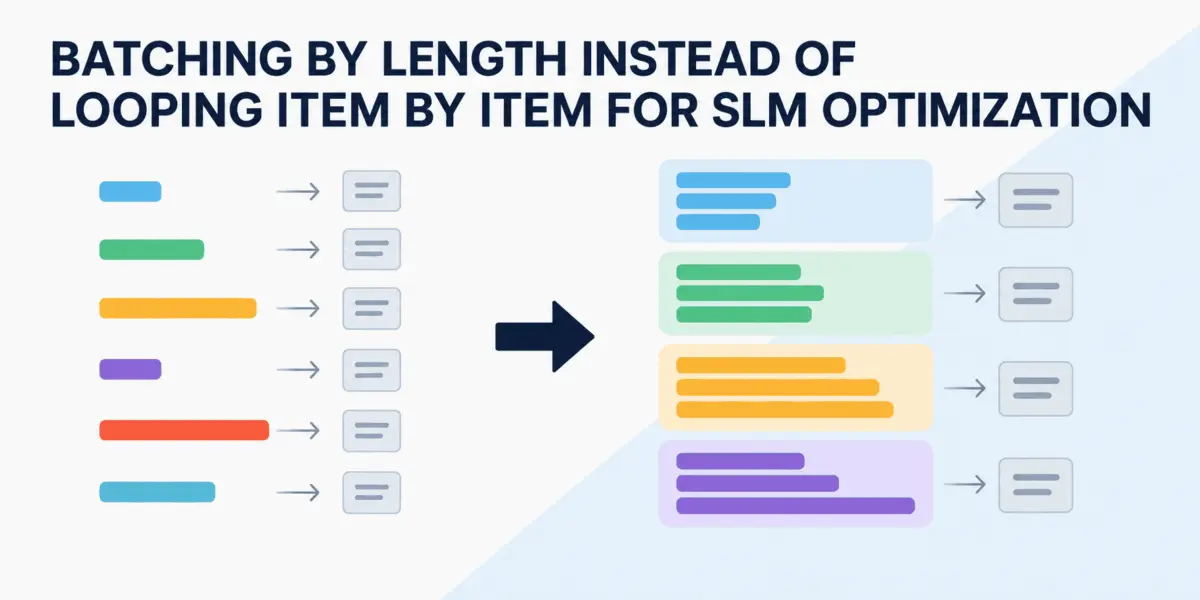
As developers increasingly deploy small language models (SLMs) for narrow automation tasks, hardware efficiency has become a critical bottleneck. In the final installment of a technical series exploring SLM optimization, data science practitioners are examining how batching text sequences by token length—rather than processing them item by item or through naive batching—can drastically accelerate inference speeds without altering model accuracy.
Previous discussions in this optimization series focused on constraining the output space of small language models and reusing prompt prefixes via key-value caches. Building on those foundations, this concluding chapter addresses the single largest source of pipeline waste: processing text sequences individually through a forward pass.
All benchmark testing for these optimization strategies relies on the Qwen2.5-0.5B-Instruct model operating in float16 precision via Hugging Face Transformers. The execution environment uses an M2 MacBook Air equipped with 24GB of RAM and a 16-core Neural Engine, running standard Python libraries including PyTorch and NumPy alongside a simulated support ticket classification framework.
The Cost of Sequential Inference and Naive Batching
When an AI pipeline processes a single text classification ticket per forward pass, a small language model becomes heavily memory-bandwidth bound rather than compute-bound. At a batch size of one, the underlying hardware streams every parameter weight out of memory to serve a single sequence, repeats the process for the next item, and leaves the arithmetic processing units largely idle in the interim. This inefficiency occurs regardless of whether the model runs on a dedicated graphics card or the local CPU hardware typical of lightweight deployment environments.
Batching multiple requests together is the traditional method for amortizing weight reads across many sequences, but standard batching introduces its own form of resource waste. Natural language data features a long-tail distribution: while the median token length for a dataset may be under a hundred tokens, the longest items can span several hundred. If a system naively pads every batch to match the global maximum length of the entire dataset, a vast majority of the computed tokens will consist of useless padding rather than actual text data.
The solution to this hardware dilemma is to sort incoming text sequences by token length prior to batch formation. By organizing items into length-bucketed batches, each group contains similarly sized sequences and pads only to its own local maximum length. This strategy preserves computational resources and minimizes redundant processing.
Analyzing the Per-Item Baseline
To understand the magnitude of the efficiency gains, developers must first establish a baseline using an unbatched, item-by-item loop. Utilizing a simulated dataset of support tickets with a long-tailed length distribution—where most items remain concise and a small fraction extend significantly—each ticket passes through the model individually. Constrained scoring parameters ensure that each classification request costs exactly one model forward pass.
Running this sequential process across hundreds of varied support tickets highlights the inherent friction of single-item execution. Even with an optimized 0.5B parameter model, processing hundreds of items sequentially on a local CPU demands minutes of uninterrupted execution time, resulting in a low throughput measured in single-digit items per second. Furthermore, calculating the length distribution across the dataset reveals that padding every sequence to a global maximum would multiply the required computational workload significantly, underscoring why unbatched execution and naive batching are both sub-optimal choices for production environments.
Implementing Length-Bucketed Batching
When shifting to a batched architecture, performance improvements become immediately apparent. Running the same dataset through the pipeline using length-sorted batches demonstrates how intelligent scheduling maximizes hardware utilization.
In controlled benchmarks, sorting the input sequences by token length before grouping them into fixed-size batches drastically reduces the proportion of processed tokens dedicated to padding. While an arbitrarily ordered batching approach might still suffer from variable sequence lengths within individual groups, sorting the data ensures that short prompts are grouped with short prompts, and long prompts are grouped with long prompts.
Measuring the performance differential between unbatched execution and length-bucketed batching reveals a dramatic increase in operational throughput on identical hardware and model weights. Because the batched runs execute the exact same arithmetic operations per real token, the performance gap serves as a direct measurement of the efficiency gained by eliminating unnecessary padding computations.
Crucially, this speedup is achieved without sacrificing model reliability. Verification checks comparing the outputs of length-bucketed batches against single unpadded reference paths confirm 100% agreement in classification predictions. Any optimization that alters model outputs would represent a functional regression; true optimization accelerates execution while preserving identical analytical results.
Practical Considerations and Context
While length-bucketed batching provides a reliable pathway to higher throughput, engineers must exercise caution when combining multiple optimization strategies. For instance, integrating prefix caching with dynamic batching requires careful tensor manipulation. Because key-value caches are typically structured for single-sequence batch dimensions, reusing a cache across a multi-item batch necessitates expanding and cropping tensor dimensions accurately to prevent alignment errors. Developers must verify batched predictions against unplated reference paths rather than assuming that disparate optimization techniques will compose automatically without validation.
Ultimately, length-bucketed batching concludes this exploration of small language model optimization by addressing the physical realities of hardware execution. By replacing sequential processing loops with sorted, locally padded batches, engineering pipelines can successfully bypass memory-bandwidth constraints. This approach delivers substantial improvements in wall-clock execution time for narrow automation tasks, ensuring that lightweight models operate at peak efficiency without compromising the integrity of their output data.