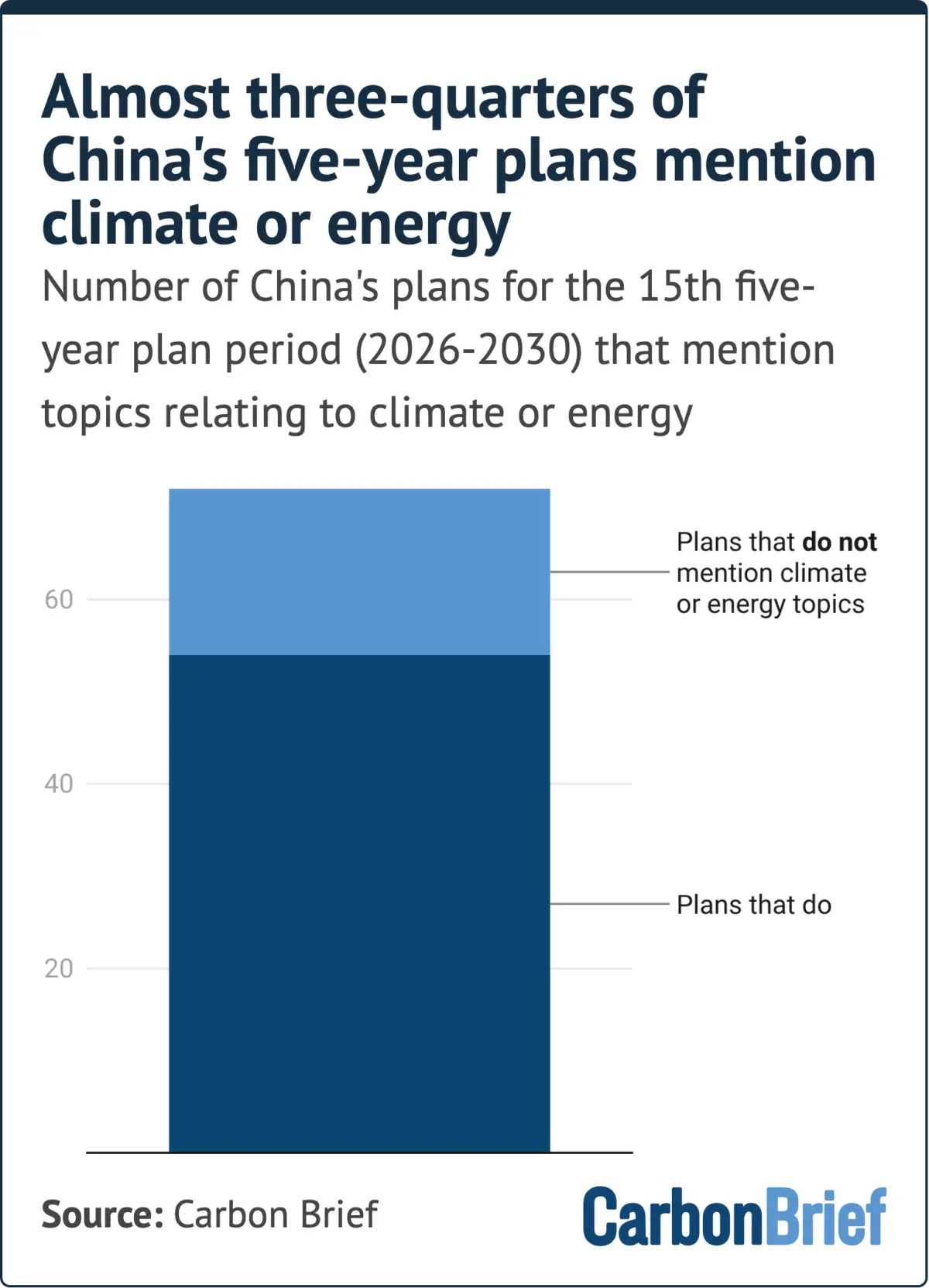
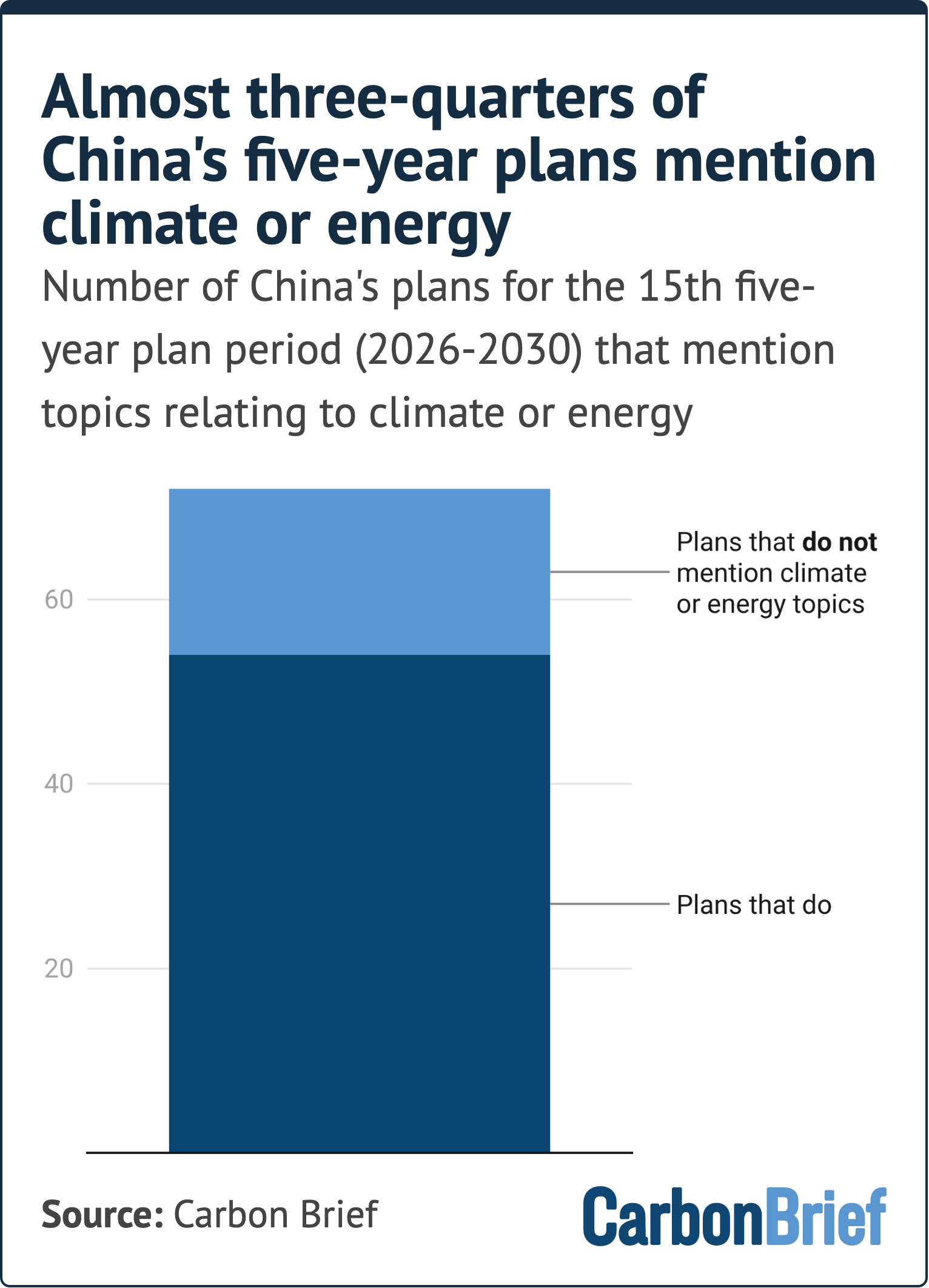
Almost three-quarters of the 72 five-year plans published by China this year include explicit policies or targets related to climate change and energy, according to a comprehensive new analysis by Carbon Brief.
Five-year plans serve as a foundational pillar of China’s policymaking apparatus, acting as vital instruments that signal key national priorities, outline overarching economic visions, and establish concrete targets for the coming years. The highest-level framework, the 15th five-year plan, governs economic and social development for the critical 2026-2030 period and was officially published in March 2026. Following this overarching roadmap, the Chinese government has steadily rolled out a series of thematic, national-level five-year plans specifically tailored to address climate and energy challenges. These specialized policy documents span a wide array of critical sectors, ranging from renewable energy expansion and long-term climate change adaptation strategies to the evolving management of traditional fossil-fuel industries.
Beyond these dedicated blueprints, a vast majority of national-level plans that are not traditionally or directly associated with climate change nevertheless incorporate climate-related policies, albeit with varying degrees of granularity and detail. To map out this extensive policy web, Carbon Brief researchers meticulously examined all available central-government ministry 15th five-year plans currently accessible to the public, searching systematically for any and all mentions of climate change and energy transition metrics.
The findings, compiled into a comprehensive and interactive public tracker, reveal that 54 out of the 72 plans published thus far incorporate formal climate policies or quantitative targets. For each evaluated plan, the tracker outlines the most critical primary goals, key numerical and non-numerical targets, notable secondary policies, and direct links to full texts or summaries where complete documents are unavailable.
Using the Tracker and Understanding the Policy Cycle
Across China, five-year plans are deployed as primary administrative instruments to steer both economic growth and social development. The overarching top-level plan is unveiled in March during the opening of each five-year cycle, setting forth the broad, high-level targets and policies that will govern every major sector of society. In the months and years that follow, a succession of more targeted sectoral and thematic plans is released, focusing deeply on individual industries or administrative domains.
To date, Carbon Brief has successfully tracked 72 plans covering the 15th five-year plan period. These documents address an immense diversity of subjects, spanning everything from the domestic coal industry and the rapid expansion of electric vehicles to carbon accounting methodologies and the tourism sector. While it remains uncertain precisely how many additional plans will be released for this five-year cycle—or what exact topics they will cover—analysts understand that the most crucial foundational documents concerning national climate and energy policy have now likely been made public.
The current five-year plan window is widely regarded by domestic and international observers as exceptionally critical for global climate action. This specific policy timeframe directly precedes China’s historic international pledge to peak its carbon dioxide emissions before 2030. Consequently, every policy document issued during this window is being scrutinized for its alignment with that overarching environmental milestone.
For each individual five-year plan cataloged, the policy tracker categorizes climate and energy commitments classified as primary goals. These objectives, referred to in official policy lexicons, encompass a strategic blend of both numerical metrics and qualitative directives.
For example, within the overarching national development plan, numerical primary targets include a mandated 17% reduction in carbon intensity—measured as carbon emissions per unit of gross domestic product—across the span of the five-year cycle. These core benchmarks, alongside broader commitments announced prior to March 2026, such as Beijing’s Paris Agreement pledge to drive greenhouse gas emissions down to 7% to 10% below peak levels by 2035, form the bedrock of Chinese climate policymaking for the next half-decade.
At the same time, sectoral and thematic five-year plans provide deeper, more granular targets and specialized regulatory directions. Non-numerical primary goals, designated as other primary goals on policy information cards, capture qualitative aspirations. For instance, the specialized five-year plan dedicated to national meteorological development outlines ambitious objectives to significantly enhance capabilities for monitoring, forecasting, and early warning systems regarding extreme weather events, while simultaneously driving major progress in comprehensive Earth system forecasting models.
Primary goals are typically embedded within the opening sections of these policy documents, appearing either directly in the main body as strategic milestones to be achieved by 2030 or within comprehensive statistical data tables. Furthermore, each plan card details notable secondary policies related to climate action and the energy transition. These directives capture broader regulatory expectations found from the second section onward in specialized publications, such as the dedicated five-year plan for the coal industry. Unless otherwise noted in the official texts, quantitative targets are benchmarked against a 2030 horizon relative to a 2025 baseline.
To simplify navigation, the tracked plans are organized into distinct functional categories, allowing researchers, policymakers, and industry observers to examine how climate considerations permeate different layers of government administration. A complete inventory of all Chinese 15th five-year plans referencing climate change or energy is accessible through the public tracker, where specialized keyword search functions and topic-specific dropdown menus enable users to isolate documents addressing particular issues such as coal production, clean-energy technologies, or international climate diplomacy.
This analytical effort is further supported by dedicated reference materials, including specialized glossaries designed to decode the nuanced terminology utilized within Chinese energy and policy circles. Understanding specific administrative phrasing—such as references to new energy vehicles, carbon intensity metrics, and the guiding national vision of a Beautiful China—remains essential for accurately interpreting the true scale and intent behind Beijing’s evolving regulatory landscape.