Nearly five decades of continuous satellite observations have revealed a troubling and profound transformation unfolding across the Arctic. Comprehensive data gathered from space show that sea ice is steadily shrinking in both the summer and winter seasons. Furthermore, much of the ice that manages to survive is becoming younger, thinner, and structurally more vulnerable, marking a fundamental shift in a polar landscape that has endured for millennia.
The Arctic Ocean, a vast expanse of frozen seawater, naturally expands and contracts according to the rhythms of the seasons. Historically, ice builds up steadily throughout the long, dark polar winter, reaching its maximum geographical extent every March before retreating during the warmer, sunlit months to a September annual minimum. This dependable seasonal cycle has persisted for thousands of years, anchoring the Earth’s global climate system and regulating regional temperatures. However, modern satellite measurements reveal that the amount of frozen water blanketing the ocean has declined substantially at both ends of this crucial cycle.
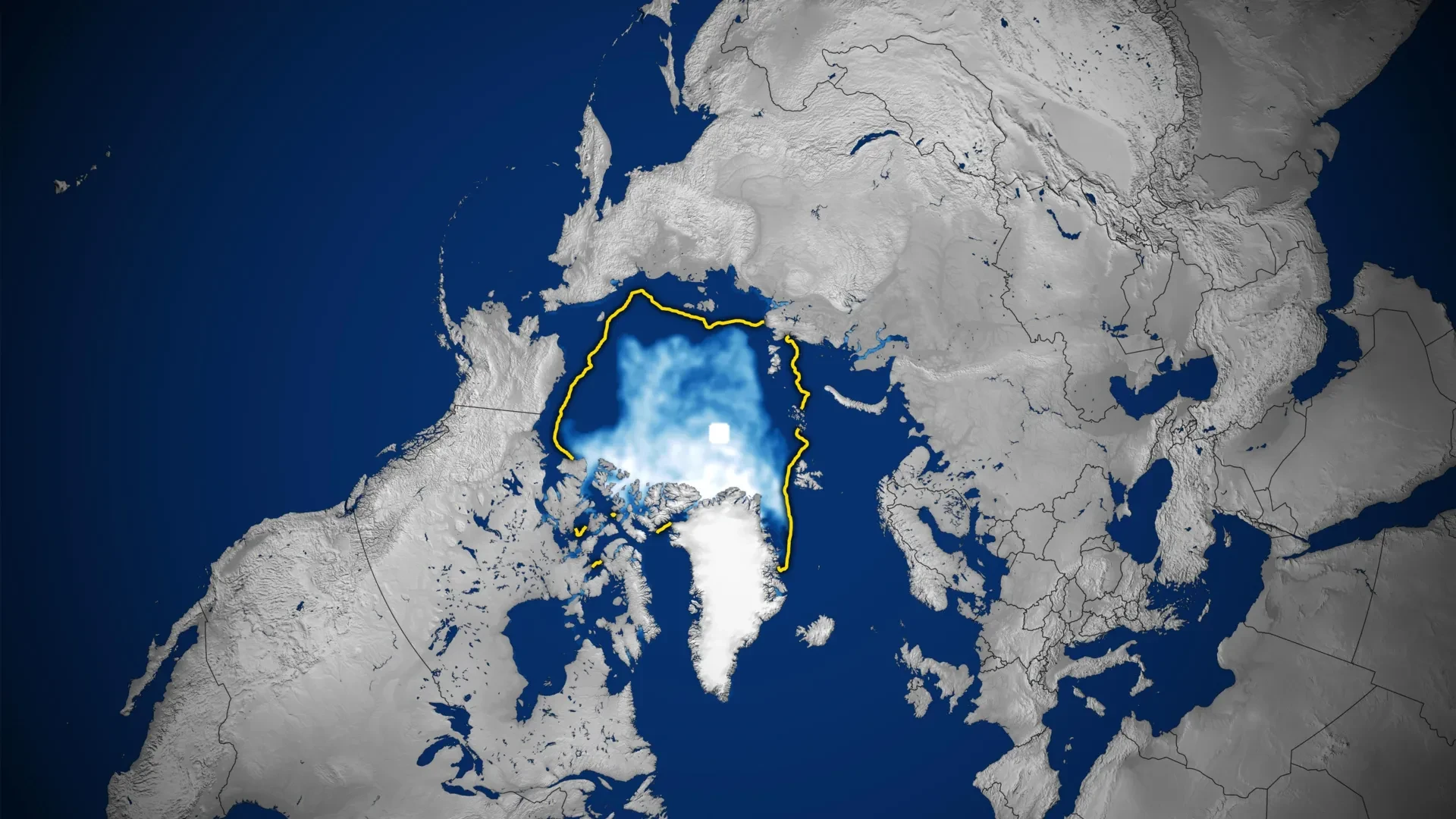
In 2026, Arctic sea ice reached its annual summer minimum extent on September 12, covering approximately 4.6 million square kilometers, which translates to roughly 1.78 million square miles. According to joint data from the National Aeronautics and Space Administration (NASA) and the National Snow and Ice Data Center (NSIDC), this figure tied the minimum extents previously recorded in 2008, 2010, and 2025. This measurement ranks as the 10th-lowest level observed since comprehensive satellite monitoring began in the late 1970s.
Decades of Arctic Sea Ice Loss
Satellites have continuously tracked the seasonal expansion and retreat of Arctic sea ice since late 1978, providing the scientific community with nearly five decades of uninterrupted observations. Those long-term measurements reveal a steady downward trend in ice coverage that accelerated significantly during the 2000s, leading to a succession of exceptionally low ice levels that shattered historical records.
One particularly striking pattern in the satellite record is that every single summer from 2007 through 2026 ranks among the 20 lowest September sea ice extents ever documented. Within this troubling era, the absolute smallest ice extent ever observed by instruments occurred in September 2012, setting a benchmark for summer melt.
However, researchers note that the rate of summer ice loss has not maintained a perfectly consistent trajectory. During the past decade, September sea ice coverage has remained comparatively stable rather than continuing the rapid, steep declines seen in earlier years. Scientists emphasize that short-term weather conditions and atmospheric variability can strongly influence how much ice ultimately disappears during any given summer melting season.
For instance, increased cloud cover over the Arctic basin during recent years has reduced the amount of direct sunlight reaching the surface of the ice, helping to buffer the region against additional melting. NASA researchers have identified this atmospheric factor as a key contributor to the recent period of temporary stabilization. Yet, even with that brief respite in the rate of decline, September ice coverage remains profoundly far below its historical average, signaling that the broader warming trend remains firmly intact.
The Arctic Is Losing Its Oldest, Thickest Ice
The dramatic changes occurring in the Far North extend far beyond the shrinking geographical area covered by sea ice. Over the same multi-decade monitoring period, scientists have also documented a major, qualitative shift in the composition of the ice itself, which is becoming increasingly young and thin.
Historically, a substantial portion of the Arctic Ocean contained multiyear ice—ice that survives at least one summer melting season without completely disappearing. Because this resilient ice can persist and accumulate over multiple years, it generally grows much thicker, denser, and structurally stronger than seasonal ice that forms and melts within a single winter cycle.
Satellite observations now confirm that multiyear ice has declined significantly over the decades. As a result, the Arctic is increasingly dominated by thinner, first-year ice. This younger ice forms easily during the freezing winter months, but it possesses far less structural integrity, making it drastically more susceptible to rapid melting when the warm summer temperatures return.
This pervasive decline is also clearly evident during the winter months, when Arctic sea ice normally reaches its greatest geographic coverage. In March 2026, the annual maximum extent statistically tied the March 2025 maximum, marking some of the lowest winter ice peaks recorded in the entire satellite observational history.
Could the Arctic Become Nearly Ice-Free?
Natural climate patterns routinely influence Arctic sea ice from one year to the next, introducing considerable year-to-year variability. One prominent example is the Arctic Oscillation, a large-scale pattern of atmospheric circulation that dictates temperatures, prevailing winds, and ice dynamics across the polar cap.
Despite the powerful influence of these natural fluctuations, scientists stress that short-term weather cycles cannot fully account for the persistent, long-term decline recorded by satellites since 1978. The relentless rise in global temperatures, interacting with natural climate variability, has driven the compounding loss of Arctic sea ice over the last half-century.
Looking ahead to the coming decades, climate scientists project that the Arctic Ocean could become essentially free of sea ice during the summer months at least once before the middle of the 21st century. Such an unprecedented milestone would mark a profound and historic change for a region that has maintained extensive seasonal ice cover for millennia, altering marine ecosystems, global weather patterns, and ocean circulation.
How Satellites Track Arctic Ice Through Clouds
Scientists measure and monitor Arctic sea ice coverage using specialized satellites equipped with passive microwave sensors. These sophisticated instruments are designed to detect the natural microwave energy emitted by Earth’s surface, allowing researchers to accurately distinguish frozen seawater from the surrounding open ocean.
Because sea ice emits a noticeably different amount of microwave energy than liquid water, it produces a clear, recognizable contrast in satellite observations. Unlike visible-light imaging, which is blocked by darkness or atmospheric obstacles, microwave measurements can easily penetrate cloud cover. This crucial technical capability makes it possible to monitor the remote Arctic consistently and reliably, even when severe storms or persistent clouds completely obscure the surface from view.
The continuous satellite record of polar ice began in late 1978 with the launch of NASA’s Nimbus-7 spacecraft. Additional critical observations followed through the Defense Meteorological Satellite Program, beginning in 1987, and NASA’s Aqua satellite, which provided vital measurements between 2002 and 2011.
More recently, in 2025, researchers began incorporating advanced observations from the Japan Aerospace Exploration Agency’s GCOM-W satellite, continuing the decades-long international effort to measure uninterrupted changes in the planet’s polar ice sheets and sea ice packs.
The satellite maps generated by these missions also contain a distinct white circular region located directly at the North Pole, often referred to by researchers as the "pole hole." This visual feature represents a geographic area that lies beyond the historical coverage limits of the satellite sensors, where direct overhead measurements were historically unavailable. When calculating total sea ice extent across the entire basin, scientists apply standardized algorithms that assume this unmeasured region remains covered by ice.