Public contracting has long been recognized as a potentially powerful engine for local economic growth and community inclusion. Yet, for many years in Boston, small and diverse businesses routinely missed out on these lucrative opportunities. A landmark Disparity Study commissioned by the City in 2020 exposed a stark reality: minority- and women-owned business enterprises (M/WBEs) had received just 11% of the total value of Boston’s contracts over a five-year period, despite being ready, willing, and able to compete for an estimated 16.9% of contracting dollars.
The disparities were particularly severe for Black-owned businesses, which won roughly $12 for every $100 they might have been expected to secure based on market capacity. Determined to reverse these trends, city leaders set out to overhaul their procurement practices. Their goal was twofold: to open up broader avenues for historically disadvantaged enterprises while simultaneously building a sophisticated, data-driven system to track participation, monitor spending, and rigorously evaluate whether their sweeping policy reforms were actually working.
A Strategic Open Contracting Approach
To turn policy goals into tangible outcomes, Boston introduced a series of structural reforms designed to increase earnings for minority and women entrepreneurs, foster local employment opportunities for residents, and cultivate a more competitive marketplace that could ultimately secure better pricing and value for the City. Officials from diverse government sectors—spanning procurement, finance, legal, auditing, and information technology—forged cross-departmental coalitions to focus on three core areas.

First, the City concentrated on opening up smoother routes into municipal contracting for small and diverse enterprises. Second, it strengthened internal coordination so that municipal buyers could plan their purchases much earlier and implement innovative procurement methods consistently. Third, Boston prioritized data-driven monitoring and spending analysis to measure real-world impact.
In the summer of 2023, the Open Contracting Partnership (OCP) stepped in as a strategic partner through its Lift impact accelerator program. Selected from more than 150 global proposals, Boston joined a cohort of ten projects receiving financial support and hundreds of hours of tailored technical assistance. This collaboration helped the City sharpen its reform strategy, design key performance indicators, develop public dashboards, and refine its procurement forecasting.
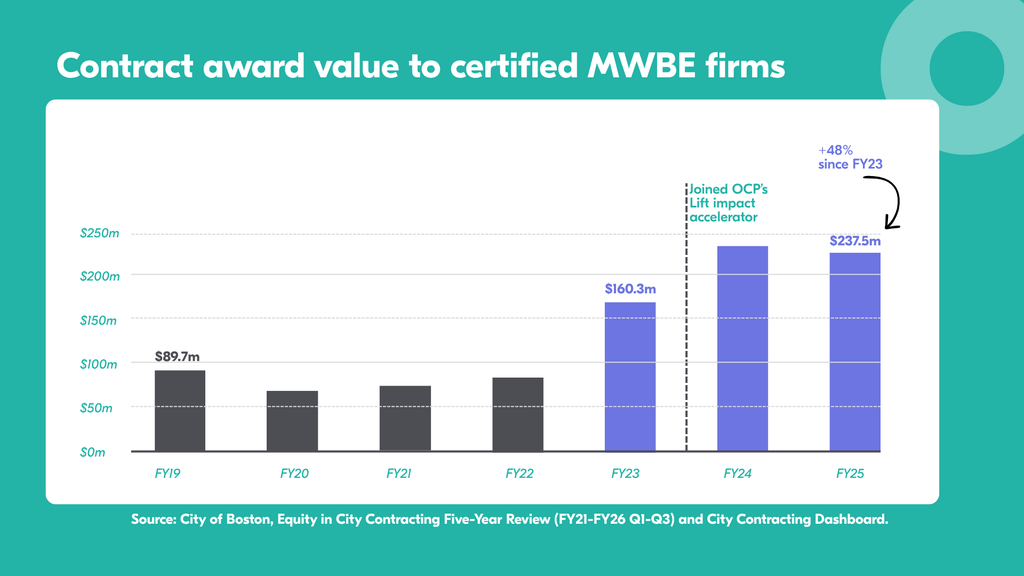
The results of these concerted efforts have been profound. Since the launch of the Lift partnership in 2023, the total value of contracts awarded to certified M/WBE firms surged by nearly 50%, rising from $160.3 million to a peak of $237.5 million in fiscal year 2025. The raw volume of contracts secured by these businesses also climbed 25%, jumping from 181 to 226 in that same single fiscal year. Furthermore, the share of discretionary spending—representing the money directly paid to suppliers where the City exercises vendor choice—more than doubled.
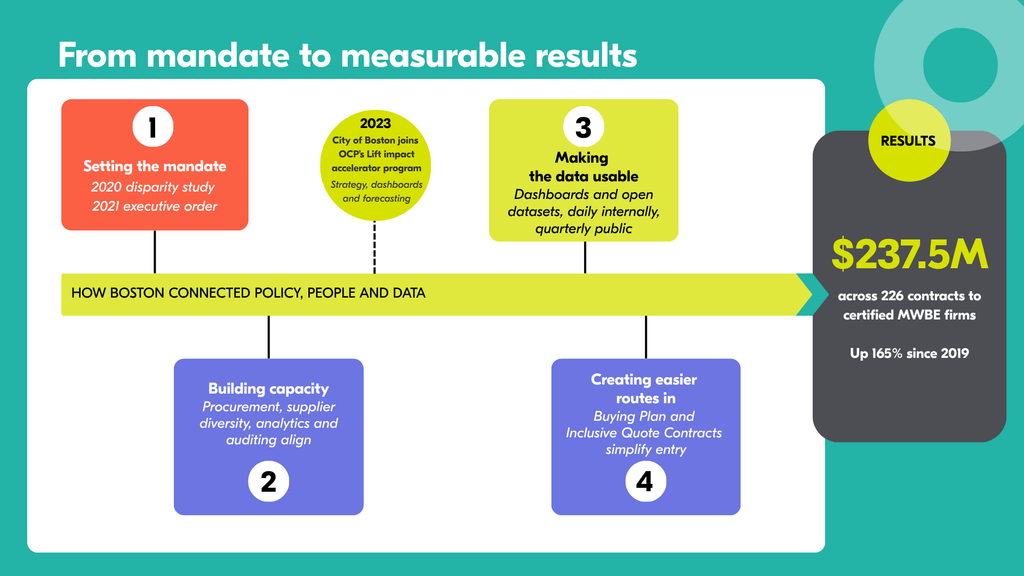
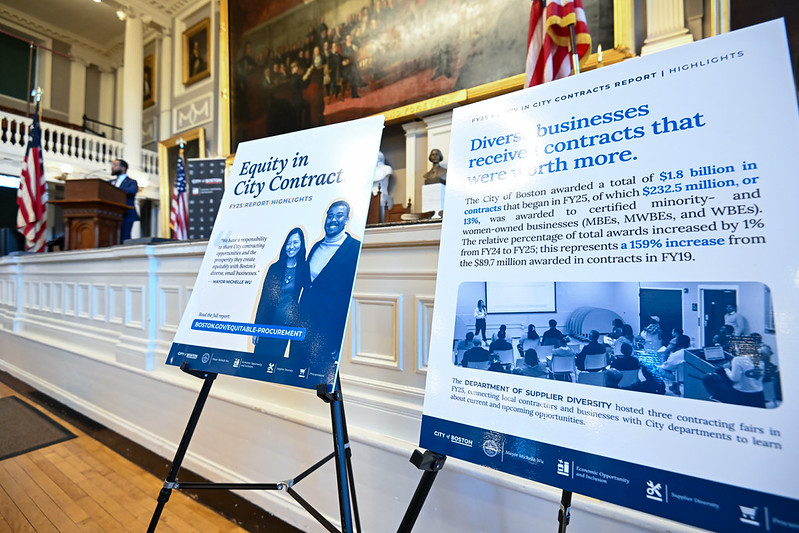
When measured against the baseline period prior to the 2021 executive order, the value of contracts awarded to certified firms has skyrocketed by 165% at its fiscal year 2025 peak, lifting their share of total award value to 12% across all municipal contracts, up from 9%. To maintain transparency, Boston now automatically tracks these critical indicators on a dedicated public spend dashboard, accompanied by three new open datasets providing timely insights into contract awards, vendor payments, and future purchasing plans. According to OCP estimates derived from publicly available government data, these municipal contracts have directly benefited more than 10,000 employees across 514 businesses over a two-year span.
From Local Wins to Systemic Change
The path to these institutional reforms was paved by a combination of high-profile successes and rigorous municipal research. On the morning of May 18, 2022, local entrepreneur Sheldon Lloyd stood outside the Orchard Gardens school alongside Boston Mayor Michelle Wu to announce a milestone achievement. Lloyd’s food service enterprise, City Fresh Foods, had secured a three-year, $17 million contract to supply daily meals to nearly 50,000 Boston public school students.
Started in 1994 by Sheldon’s brother Glynn with just two employees, City Fresh Foods had grown into a major operation employing nearly 200 people. In 2020, the company transitioned to an employee-owned model, granting its predominantly Black, Hispanic, and immigrant workforce a direct financial stake and a reliable pathway toward wealth generation. This landmark agreement was the largest non-construction contract ever awarded to a minority-owned business in Boston, perfectly mirroring the municipal government’s broader strategy to leverage its purchasing power for racial equity, environmental sustainability, and localized economic growth.
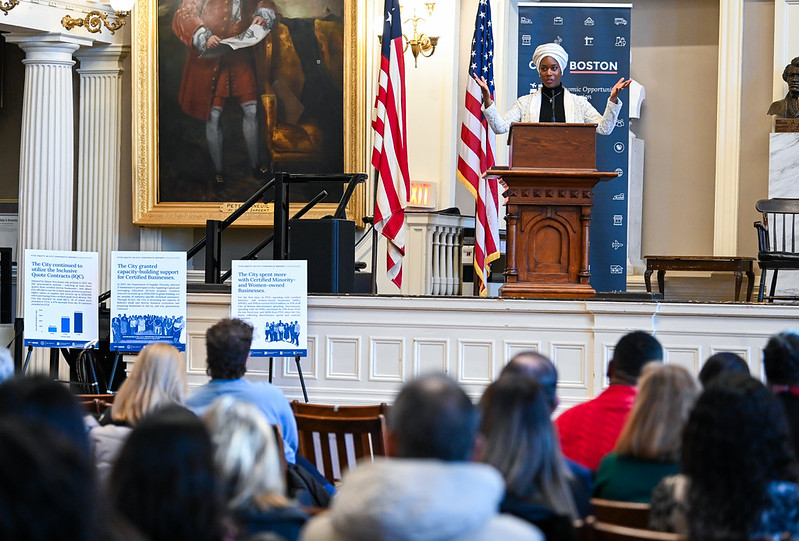
The momentum of 2022 also saw the relaunch of the Boston Contracting Opportunity Fund. Over its three-year run, the fund distributed grants to 178 businesses, with approximately 80% going to minority-owned enterprises and 34% directed to women-owned companies. These financial lifelines were specifically engineered to combat the systemic barriers highlighted in the City’s 700-page Disparity Study.
The comprehensive research project, which analyzed five years of historical procurement records and surveyed hundreds of local business owners, revealed that M/WBEs were receiving only $65 for every $100 of procurement dollars they were fully qualified to earn. While minority-owned businesses were capturing roughly 2.5% of municipal contracting dollars against an estimated availability of 5.7%, and white women-owned businesses were winning 8.5% against an availability of 11.2%, Black-owned enterprises faced the most acute deficit, collecting just $12 for every $100 they could have reasonably anticipated.
Armed with empirical evidence, then-Mayor Martin Walsh signed an executive order in February 2021 codifying the study’s findings into official policy and establishing an ambitious target of directing 25% of all city spending to M/WBEs. The directive mandated the creation of a comprehensive Supplier Diversity Plan, extensive vendor outreach, and contract-specific participation goals. By 2023, however, municipal officials realized that these mandates required robust, real-time data infrastructure—including dynamic vendor directories, digitized procurement pipelines, and accurate spending analytics—to track progress effectively. Applying to the OCP Lift program provided the exact technical catalyst needed to operationalize these ambitious visions.

Opening Routes for Small and Diverse Businesses
Boston’s reform initiatives systematically dismantled everyday logistical hurdles by giving enterprises earlier sight of upcoming opportunities, simplifying the pathways to eligible contracts, and clarifying channels for direct engagement with municipal buyers.
Central to this effort is the annual "Buying Plan," which provides firms with advanced notice of planned procurements well before formal solicitations go live. This early visibility gives business owners adequate time to assess their capacity, identify potential partnerships, and prepare complex paperwork. For municipal departments, compiling the Buying Plan requires looking across various programs months in advance to forecast needs for professional services, instructional support, equipment, and transportation.
Boston has published these procurement plans as open data for three consecutive years. The fiscal year 2027 Buying Plan detailed 688 distinct opportunities across 56 municipal departments, representing an estimated value of $808.3 million—an 82% increase over the previous year that underscored the City’s expanding transparency.
To lower administrative burdens for smaller vendors, the City expanded the use of Inclusive Quote Contracts (IQCs). Instead of requiring a full, formal public solicitation, municipal buyers can utilize a streamlined written quote process that collects at least three bids from certified diverse businesses. By the time Boston published its Five-Year Supplier Diversity Program Review in July 2026, the municipal government had successfully awarded 81 IQCs totaling $11.4 million over four years.
Furthermore, the City amplified its outreach campaigns by translating marketing materials for the Buying Plan into seven languages and meeting entrepreneurs directly at community events. These efforts drove substantial growth in subscriptions to the City Record—a digital newsletter detailing active contracting opportunities—and sparked heavy turnout at supplier diversity workshops and fairs.
Administrative collaboration inside City Hall proved equally essential. Under Mayor Wu, Boston expanded staffing within its procurement, supplier diversity, and analytics teams while breaking down historical silos between auditing, legal, information technology, and individual purchasing departments. As Laura Melle, Director of Procurement Planning and Support Services, observed, the municipal government successfully transitioned procurement from a risk-averse, administrative back-office chore into a strategic partner capable of mitigating risk while delivering superior public solutions.
Building Modern Data Infrastructure
Prior to these modernizations, municipal outreach regarding bidding opportunities typically occurred merely one to two weeks before deadlines, and spending reports were compiled manually through disjointed software systems. Data analysts noted that prior tracking methods could only provide high-level aggregate figures rather than the granular insights required for meaningful supplier diversity management. Contract award data frequently captured only commitments over $10,000, completely overlooking smaller purchase orders, and tracked intended award amounts rather than actual disbursements.
To resolve these blind spots, Boston integrated business certification data directly into its financial architecture and established automated synchronization processes within its PeopleSoft enterprise resource planning software. Rather than replacing its existing enterprise software, the City built a sophisticated translation layer—evolving from early visualization tools to advanced cloud platforms—to unify procurement data and display it clearly.
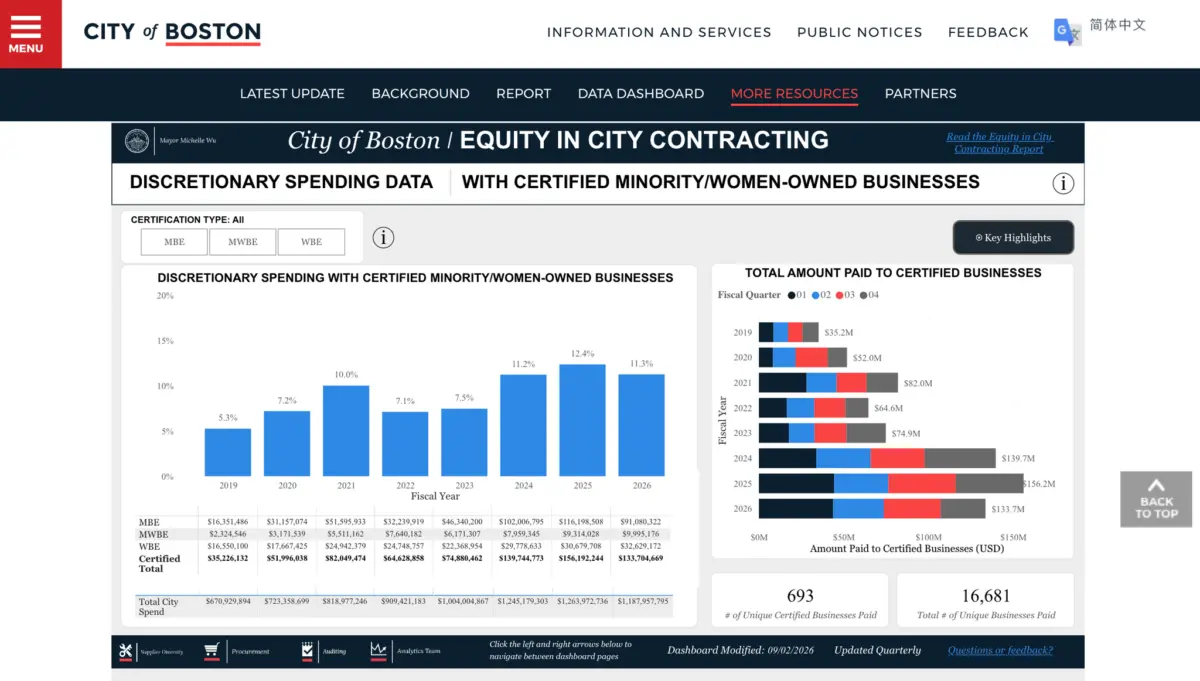
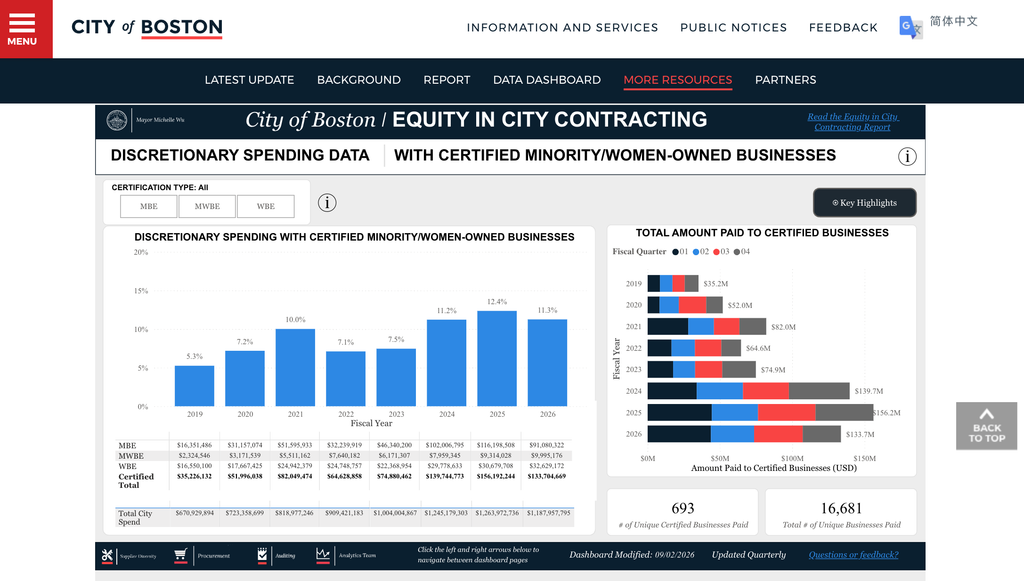
The culmination of this technical work is Boston’s public spend and contract dashboard, which refreshes on a quarterly basis. Internal dashboards update daily, granting municipal buyers direct access to current figures without bottlenecks. By linking payments directly to specific contracts, finance teams can instantly identify anomalies, such as vendors whose multiple smaller contracts collectively cross thresholds that would normally trigger competitive bidding requirements.

Tangible Results and Lessons for Cities
The financial and operational metrics illustrate a profound cultural shift in how Boston does business. In fiscal year 2023, contract values awarded to certified M/WBE firms stood at $160.3 million. By fiscal year 2025, that figure climbed to $237.5 million, accompanied by a 25% increase in total contracts awarded and a doubling of discretionary spending directed toward diverse suppliers. Early indicators from fiscal year 2026 demonstrate that these gains are stabilizing, with certified firms capturing $133.7 million, or 11.4% of total municipal spending, while discretionary spending shares remain steady between 11% and 12%.
Beyond the spreadsheets and financial totals lie active workplaces and expanding local enterprises. Between January 2024 and December 2025, over 500 certified businesses received municipal payments, collectively supporting an estimated workforce of more than 10,000 local employees who rely on the stability generated by public contracts.
Boston’s comprehensive transformation offers a clear blueprint for other urban centers seeking to bridge the gap between equity policy and daily administrative execution. As municipal leaders emphasize, addressing systemic disparities requires more than a diagnostic study; it demands robust data infrastructure, shared operational definitions, cross-departmental accountability, and dashboards that buyers use as a matter of routine.
While significant challenges remain—particularly in tracking complex, high-value construction projects and measuring lower-tier subcontracting—Boston’s ongoing journey demonstrates that strategic procurement reform is not a zero-sum game. By opening municipal doors to a broader array of competitive vendors, the City has simultaneously enhanced the efficiency and effectiveness of its own public operations.