Nearly three years after the international community struck a landmark pact to halt and reverse the destruction of the natural world, a little more than half of the world’s countries have formally met a United Nations call to submit updated national plans for tackling biodiversity loss, according to a new analysis.
Data compiled by Carbon Brief indicates that 58% of eligible countries have now submitted their updated national biodiversity strategies and action plans, commonly known as NBSAPs. The milestone comes just ahead of the upcoming COP17 biodiversity summit, which is scheduled to open next week in Yerevan, Armenia.
The unveiling of these updated national strategies arrives at a critical juncture for global conservation efforts. COP17 marks the formal halfway point of the Kunming-Montreal Global Biodiversity Framework (GBF), the sweeping historic agreement brokered in December 2022 in Montreal, Canada, where nearly every government on Earth committed to halting the alarming degradation of ecosystems and reversing biodiversity loss by the year 2030.
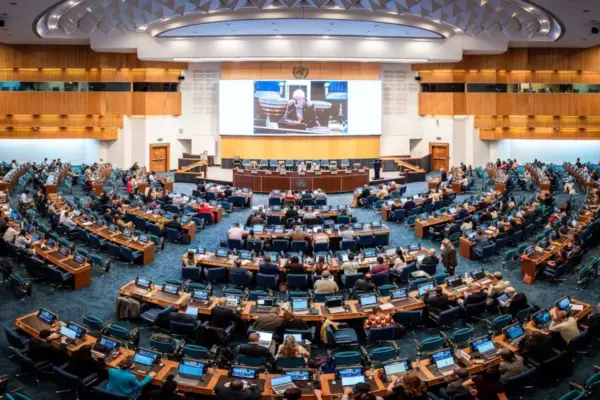
The upcoming summit in Armenia will serve as the primary stage for the first comprehensive global review of how effectively nations are translating their ambitious promises into concrete domestic action. As diplomats, environmental ministers, and civil society observers prepare to convene in Yerevan, the new figures reveal both significant momentum and persistent gaps in the global fight to protect the planet’s remaining wildlife, forests, and aquatic ecosystems.
The Long Road to Submitting Biodiversity Strategies
Under the original timeline established during the biodiversity negotiations, nations were formally requested to submit their updated NBSAPs by the start of the COP16 summit, which took place in October 2024. However, that initial deadline was met by a mere 15% of participating governments, exposing widespread administrative hurdles, domestic capacity constraints, and delays in securing necessary financial resources.
Confronted with widespread missed deadlines, delegates at COP16 in Cali, Colombia, negotiated and agreed upon a new diplomatic text that strongly urged countries to release their strategic action plans "as soon as possible."
The latest analysis demonstrates a substantial acceleration in policy delivery over the past year. Carbon Brief’s tracking shows that 113 countries have now officially come forward with their new NBSAPs. This represents a dramatic increase from the 55 nations that had completed their documents just a year ago, reflecting a concerted effort by many capitals to finalize their frameworks ahead of the upcoming stocktake in Yerevan.
The geographical distribution of these newly submitted plans highlights particularly strong engagement across several regions. Over the past twelve months, a wave of African nations has published comprehensive NBSAPs. This roster includes Algeria, Benin, Botswana, Cameroon, Comoros, Congo, Côte d’Ivoire, the Democratic Republic of Congo, Egypt, Equatorial Guinea, Eritrea, Ethiopia, Gabon, Gambia, Guinea, Lesotho, Liberia, Madagascar, Malawi, Mali, Namibia, Rwanda, Senegal, Sierra Leone, Somalia, Sudan, Zambia, and Zimbabwe.
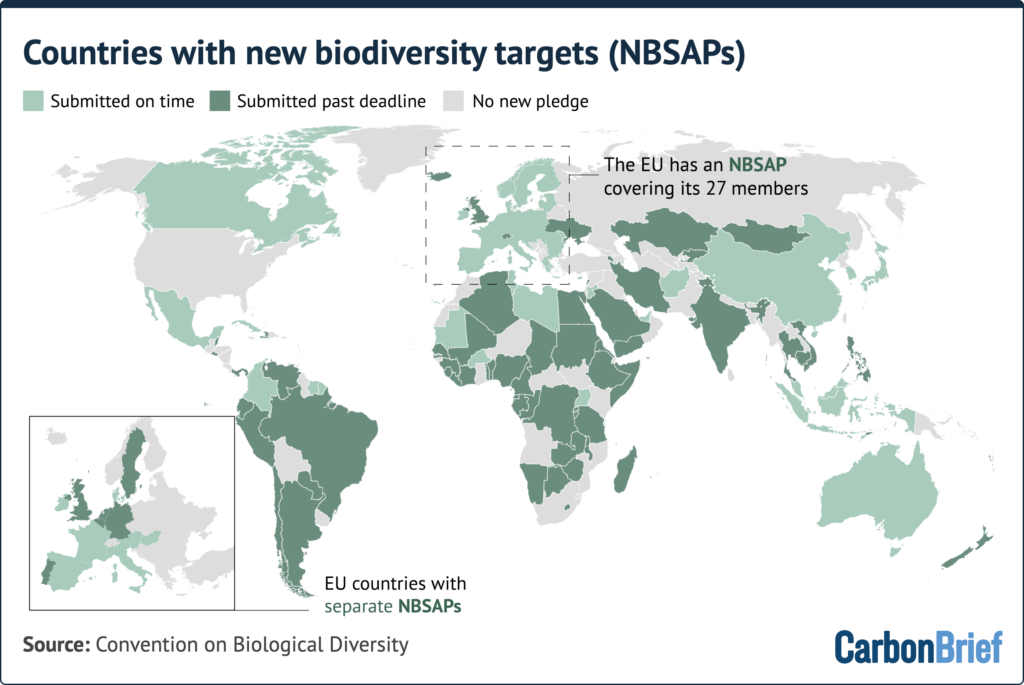
Similarly, several key South American nations have stepped up to publish their updated frameworks. Most notably, Brazil—widely recognized as the world’s most biodiverse nation—has released its updated strategy following a concerted national push. Other regional participants, including Belize and Chile, have also finalized their documents. Meanwhile, COP17 host nation Armenia published its own updated biodiversity plan in April, setting the stage for its diplomatic leadership role at the upcoming summit.
Global Review and the 2030 Targets
The central mission of the Kunming-Montreal Global Biodiversity Framework is deceptively simple in its urgency: to halt and reverse nature loss by the close of the decade. Beneath this overarching mandate lies a complex architecture consisting of 23 distinct targets for 2030. These targets span an expansive spectrum of environmental policy, ranging from the large-scale restoration of degraded terrestrial and marine ecosystems and the mitigation of climate-driven pressures on wildlife, to the mobilization of substantial financial assistance for developing nations to help bear the costs of conservation.
To ensure accountability, the framework outlines a structured schedule for monitoring individual and collective progress. This mechanism relies heavily on a comprehensive "global report" coordinated by the United Nations, which synthesizes data from national biodiversity strategies, individual domestic targets, and seventh national reports. These national reports were originally scheduled for submission to the UN by February of this year.
According to Carbon Brief’s evaluation, out of 196 total parties to the convention, 113 have produced new NBSAPs, pushing the compliance rate to 58%. Furthermore, the broader reporting landscape has also improved significantly. While roughly half of all member nations managed to meet the initial deadline for their seventh national reports in February, compliance has since climbed to 73%.
Recognizing that some governments were not in a position to finalize comprehensive, multi-year strategic plans ahead of COP16, the UN framework offered a flexible alternative: countries facing administrative or technical hurdles were permitted to submit standalone national targets. Unlike full NBSAPs, which typically outline detailed implementation mechanisms, budgets, and enforcement strategies, these national targets enumerate specific biodiversity goals without necessarily providing an immediate, fully fleshed-out roadmap for achievement.
By the conclusion of COP16, approximately 119 parties had established at least one national target. Two years later, that figure has expanded significantly to 175 countries, representing roughly 89% of the global community.
Despite this broad participation, notable absences remain among the international community. Four of the world’s designated "megadiverse" nations—countries that collectively harbor the vast majority of Earth’s total plant and animal species—have not yet published updated NBSAPs. These holdouts include Papua New Guinea, Peru, South Africa, and the United States.
The absence of the United States stems from its unique geopolitical status as the sole UN member state that is not a formal signatory to the UN Convention on Biological Diversity. Additionally, Russia, which encompasses the largest land area of any country on Earth, has likewise refrained from producing a new NBSAP.

Financing Constraints and Administrative Support
Throughout the two-year period following the COP16 summit, representatives from numerous developing nations repeatedly voiced concerns that severe financial constraints were directly impeding their ability to draft, review, and finalize their national biodiversity strategies. Designing robust, science-based environmental plans requires extensive ecological data collection, stakeholder consultations, and institutional capacity that many lower-income countries struggle to fund independently.
To alleviate these pressures, multilateral funding mechanisms have sought to streamline access to financial assistance. A spokesperson for the Global Environment Facility (GEF)—the principal multilateral fund tasked with supporting developing nations in preparing their NBSAPs—reported that out of 139 countries that requested financial support following COP16, a total of 120 successfully secured the necessary funds.
The UN Environment Programme has similarly been engaged in addressing outstanding administrative bottlenecks, working to resolve lingering issues to ensure that the remaining 19 countries can access the financial assistance required to complete their national frameworks.
As delegations prepare to pack their bags for Yerevan, the focus will inevitably shift from administrative compliance to tangible implementation. With the 2030 deadline looming halfway on the horizon, the discussions at COP17 will test whether the global community’s paper commitments are translating into real-world protection for the planet’s fragile ecosystems.