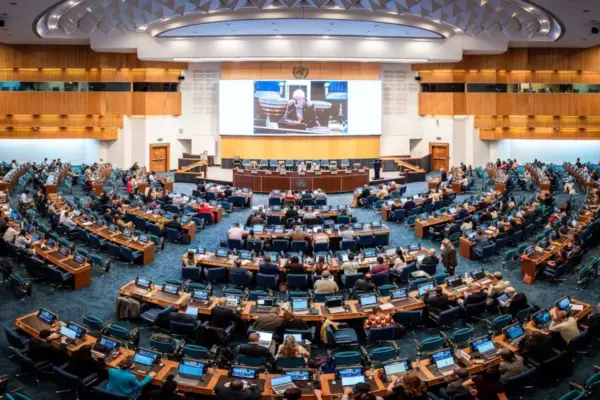
The findings indicate that roughly 58% of countries have met a United Nations call to submit new pledges targeting nature loss. This milestone comes roughly two years after the original, widely missed deadline. The analysis highlights a substantial surge in participation, driven by renewed diplomatic urgency as delegates prepare to gather next week in Yerevan, Armenia, for the upcoming COP17 biodiversity summit.
The roadmap for these national submissions was established during the COP15 biodiversity summit in Montreal, Canada, in December 2022. At that landmark conference, nearly every government in the world rallied behind the Kunming-Montreal Global Biodiversity Framework (GBF). The overarching mission of this historic agreement is to halt and definitively reverse the decline of nature by the year 2030, establishing a safety net for ecosystems and wildlife across the globe.
To guide countries toward this ambitious goal, the framework outlines an expansive set of 23 distinct targets for 2030. These benchmarks cover a wide spectrum of environmental necessities, ranging from restoring degraded ecosystems and tackling the compounding threats of climate change to ensuring that developing nations receive adequate financial support to shoulder the costs of comprehensive nature conservation.

As part of the monitoring mechanisms embedded in the GBF, countries agreed to a strict schedule for tracking their progress. Central to this process was the creation of national biodiversity strategies and action plans, commonly referred to as NBSAPs. Nations were explicitly requested to formulate and submit these comprehensive planning documents by the start of the COP16 biodiversity summit, which took place in Cali, Colombia, in October 2024.
However, the initial response to the deadline fell severely short. When COP16 opened, a mere 15% of nations had successfully delivered their NBSAPs. The widespread delays prompted intense negotiations at the summit, resulting in an agreed-upon text that strongly urged all remaining countries to release their strategic plans as soon as possible.
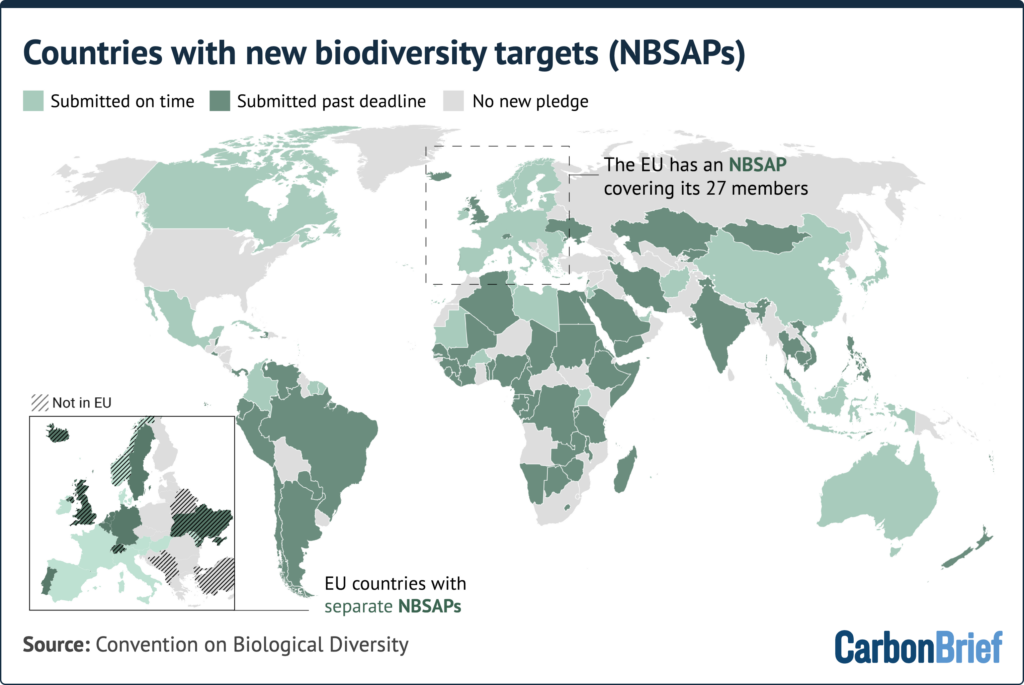
In the months following COP16, that pressure has yielded measurable results. The latest figures show that 113 countries have now come forward with new NBSAPs. This represents a substantial improvement from a year ago, when only 55 nations had published their updated plans, bringing the global compliance rate up to 58% of the 196 total parties to the convention.
Global Review
The release of these updated plans is particularly timely, as the international community prepares for the upcoming COP17 summit in Yerevan. This gathering marks the exact halfway point of the Kunming-Montreal Global Biodiversity Framework, setting the stage for the first comprehensive global review of how effectively countries are tracking toward the 2030 targets.
The upcoming global review will be informed by a major progress report coordinated by the United Nations. This UN report draws heavily upon the newly submitted NBSAPs and newly established national targets, alongside the seventh national reports that countries were required to submit earlier this year.
Geographic trends in the recent submissions reveal a notable surge in engagement from across the African continent. Over the past year, a large wave of African nations has published new NBSAPs. The roster of countries releasing updated strategies includes Algeria, Benin, Botswana, Cameroon, Comoros, Congo, Côte d’Ivoire, the Democratic Republic of Congo, Egypt, Equatorial Guinea, Eritrea, Ethiopia, Gabon, Gambia, Guinea, Lesotho, Liberia, Madagascar, Malawi, Mali, Namibia, Rwanda, Senegal, Sierra Leone, Somalia, Sudan, Zambia, and Zimbabwe.
Similar momentum has been observed in South America. Several nations across the region have stepped up to release new biodiversity strategies, most notably Brazil, which holds the distinction of being the world’s most biodiverse nation. Other South American and regional nations, such as Belize and Chile, have also published their updated plans, while the COP17 host nation, Armenia, released its official NBSAP in April.
Despite this progress, gaps remain in the global architecture of nature conservation. Under the guidelines of the GBF, countries that found themselves unable to meet the rigorous requirements for a full NBSAP ahead of COP16 were permitted to submit simplified national targets instead. Unlike comprehensive NBSAPs, which include detailed operational frameworks and implementation roadmaps, these national targets merely list the specific biodiversity goals a government aims to achieve.
Furthermore, several critical players have yet to formalize their commitments through new NBSAPs. Four of the world’s officially recognized megadiverse nations—countries that collectively harbor the vast majority of Earth’s native species—have not yet published updated plans. This group includes Papua New Guinea, Peru, South Africa, and the United States.
The absence of the United States carries unique diplomatic implications, as it remains the only UN member country that is not a signatory to the underlying UN Convention on Biological Diversity. Additionally, Russia, which encompasses the largest land area of any nation on Earth, has also failed to produce a new NBSAP.
Even with these prominent absences, secondary tracking metrics show widespread adoption of alternative commitments. By the conclusion of COP16, roughly 119 parties had managed to produce at least one formal national target. Over the subsequent two years, that figure has climbed to 175, meaning that 89% of countries have now established baseline biodiversity goals.
Compliance has similarly improved regarding formal reporting obligations. While only about half of all nations met the initial deadline to produce their seventh national reports by February of this year, that proportion has steadily risen, with 73% of countries now having completed the requirement.

Financial and Institutional Challenges
Throughout the implementation period, the slow pace of strategic planning in many parts of the developing world has been closely tied to resource constraints. Over the past two years, numerous developing nations have voiced deep concerns that a critical lack of available funding has directly prevented them from finalizing and publishing their NBSAPs. Crafting these extensive frameworks often requires substantial technical expertise, scientific research, and administrative capacity, all of which demand sustained financial investment.
To address these barriers, multilateral institutions have worked to channel financial assistance to governments in need. According to representatives from the Global Environment Facility, the primary multilateral fund tasked with supporting the preparation of NBSAPs, 120 out of 139 countries that requested financial support following COP16 have successfully accessed the necessary resources.
UN Environment Programme officials have also reported ongoing efforts to resolve remaining administrative and technical bottlenecks, aiming to unlock financial assistance for the small group of remaining nations still working to secure support. As delegates unpack these financial realities and review the newly expanded database of national strategies in Yerevan, the outcomes of COP17 will help determine whether the international community can bridge the gap between high-level ambition and on-the-ground execution before the 2030 deadline arrives.