Nearly three years after the historic adoption of a global framework designed to rescue the planet’s collapsing ecosystems, 58% of the world’s countries have finally met a United Nations call to submit comprehensive new pledges addressing biodiversity loss.
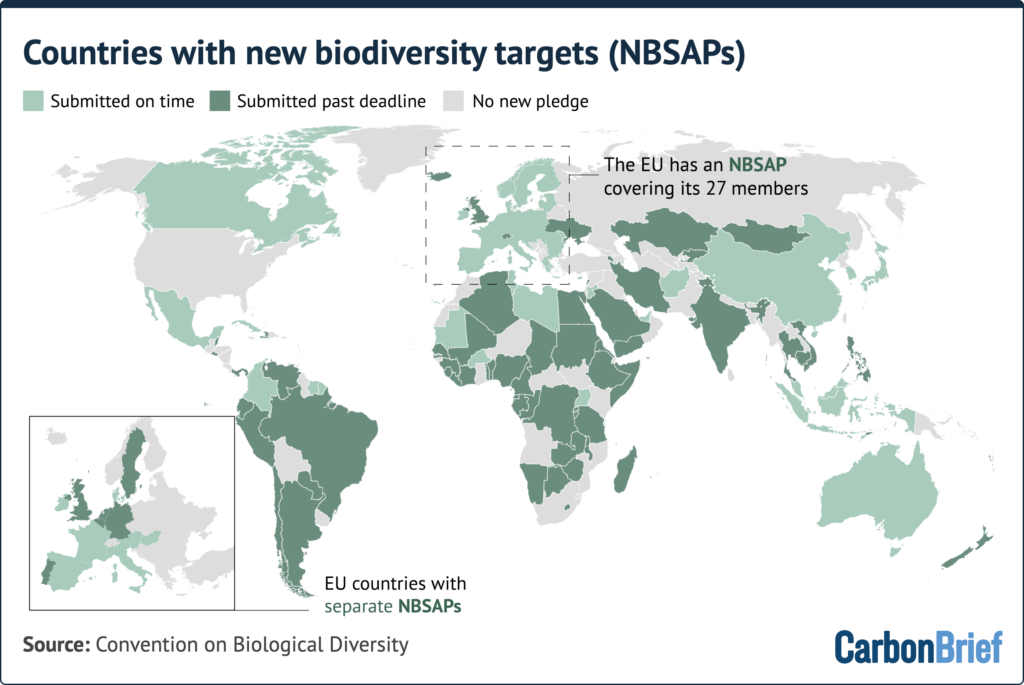
According to a comprehensive new analysis by Carbon Brief, 113 countries have now come forward with official national biodiversity strategies and action plans, known as NBSAPs. This marks a significant acceleration from just a year ago, when only 55 nations had complied, and represents a sharp improvement over the initial 15% compliance rate recorded at the original deadline.
The milestone arrives just as government delegates, environmental ministers, and international experts prepare to gather in Yerevan, Armenia, for the upcoming COP17 biodiversity summit. The upcoming conference marks the crucial halfway point of the Kunming-Montreal Global Biodiversity Framework, a landmark international pact forged in December 2022 during COP15 in Montreal, Canada.
The overarching mission of the framework is ambitious yet precise: to halt and reverse the catastrophic decline of nature and biodiversity by the year 2030. To achieve this, the agreement established a comprehensive list of 23 specific targets for 2030, covering an expansive and interconnected range of critical topics. These goals include the large-scale restoration of degraded ecosystems, active mitigation strategies against accelerating climate change, and the mobilization of adequate financial resources for developing nations to help offset the heavy economic costs of protecting domestic natural capital.
As part of the monitoring mechanisms embedded within the Kunming-Montreal framework, member nations agreed to a rigorous schedule designed to track individual and collective progress toward the 2030 targets. This infrastructure includes the preparation of a comprehensive global progress report coordinated directly by the United Nations. The findings of this UN report will serve as the foundation for the first official global review of country-level progress, which will take place during the high-stakes negotiations at COP17.
The UN report draws heavily from two primary sources of national data: the newly submitted NBSAPs and individual national targets, alongside the seventh national reports that countries were required to submit to the UN earlier this year.
Carbon Brief’s updated figures indicate that out of 196 total parties to the UN Convention on Biological Diversity, 113 have now successfully formulated and published their updated NBSAPs, accounting for 58% of the membership.
Global Review
The geographical distribution of these submissions reveals notable momentum across several regions, particularly in Africa and South America. Over the past year, a wave of African nations has published updated strategies, signaling a growing political commitment to ecological preservation across the continent.
Among the African countries releasing new plans are Algeria, Benin, Botswana, Cameroon, Comoros, Congo, Côte d’Ivoire, the Democratic Republic of Congo, Egypt, Equatorial Guinea, Eritrea, Ethiopia, Gabon, Gambia, Guinea, Lesotho, Liberia, Madagascar, Malawi, Mali, Namibia, Rwanda, Senegal, Sierra Leone, Somalia, Sudan, Zambia, and Zimbabwe.
South America has also seen key additions to the registry. Notably, Brazil—widely recognized as the world’s most biodiverse nation—has published its new strategy, alongside neighboring Belize and Chile. Meanwhile, COP17 host nation Armenia officially released its own updated NBSAP in April, setting the stage for its diplomatic leadership at next week’s summit.
Despite this progress, significant gaps remain in the global architecture of nature protection. Under the rules of the framework, countries that were not in a position to finalize comprehensive action plans ahead of the initial COP16 deadline in October 2024 were permitted to submit simpler national targets instead. Unlike full NBSAPs, these national targets outline specific biodiversity goals that countries aim to achieve, but they lack the detailed, operational roadmap required to implement them.
Furthermore, several of the world’s most ecologically vital nations—known as megadiverse countries because they account for the vast majority of Earth’s remaining plant and animal species—have yet to publish new NBSAPs. This group includes Papua New Guinea, Peru, South Africa, and the United States.
The absence of the United States remains a unique political hurdle in international environmental diplomacy, as it is currently the only UN member country that is not a signatory to the UN Convention on Biological Diversity. Additionally, Russia, which encompasses the largest land area of any nation on Earth, has also failed to produce a new NBSAP.
Despite the missing comprehensive plans from these key players, broader participation metrics show substantial improvement across other reporting categories. By the conclusion of COP16, roughly 119 parties had produced at least one formal national target. Over the subsequent two years, that figure has climbed to 175, representing 89% of all countries.
Progress has similarly accelerated regarding the seventh national reports. While only about half of all nations met the initial February deadline this year, compliance has since risen to 73% of countries worldwide.

Financial constraints have frequently been cited as a primary obstacle preventing developing nations from meeting their environmental reporting and planning obligations. Over the past two years, numerous developing countries expressed deep concerns that a lack of accessible international funding was directly stalling the development of their NBSAPs.
In response to these systemic hurdles, multilateral financial institutions have worked to streamline access to capital. A spokesperson for the Global Environment Facility, the primary multilateral fund dedicated to assisting developing nations with the preparation of their NBSAPs, reported that 120 out of 139 countries that requested financial support since COP16 have successfully accessed those funds.
The spokesperson added that the UN Environment Programme has continued working to resolve remaining administrative and logistical issues to ensure that the final group of 19 countries can secure the financial assistance they need to complete their national nature strategies.
As delegates prepare to convene in Yerevan, the focus will shift squarely to evaluating whether these submitted plans, targets, and financial commitments are sufficient to alter the trajectory of global biodiversity loss before the critical 2030 horizon arrives.