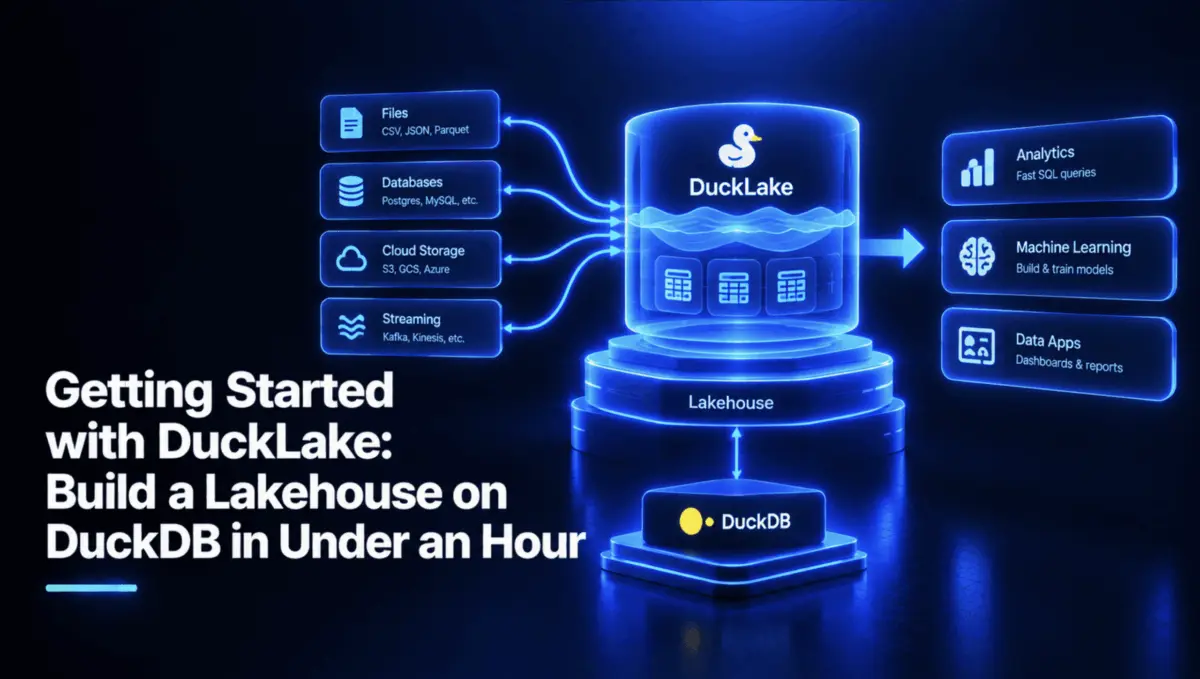
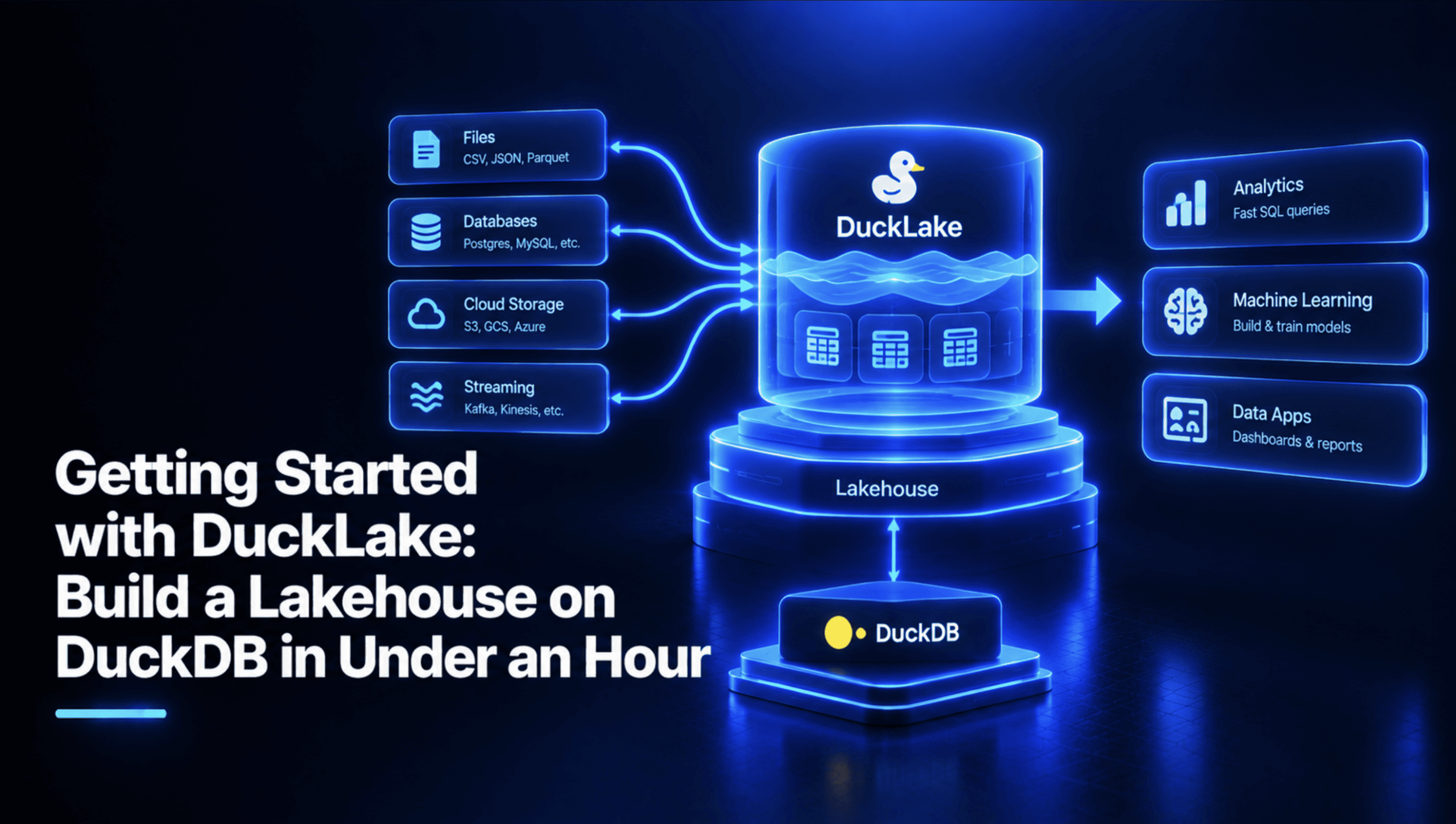
The development team behind DuckDB has officially released DuckLake 1.0, an open lakehouse table format designed to simplify modern data engineering by storing table metadata in a standard SQL database while keeping bulk data in Apache Parquet files. Shipped with a stable specification and guaranteed backward compatibility, DuckLake 1.0 allows developers and data analysts to build, query, and maintain fully functional lakehouses locally using Python and the core DuckDB package.
Unlike traditional open lakehouse formats such as Apache Iceberg or Delta Lake, which rely on specialized metadata files distributed across object storage, DuckLake takes a novel architectural approach. It delegates catalog management to any SQL database that supports ACID transactions and primary key constraints. This means that locating relevant data files for a query boils down to a single, efficient SQL statement rather than traversing complex hierarchies of metadata logs.
The architecture relies on a clear division between storage layers. The actual data lives in Parquet files situated within a designated folder or object storage bucket, while everything else—including table lists, schemas, snapshots, and granular file statistics—resides entirely within the catalog database. According to the official documentation, the choice of catalog database depends heavily on the intended use case. DuckDB itself serves as the ideal option for a single-client environment or local laptop deployment. For scenarios involving multiple local clients, SQLite provides a lightweight alternative, whereas transitioning to a multi-user enterprise lakehouse environment requires connecting DuckLake to a PostgreSQL catalog.
Similar to other prominent lakehouse formats, DuckLake maintains certain design parameters, notably omitting support for traditional database indexes, primary keys, foreign keys, and explicit UNIQUE or CHECK constraints at the lake layer. However, the system compensates with robust versioning and time-travel capabilities, allowing teams to seamlessly query historical states of their data without incurring massive storage overheads.
Achieving a working DuckLake implementation requires DuckDB version 1.5.2 or newer alongside a standard Python environment. Upon initial execution, DuckDB automatically retrieves and loads the required ducklake extension. The workflow begins by generating sample datasets—such as multi-month simulations of customer orders—and writing them directly into raw Parquet files using native DuckDB commands. These raw files are subsequently ingested into the lake environment to establish the initial baseline table structure.
As operations progress, every modification made to the lakehouse—whether appending new data partitions, executing large-scale updates, or altering the underlying table schema—automatically generates a new, immutable snapshot. When updates occur, DuckLake handles modified rows through an underlying mechanism of deletes followed by inserts, masking older records with delete files while writing updated versions as fresh data. Meanwhile, schema alterations like adding new columns or renaming existing fields operate purely as metadata adjustments. This ensures that historical Parquet files remain untouched, with the catalog dynamically mapping legacy file structures to the newly evolved table schema.
This snapshot-based architecture underpins DuckLake’s time travel and recovery features. Analysts can query historical states of tables by appending specific version identifiers or timestamps directly into their SQL queries. This capability proves invaluable for auditing data pipelines or quickly undoing operational mistakes. If a batch deletion erroneously strips out an entire regional segment of data, engineers can easily restore the missing records by querying a previous snapshot and re-inserting the affected rows into the active table.
Maintenance is another critical component of managing a DuckLake deployment. Frequent write operations naturally generate a proliferation of small adjacent files, which can degrade query performance over time. To counteract this, DuckLake provides specialized maintenance routines that merge small neighboring files sharing the same schema version into larger, optimized Parquet files. Furthermore, because time-travel functionalities rely on preserving historical data, DuckLake intentionally avoids automatically purging old data files. To reclaim storage space, administrators must explicitly expire older snapshots and execute checkpoint procedures, carefully balancing historical retention policies against storage constraints.
Advanced configurations also include data inlining, a feature enabled by default for small writes below a defined threshold of ten rows. Instead of immediately spinning up a new Parquet file on disk, tiny write operations are stored directly within the catalog database, to be flushed out into standard data files during later maintenance cycles.
Looking ahead, the development roadmap for DuckLake points toward even greater capabilities. Discussions surrounding a potential DuckLake version 2.0 include introducing git-like branching and incremental materialized views. These prospective features arrive as DuckDB Labs continues to expand its technical footprint, following its alignment with AWS while maintaining its core focus on advancing DuckDB, DuckLake, and related ecosystem tools. As organizations increasingly seek lightweight, high-performance data architectures that bridge the gap between local development and production cloud storage, DuckLake 1.0 offers a streamlined path toward modern lakehouse implementation.