In the evolving landscape of artificial intelligence, practitioners often face a distinct architectural challenge: how to effectively pair the immense contextual understanding of modern large language models with the speed, efficiency, and predictability of traditional, lightweight machine learning classifiers. Handling raw, lengthy, and noisy text directly has long been a bottleneck for classical text mining pipelines, frequently requiring exhaustive preprocessing stages to distill clean, actionable signals from unstructured data. A novel approach developed by AI experts demonstrates how developers can bypass these traditional limitations by seamlessly embedding LLM-driven text summarization directly into a standard scikit-learn workflow.
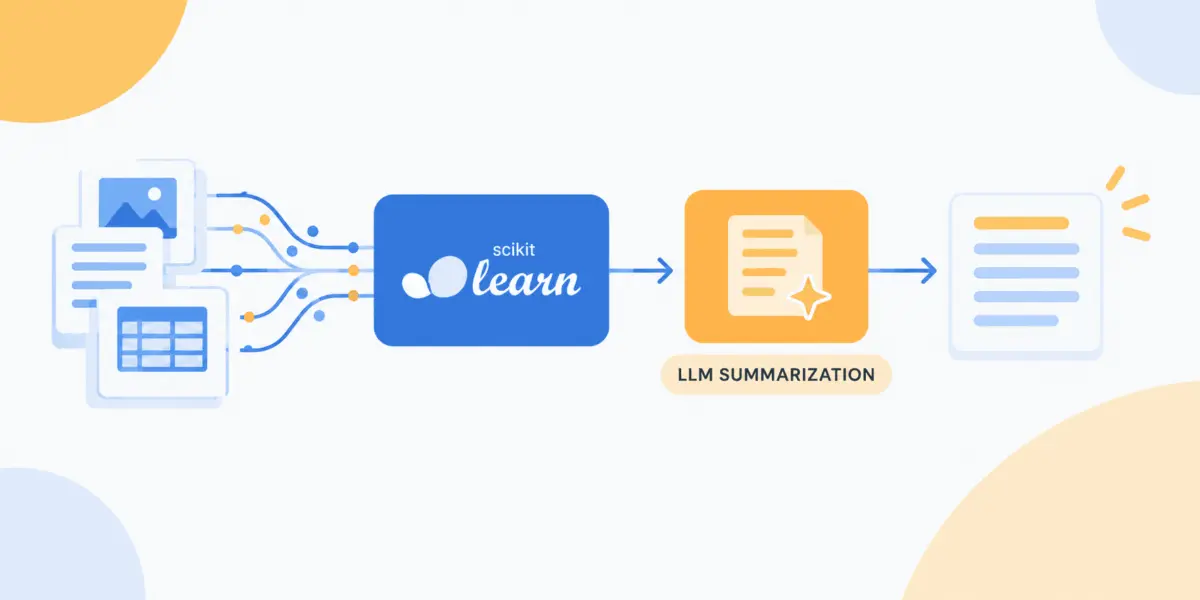
The architecture brings together two traditionally distinct worlds. By utilizing Scikit-LLM—a specialized integration library designed to bridge prompt-based models with classical machine learning toolkits—developers can configure an end-to-end pipeline where large language models perform initial text distillation. This condensed output is then fed into traditional vectorizers and linear classifiers, uniting the semantic comprehension of generative models with the robust and computationally inexpensive inference of classical statistical learning. Crucially, this advanced methodology can be implemented using exclusively free development tools, democratizing access to hybrid AI architectures for engineers, researchers, and data scientists worldwide.
The practical implementation of this hybrid pipeline relies on an open ecosystem centered around cloud-based development environments and accessible inference endpoints. By utilizing a Google Colab notebook, developers can execute the entire workflow without requiring dedicated local hardware infrastructure. To eliminate per-token costs associated with proprietary commercial APIs, the architecture routes its requests through Groq’s high-performance LLM infrastructure, leveraging compatible open-weight models. Practitioners must simply register on the Groq platform to generate an API key, which is then securely stored within the Colab environment’s secret variables to maintain secure authentication during runtime.
Once the environment is properly authenticated and the Scikit-LLM package is installed, the next phase involves configuring the system architecture. Rather than relying on default routing to OpenAI’s proprietary endpoints, the framework directs its API calls to Groq’s high-speed OpenAI-compatible endpoint. This configuration ensures that subsequent text summarization tasks are executed efficiently using pre-trained models, bypassing the substantial computational overhead typically required for running massive generative networks locally while avoiding recurring subscription or pay-per-use fees.
The foundation of the pipeline begins with the establishment of training data, consisting of a carefully curated set of lengthy, verbose, and realistically noisy documents alongside their corresponding class labels. In typical machine learning scenarios, feeding unrefined, paragraph-length text directly into feature extraction tools like term frequency-inverse document frequency vectorizers results in noisy numerical representations that degrade downstream classification accuracy. However, much like few-shot classification paradigms in modern generative AI, the pipeline requires only a minimal set of representative training examples. This small batch does not actually "train" the underlying LLM weights through gradient descent; instead, it provides the generative model with the necessary contextual framework to understand how to process subsequent inputs.
The core innovation of the architecture lies in its unified three-step sequential pipeline, which constructs a coherent bridge between modern generative summarization and classical statistical learning. The first stage of the pipeline deploys a specialized summarizer object—encapsulated via Scikit-LLM and powered by a compatible model hosted on Groq—to condense lengthy, unstructured documents down to concise, keyword-rich summaries capped at a specific word limit. The second stage processes these newly distilled summaries through a traditional term frequency-inverse document frequency vectorizer, converting the clean text signals into numerical matrices. Finally, the third stage passes these streamlined vector representations into a standard logistic regression classifier, which learns to categorize the data based on the distilled vocabulary.
Examining the mechanics behind this hybrid pipeline reveals why it achieves high performance even when trained on an exceptionally small number of examples. The success of the downstream logistic regression classifier is not a consequence of the model independently learning sweeping abstract concepts across complex categories. Rather, it is the result of a symbiotic filtering mechanism: the large language model acts as an intelligent linguistic filter, transforming noisy prose into canonical, highly representative keywords. Consequently, the downstream vectorizer restricts its entire vocabulary space to those few remaining terms, effectively simplifying what would otherwise be a complex semantic classification task into a straightforward, highly reliable keyword-matching operation.
Verifying the intermediate output of the pipeline confirms the precision of the summarization phase. When inspecting the internal state of the summarizer object across the initial training documents, the generated texts successfully strip away conversational filler, run-on clauses, and irrelevant contextual noise while preserving core domain-specific entities. For instance, verbose descriptions concerning the efficiency gains of novel perovskite solar layers are distilled into concise summaries highlighting cost reductions and residential green energy adoption. Similarly, lengthy reports detailing unexpected central bank interest rate hikes and subsequent market downturns are successfully condensed into direct statements concerning financial market volatility and tech sector sell-offs.
With the intermediate summarization verified for accuracy, the pipeline can immediately process unseen test data through the exact same automated sequence. When new, lengthy, and previously unencountered documents are introduced to the system, the architecture automatically handles the entire lifecycle without manual intervention: the LLM first condenses the raw text, the vectorizer transforms the summary into numerical features, and the logistic regression model assigns a final predicted category. Testing this workflow against diverse unseen documents spanning multiple distinct domains yields remarkably accurate categorization results.
When applied to unseen text regarding breakthrough medical advancements in mRNA vaccines, the pipeline successfully generates an intermediate summary emphasizing clinical efficacy and global immunity before correctly classifying the document under the healthcare domain. Similarly, paragraphs discussing the development of grid-scale sodium-ion batteries to resolve renewable energy intermittency are distilled and accurately categorized as energy initiatives. Reports detailing late-session stock market rallies driven by semiconductor earnings and optimistic economic forecasts are similarly processed, resulting in precise classifications within the financial sector.
The successful integration of Scikit-LLM into traditional scikit-learn workflows highlights a powerful, highly practical paradigm for modern software and machine learning engineering. By merging prompt-based text distillation with lightweight classical vectorizers and linear classifiers, developers can construct artificial intelligence solutions that are simultaneously powerful, interpretable, and computationally inexpensive. This hybrid approach circumvents many of the resource constraints traditionally associated with deploying large language models at scale, proving that combining foundational generative tools with classical machine learning pipelines offers a viable, highly efficient path forward for text classification and natural language processing tasks.