Global fossil-fuel emissions are on track to decline by approximately 0.5% in 2026, driven by the profound economic and geopolitical fallout from the ongoing crisis in the Strait of Hormuz, according to a comprehensive new analysis by Carbon Brief.
The prolonged conflict between the United States and Iran has severely disrupted critical maritime trade through the Strait of Hormuz, triggering a massive, volatile spike in global oil and gas prices that continues to send shockwaves throughout the international economy. As the conflict drags on, each month of disruption and every new regional flashpoint—such as renewed violence in Yemen—is dramatically increasing the financial and strategic incentive for nations, industries, and consumers to pivot away from vulnerable petroleum and gas supplies toward alternative energy sources.

Those alternatives have notably included coal, with the latest energy market forecasts pointing toward a 1.2% rise in global coal demand this year. This upward tick in coal consumption has seemingly lent support to widespread media claims of a significant "return to coal" in the immediate wake of the geopolitical energy crunch.
However, Carbon Brief’s detailed analysis demonstrates that the rise in carbon dioxide emissions associated with this increased coal usage—much of which is actually unrelated to the Hormuz bottleneck—will be more than entirely offset by steep, unprecedented declines in oil and gas consumption across major global economies. Consequently, the estimated overall net impact on carbon dioxide emissions originating from fossil fuels in 2026 amounts to a reduction of roughly 0.5% compared to 2025 levels.
To put the scale of this environmental footprint into perspective, fossil fuels historically account for roughly two-thirds of all global greenhouse gas emissions. The latest emissions estimates for each individual fossil fuel are derived from updated, authoritative forecasts published by the International Energy Agency (IEA) regarding coal, oil, and gas markets, all evaluated against the backdrop of the ongoing global energy crisis.
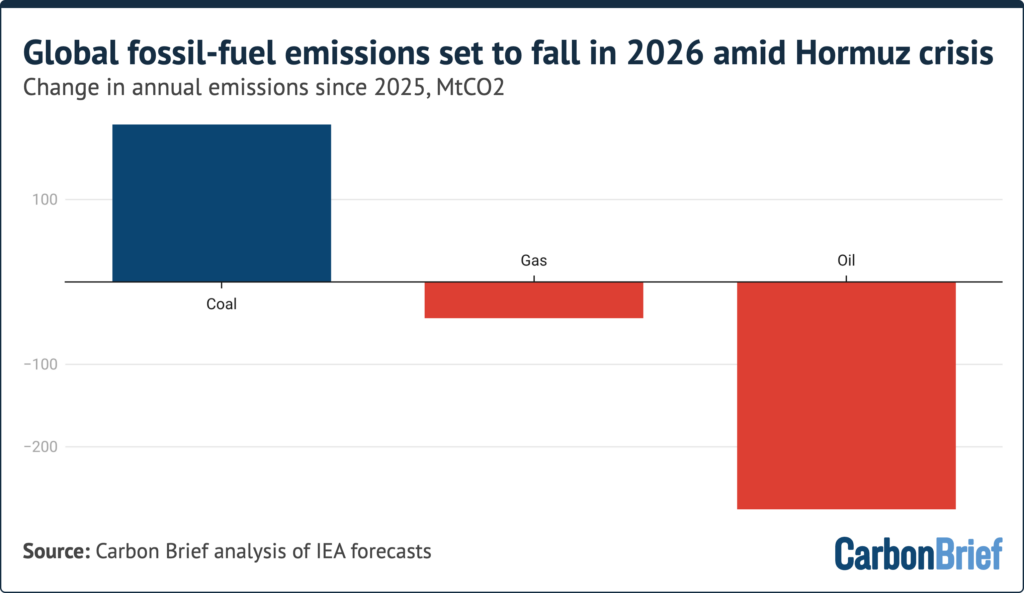
The shifting trajectory of these fossil fuels throughout the year highlights a volatile energy landscape. For example, the IEA initially anticipated that global coal demand would register a decline over the course of 2026. In its end-of-year coal report published in mid-December, the agency projected that falling coal demand inside China would successfully outweigh the potential upward impact of pro-coal policies implemented under United States President Donald Trump.
By stark contrast, the IEA’s subsequent mid-year update, published in September 2026, reversed course, projecting that global coal demand would instead rise by 1.2% this year, confounding earlier expectations of a downward trend. That report highlighted the immediate, temporary boost given to coal consumption by inflated natural gas prices following the closure and militarization of the Strait of Hormuz. However, analysts emphasize that there are strict structural limits to this shift, as very few countries possess the infrastructure required to switch rapidly from gas to coal generation on a massive scale.
Furthermore, the IEA’s latest assessments underscore the heavy influence of concurrent meteorological and short-term market dynamics. A strong El Niño weather pattern has pushed up electricity demand for cooling purposes while simultaneously depressing hydroelectric power generation in key global markets. Additional short-term anomalies, such as rising volumes of "wasted" or curtailed wind and solar power in rapidly expanding renewable markets like China, have further complicated the coal demand picture for the year.
The outlook for natural gas tells a different story of contraction under severe economic pressure. Initially, the IEA did not alter its early-year forecast, published in January, which anticipated that global gas demand would climb by 2.0% through 2026. However, by the time the agency published its updated market report in July, that projection had already been downgraded to a 0.6% drop in demand. In the months since that July report, the immense pricing pressure exerted on natural gas consumers worldwide has only intensified, further eroding demand.
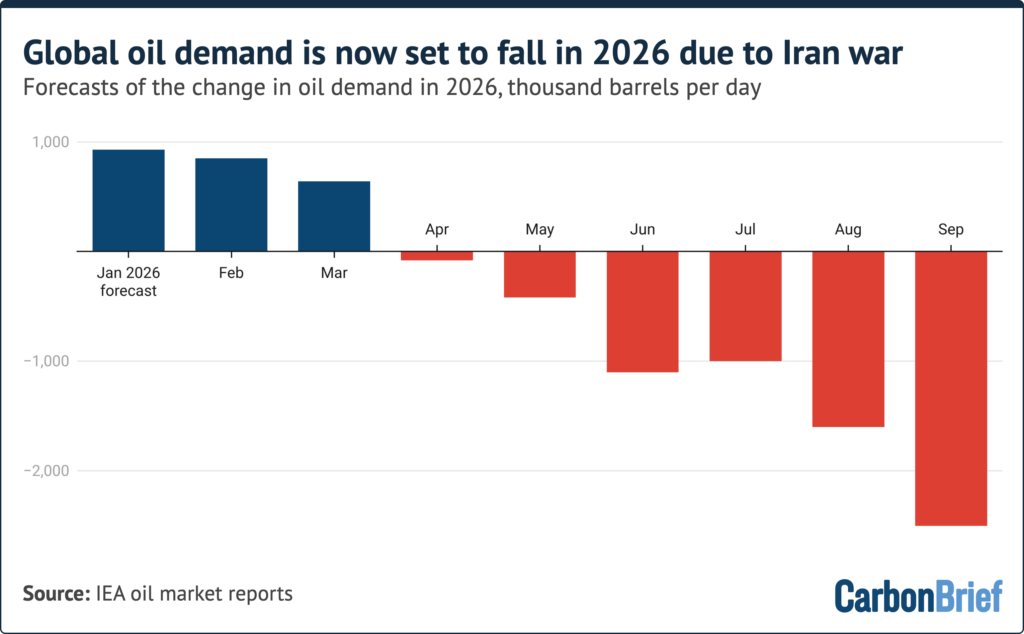
For oil, the downward revision in forecasts has been far more dramatic and consequential. In its January 2026 oil market report, the IEA originally forecasted a modest demand growth of 930,000 barrels per day (bpd) for the year. As the Hormuz crisis abruptly ignited and subsequently extended into a prolonged standoff, that forecast was steadily marked down month after month.
By September, the IEA’s outlook projected an astonishing drop in oil demand of 2,500,000 barrels per day for 2026, which translates to a 2.4% reduction from 2025 levels. Independent financial institutions have arrived at similar conclusions; a research note published in mid-September by analysts at Morgan Stanley pegged the broader market consensus at a demand drop of approximately 2,415,000 bpd for the year.

While a multitude of short-term factors continue to play a role in shaping these shifting 2026 forecasts, energy experts point out that the current crisis will inevitably leave lasting structural footprints on fossil-fuel demand well into the next decade.
For instance, whereas the IEA initially suggested in mid-2026 that global oil demand would experience a sharp economic rebound in 2027, pushing consumption well past 2025 figures, the agency now expects oil usage to remain essentially flat for a consecutive two-year period. This prolonged stagnation casts a major shadow of doubt over previous baseline expectations—published by the agency late last year—which suggested that global oil demand would not reach its ultimate peak until closer to 2030.
The persistence of the conflict is accelerating long-term behavioral and technological shifts. Sverre Alvik, vice president and energy transition research lead at consultancy DNV, noted in a late-August market analysis that for every month the geopolitical conflict persists, the statistical probability of permanent oil demand destruction increases significantly.

As petroleum and refined fuel prices have surged to punishing heights, electric vehicles have successfully captured record market shares across major automotive hubs worldwide, stretching from Australia and China to European nations, Indonesia, and Thailand. In July alone, electric vehicle sales nearly doubled year-on-year across emerging automotive markets outside of China, Europe, and North America, according to industry data.
Meanwhile, the IEA notes that the 2027 outlooks for coal and gas remain deeply interdependent. Coal demand could potentially experience another upward surge if global gas prices remain persistently elevated, or it could retreat quickly if gas markets stabilize.
Simultaneously, governments across developing nations that had historically planned to expand their energy grids through imports of liquefied natural gas have begun signaling strategic policy shifts. Stung by steep import costs—exemplified by massive multi-billion-dollar gas bills—these nations are increasingly reevaluating their energy security strategies. Rather than doubling down on vulnerable LNG imports, many are pivoting toward accelerated investments in domestic clean energy generation, while others are reluctantly extending their reliance on domestic coal supplies to bridge immediate deficits.

Ultimately, the cascading effects of the ongoing crisis in the Strait of Hormuz demonstrate that the current geopolitical shock has the profound potential not only to depress fossil-fuel consumption and carbon emissions in the immediate short term, but also to fundamentally accelerate the global energy transition on a permanent, lasting basis.