NEW DELHI — In a world that often demands narrow specialization and conventional career paths, trailblazers occasionally emerge to prove that passion knows no bounds. Can one realistically picture a professional hairstylist braving sub-zero temperatures, fighting profound exhaustion, and navigating some of the most unforgiving, high-altitude environments on the planet? For celebrated Sri Lankan mountaineer Johann Peries, this striking juxtaposition is not merely a unique lifestyle choice—it is a living testament to the boundless power of human grit, personal sacrifice, and unwavering determination.
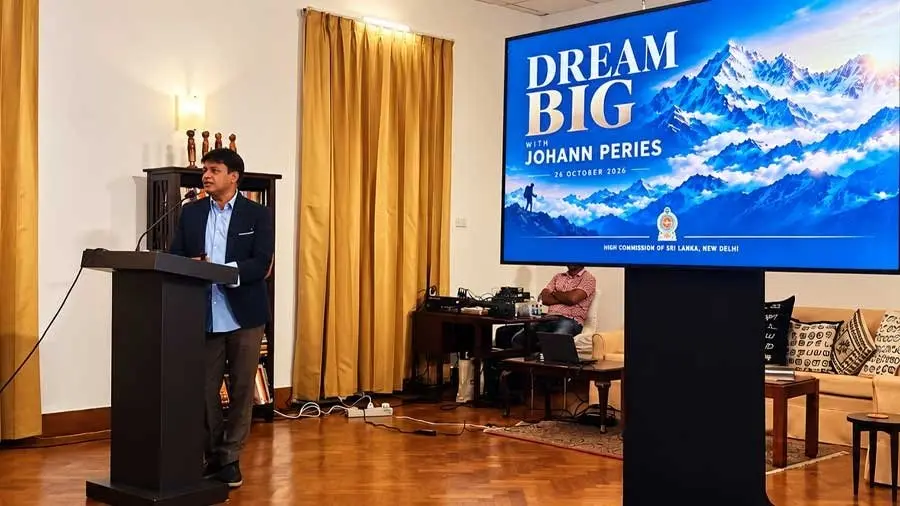
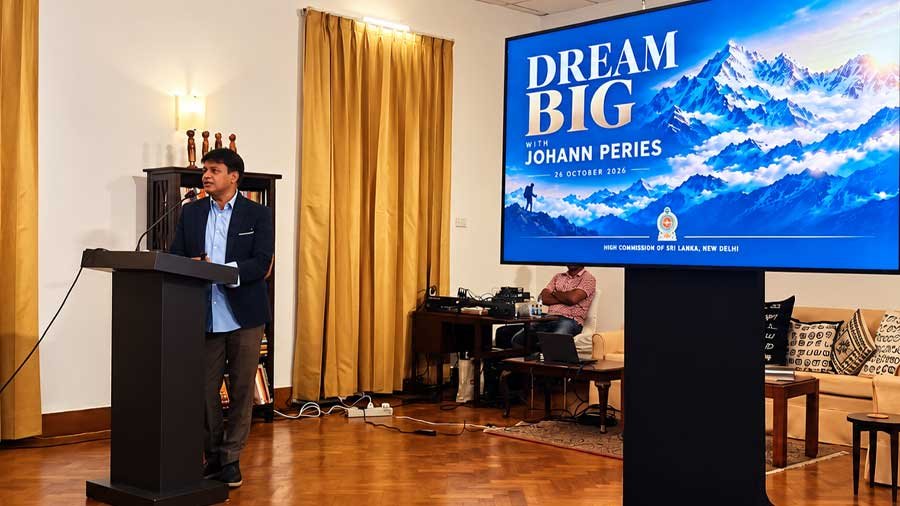
On October 26, 2026, the High Commission of Sri Lanka in India hosted a deeply moving and inspirational public lecture featuring Peries, who bared the extraordinary details of his life’s journey before an attentive audience of students. The special address offered young minds a rare glimpse into the realities of elite high-altitude mountaineering, stripping away the romanticized notions of peak-bagging to reveal the raw grit required to survive the world’s most extreme environments. The formal address seamlessly transitioned into an interactive session, during which students posed deeply curious and probing questions regarding his harrowing adventures, the mental roadblocks he faced, and the internal compass that continually drives him forward.
Beyond his exploits on jagged rock and glacial ice, Peries maintains a multifaceted professional identity. Operating as a successful hairstylist and entrepreneur while simultaneously nurturing deep personal interests in the performing arts—including dance and acting—he serves as a living counterargument to the notion that professional commitments must cage one’s broader ambitions. His defining milestone came in 2018 when he etched his name into history by becoming the first Sri Lankan man to successfully summit Mount Everest, a crowning achievement that validated years of grueling physical preparation and emotional hardship.
Addressing the assembled students with characteristic candor, Peries underscored the fundamental importance of keeping personal dreams alive. "I think it is very important for us to chase after our passions and our dreams when we actually even choose our careers," he shared, urging the younger generation not to let societal expectations dictate the boundaries of their potential.
When Life Offers a Second Chance
Peries’ lifelong love affair with the great outdoors did not materialize in a vacuum; it was cultivated during his formative years by his father, who introduced him to the rugged beauty of nature and the foundational techniques of mountain climbing. What began as localized explorations of Sri Lanka’s rolling peaks gradually transformed into an expansive ambition to step beyond the island nation’s shores and test himself against the giants of the global mountain ranges.
However, the trajectory of his life was dramatically altered by a series of catastrophic brush-with-death experiences that completely reshaped his worldview. In 1997, a horrific road accident left him with severe head and facial trauma, sending shockwaves through his family and medical team alike. The injuries were so critical that attending physicians reportedly gave him a harrowing twenty-four-hour window to survive. What followed was a grueling series of extensive reconstructive surgeries that tested his physical and psychological limits, forcing an abrupt reckoning with his own mortality.
"It gave me a second chance," Peries recalled, reflecting on the psychological shift that transformed him from a passive observer of life into an active participant willing to seize every available moment.
That fragile second chance would be tested repeatedly in the years that followed. In 2005, while residing in Mumbai, he found himself trapped in the city’s catastrophic and paralyzing floods. In a fight for basic survival, he spent an entire night desperately clinging to a bridge structure, his body submerged up to his neck as he battled the relentless, muddy force of the rising current.
Another life-threatening crucible occurred in 2012 during a high-altitude expedition to Island Peak in the rugged terrain of Nepal. A sudden, vicious mountain storm transformed what was supposed to be a routine final seven-hour ascent into an agonizing twenty-three-hour ordeal. As gale-force winds howled and temperatures plummeted, the climbers depleted their water reserves entirely, plunging rapidly into severe dehydration and systemic exhaustion.
At his physical breaking point, surrounded by blinding snow and numbing cold, Peries experienced a moment of total surrender, urging his companions to leave him behind to his fate. Fortunately, a dedicated search-and-rescue team consisting of three individuals managed to locate the stranded, frostbitten climbers in the nick of time, ushering them back down the mountain to safety.
These harrowing brushes with mortality did not deter him; instead, they tempered his resolve. They instilled in him a profound lesson that would guide every subsequent expedition: true courage on a mountain must never be reckless. Rather, it must always be balanced by sound judgment, acute situational awareness, and a deep, abiding respect for the profound fragility of human life.
The 400 Metres That Changed Everything
Among the most compelling narratives shared during the lecture was Peries’ candid account of his initial, heart-wrenching attempt on Mount Everest in 2016. At the time, he was a key member of a pioneering, historic Sri Lankan expedition team that also included Jayanthi Kuru-Utumpala, who famously made history that season by becoming the first Sri Lankan to conquer the world’s highest peak.
After enduring weeks of agonizingly slow acclimatization, grueling vertical ice-climbing, and biting winds in the infamous Death Zone, Peries came within a mere 400 vertical metres of the summit. Victory was agonizingly close, but an unexpected technical crisis involving his oxygen supply forced him to confront an impossible dilemma. His primary apparatus had failed, and his backup cylinder simply did not contain enough pressurized oxygen to guarantee both a safe ascent to the peak and a safe return down the mountain.
"I don’t care even if I die, because I have prepared myself," he recalled thinking in the heat of the moment, consumed by the single-minded obsession that drives so many mountaineers to cross the threshold of reason.
Sensing the fatal error in his companion’s thinking, his Sherpa guide pleaded with him urgently to abandon the attempt and turn back immediately. Pausing amidst the freezing chaos to collect his racing thoughts, Peries stepped back from the precipice of his ambition and made the most agonizing decision of his life.
"So I decided, yes, life is more important, and I will come back," he recounted.
The emotional fallout was devastating. In the immediate aftermath of the aborted climb, nursing his physical exhaustion and wounded pride, he publicly declared to the press that he would never return to Everest. Yet, as the months rolled on, the heavy psychological weight of unfinished business began to plague him day and night.
"I thought, I can’t live with this. I will live with regret for the rest of my life. And I decided, no, I’m going back," he admitted.
What followed was a rigorous two-year rehabilitation of his spirit, marked by relentless physical conditioning, meticulous mental preparation, and complex financial planning to fund a second expedition. On May 22, 2018, Peries stood once again on the slopes of Everest, pushed through the final punishing metres, and successfully stepped onto the summit. With that final footstep, he officially became the first Sri Lankan man to conquer the roof of the world.
Unfurling the national flag of Sri Lanka at the highest geographic point on Earth was a moment of profound personal redemption and national pride. Yet, as he emphasized to the students in India, the true value of the milestone extended far beyond the summit signpost. It was fundamentally about confronting crushing public disappointment, swallowing one’s pride, and discovering the inner fortitude required to try again when the odds appeared stacked against success.
Beyond Everest: The Seven Summits
Having achieved his life’s defining ambition on Everest, Peries did not allow himself to rest on his laurels. Instead, he immediately cast his gaze toward an even more expansive and demanding mountaineering challenge: the Seven Summits, a prestigious mountaineering circuit comprising the highest mountain peaks on each of the world’s seven traditional continents.
This elite list includes Mount Kilimanjaro in Africa, Mount Everest in Asia, Mount Elbrus in Europe, Mount Kosciuszko in Australia, the Vinson Massif in Antarctica, Mount Aconcagua in South America, and Denali in North America. Each individual peak presents an entirely distinct set of obstacles, ranging from punishing high-altitude sickness and unpredictable weather patterns to logistical nightmares and the sheer physical burden of hauling heavy gear across vast wildernesses.
Peries pointed specifically to Denali in Alaska as a prime example of this grueling brutality, noting that climbers on that particular mountain receive no outside assistance and must transport all of their food, fuel, and shelter entirely on their own, frequently pulling heavy supply sledges across treacherous expanses of snow and ice fields.
His expedition to the frozen wastes of Antarctica, meanwhile, offered a completely different, almost surreal sensory experience. Surrounded by an endless, blinding expanse of white snow and deep blue glacial ice that stretched endlessly to the horizon, the environment felt entirely detached from the familiar Earth.
"It felt like I was on another planet," he remarked, describing the profound isolation of the white continent. His successful, calculated ascent of Mount Vinson in January 2025 marked yet another monumental milestone in his ongoing quest to complete the Seven Summits circuit.
Discipline, Sacrifice, and Focus
Balancing the demands of elite international mountaineering with a thriving commercial career requires a level of personal discipline that few can fathom. Despite the massive time commitments demanded by his global expeditions, Peries continues to maintain a full-time career as a professional hairstylist, seamlessly shifting from the serene environment of a salon to the freezing, windswept slopes of the world’s most dangerous mountain ranges.
His daily training regimen begins long before the sun rises, kicking off promptly at 4:30 a.m. with rigorous physical conditioning, followed by a full workday at his business, and capped off with additional evening training sessions. Success, he explained to the captivated audience, is rarely a byproduct of simply finding spare time in a busy schedule; rather, it is forged through deliberate, uncompromising choices.
In the lead-up to major expeditions, he systematically cuts out social engagements and maintains a strict, unyielding training calendar, refusing to make allowances even during major festive periods or holidays. "It is not about finding time, it is about making time," he stressed.
Furthermore, he placed heavy emphasis on the mechanics of preparation, noting that physical fitness alone is utterly useless without the acquisition of technical knowledge, practical survival skills, and the mental maturity to confront deep-seated fears in a controlled manner. Recalling his initial, paralyzing apprehension when faced with the prospect of crossing rickety aluminum ladders spanning bottomless, gaping glacial crevasses, he explained how repeated exposure and deliberate practice gradually transformed his primal fear into measured confidence.
For the students in attendance—many of whom are currently navigating high-pressure examinations, uncertain career choices, and complex personal aspirations—his core message was direct and unambiguous: genuine long-term commitment demands sacrifice, and relying on excuses will never bring an individual closer to their ultimate objectives.
Finding Your Own Mountains
The High Commission lecture drew to a close with a powerful, philosophical reflection on the true underlying meaning of personal achievement. Drawing upon the enduring philosophy popularized by legendary Everest pioneer Sir Edmund Hillary, Peries reminded the room full of young listeners that mountaineering is never truly about dominating the natural world.
"We can’t conquer nature. We can’t conquer things around us, but what we can do is conquer ourselves," he noted.
The active question-and-answer session that followed allowed this philosophical thread to extend well beyond the formal confines of the lecture hall, encouraging the young students to turn their gaze inward and reflect critically on their own long-term aspirations, as well as the inevitable obstacles standing in their path.
Concluding his address, Peries left the audience with a final, inspiring charge: "Find your own mountains in life as you move forward."
His remarkable life story stands as an enduring testament to a vital truth: true success is rarely a straight line resulting from a triumphant first attempt. Often, it is born from the wisdom to turn back when danger calls, the resilience to learn painful lessons from adversity, and the unwavering courage to return with renewed focus. Ultimately, the most formidable mountain any individual will ever attempt to climb is the one that exists quietly within themselves.