Unmanned aerial vehicles have firmly established themselves as essential gear for modern travelers, documentary filmmakers, and digital creators. Despite regulatory hurdles and airspace restrictions across the globe, enthusiasts continue to pack drones into their luggage to capture sweeping, dramatic perspectives of landscapes that ground-level cameras simply cannot reach. While the market features an array of established brands and innovative hardware, a recent release is challenging traditional design paradigms by completely eliminating the mechanical gimbal for a vast segment of creators.
Released in late 2025, the Antigravity A1 introduces a dual-lens 360-degree capture system designed to record surrounding environments simultaneously in every direction. This configuration delivers what manufacturers describe as a "fly now, frame later" experience. Instead of meticulously planning a camera path or worrying about precise framing during flight, pilots can focus purely on navigation. The process transforms drone operation into something resembling the direction of a virtual camera within a pre-recorded digital environment.
Two Lenses and No Blind Spots
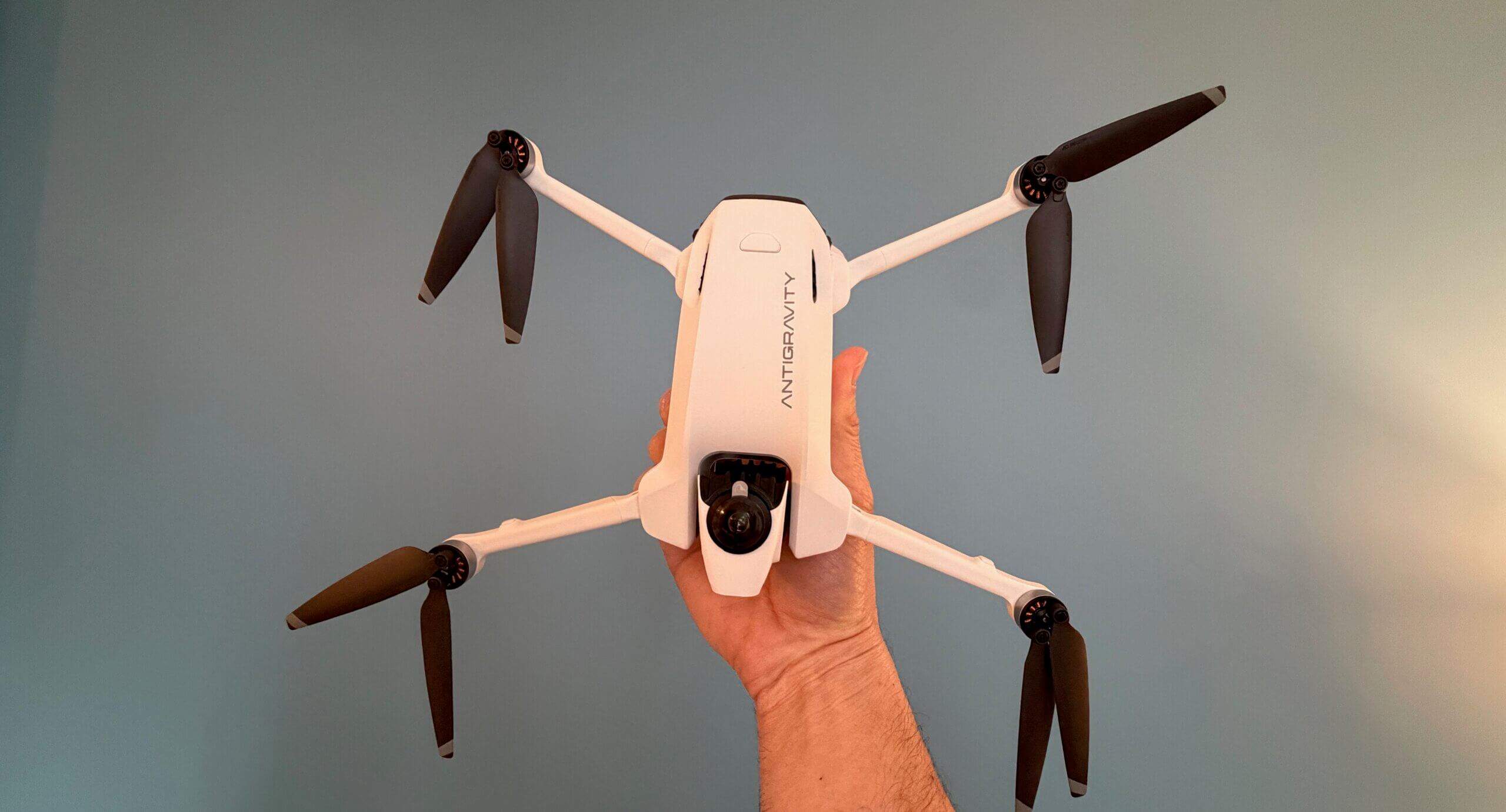
The defining architectural feature of the Antigravity 360 system is its dual-lens configuration. While the overwhelming majority of consumer drones rely on a single, forward-facing camera mounted on a stabilizing gimbal, the A1 utilizes two ultra-wide-angle lenses positioned symmetrically on the top and bottom of the central fuselage. Each lens captures a 200-degree field of view, creating an overlapping zone that merges into a seamless, full 360-degree sphere.
A particularly striking result of this optical design is that the body of the drone itself is digitally edited out of the final exported footage. This creates the visual illusion of an independent camera floating entirely unsupported in mid-air.
The optical hardware relies on 1/1.28-inch CMOS sensors. Although these sensors are physically smaller than the one-inch alternatives found on heavy-duty professional photography platforms, they are significantly larger than the sensors typically embedded in standard 360-degree action cameras. This scale provides noticeable advantages in low-light performance and expands the dynamic range, allowing the system to preserve fine details in intense highlights and deep shadows—a crucial capability when shooting under the harsh, contrasting conditions of midday sunlight.
Global aviation regulations frequently impose stricter operational requirements on aircraft weighing 250 grams or more. Recognizing the impact of this threshold on consumer adoption, Antigravity engineered the A1 to hit a precise takeoff weight of 249 grams when equipped with its standard battery. By keeping the aircraft just under the regulatory cutoff, users in many jurisdictions are exempt from formal commercial registration requirements.
Constructed from a high-grade carbon-fiber-reinforced polymer, the fuselage feels exceptionally durable, offering a superior strength-to-weight ratio compared to the standard ABS plastic common in budget alternatives. The folding arm mechanism features a tactile, click-into-place design that implies long-term structural integrity. When fully collapsed for transport, the aircraft roughly mirrors the footprint of a large smartphone, albeit at approximately three times the thickness.
The Flight Experience
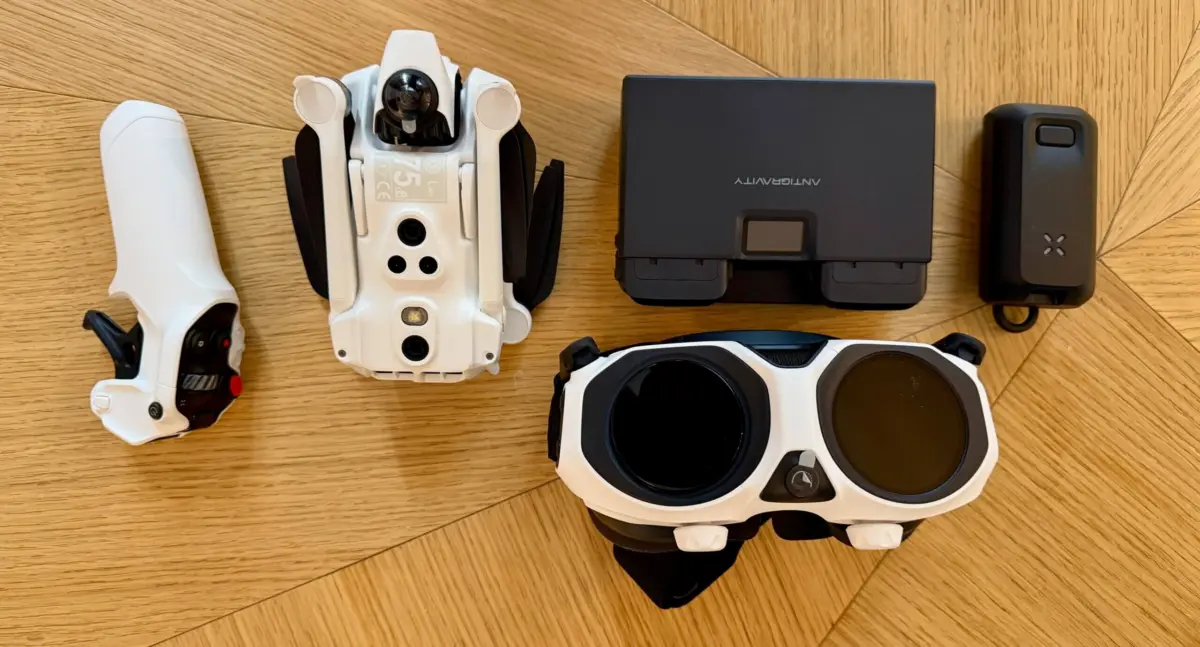
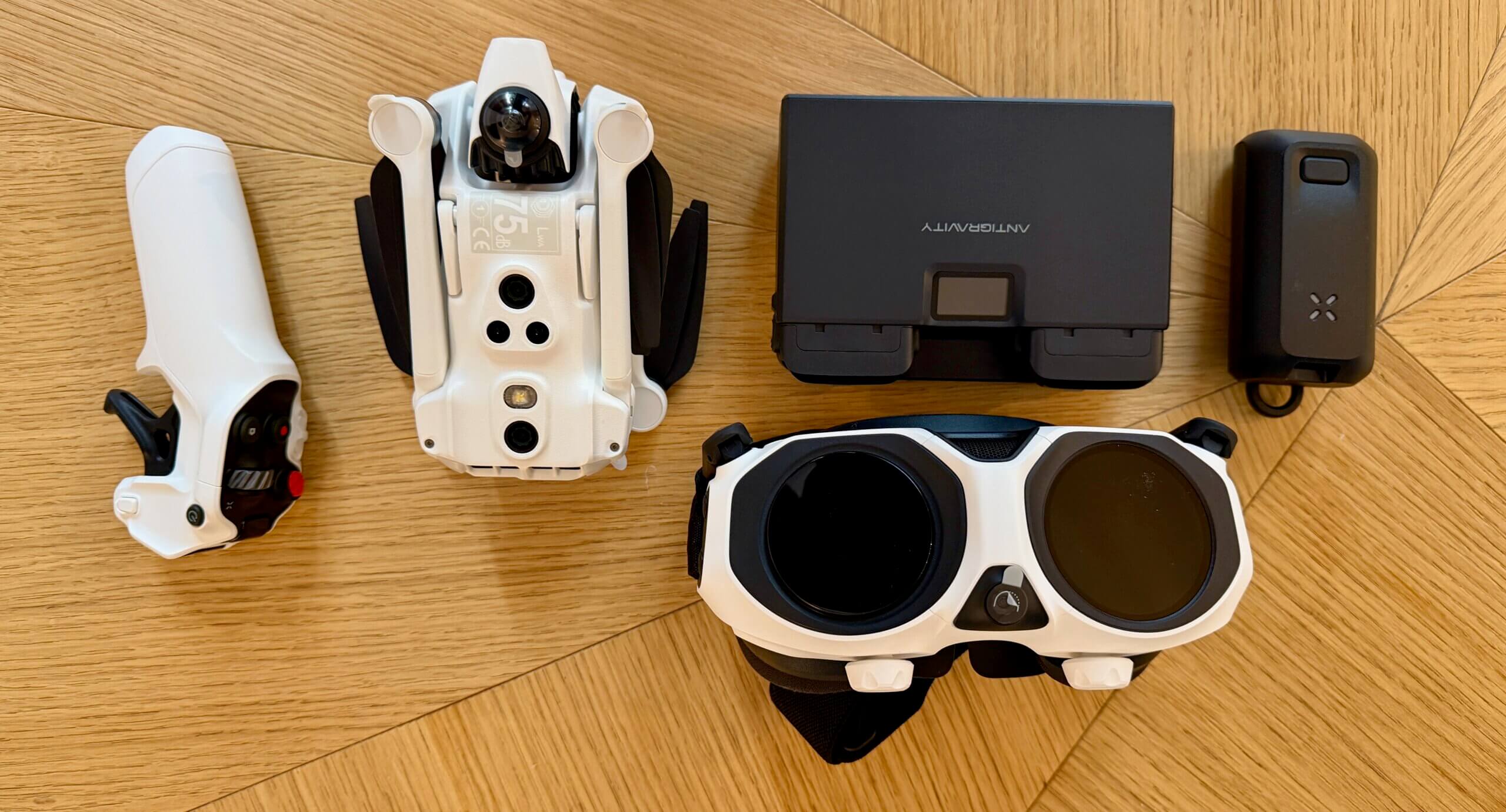
Operating the Antigravity A1 breaks away from traditional dual-stick radio controllers through the integration of dedicated vision goggles and a streamlined motion controller.
The accompanying vision goggles are lightweight and built with dual 4K micro-OLED displays supporting a 120Hz refresh rate. Operating with virtually zero noticeable latency, the system incorporates integrated head-tracking technology. Because the drone continuously records in a full 360-degree radius, the pilot’s perspective is not restricted to the forward-facing direction of the aircraft. Turning one’s head to the left immediately pans the visual feed to the left, while looking downward reveals the terrain passing directly underneath. This setup fosters an immersive sense of spatial awareness that fixed-camera platforms cannot replicate.
Flight maneuvers are managed via a single-handed motion controller. Pilots simply point the controller in the intended direction of travel and pull a trigger to accelerate. Tilting the wrist banks the aircraft, while raising the nose prompts a climb. This intuitive layout allows even novice users to navigate intricate environments within minutes of their first flight. However, for veteran FPV pilots who prefer the exact tactile feedback of manual acrobatic flight, the A1 also supports a traditional "Mode 2" stick controller setup.
Camera Performance and Reframing
Marketing materials for the Antigravity 360 prominently feature the specification of 8K resolution. In conventional cameras, an 8K designation packs every pixel into a standard 16:9 rectangular frame. In a 360-degree video ecosystem, those same pixels are distributed across the surface of an entire sphere. When a creator "reframes" that spherical capture into a standard flat video file for distribution, the final product represents a cropped portion of the total recorded environment.
Color science on the A1 shows marked improvements over previous generations of consumer 360 hardware. The device offers a "Vivid" image profile optimized for punchy, immediate social media sharing, alongside a 10-bit "Log" profile designed for professional color-grading suites where footage must be matched with cinema-grade cameras. Stabilization is handled by proprietary algorithms that effectively smooth out environmental turbulence, ensuring that footage recorded in winds up to 20 miles per hour remains steady.
Management of the high-resolution files is handled through the "Antigravity Studio" application. The software enables wireless footage downloads at speeds reaching up to 80 megabytes per second. Creators can reframe video files simply by moving their mobile device, utilizing the internal phone gyroscope to direct the virtual camera angle in real time. Additionally, an artificial intelligence tool known as "Auto-Frame" automatically identifies subjects within the footage and generates a dynamic cut to keep them centered, functioning effectively as an automated camera crew.
Battery Life and Flight Dynamics
Battery endurance remains a limiting factor for compact unmanned aerial vehicles. The standard intelligent flight battery for the A1 provides a theoretical maximum of 24 minutes of airborne time, though real-world conditions involving moderate wind and continuous recording typically yield closer to 19 or 20 minutes.
Despite the relatively brief flight duration, the efficiency of a 360-degree capture system alters the traditional workflow. Because pilots do not need to fly repeated passes to secure different angles of the same subject, a single flight can capture enough varied footage to match multiple flights with a conventional single-lens drone. For users requiring extended airtime, an optional heavy-duty battery pushes flight times to 39 minutes, though the added weight slightly reduces overall agility.
Aerodynamically, the A1 operates in the style of a "cinewhoop," prioritizing stability and predictable handling over aggressive racing performance. With a top speed of approximately 36 miles per hour, it is well-suited for tracking moving subjects like cyclists or automobiles, though it cannot compete with dedicated high-speed racing drones. In the event of a crash that leaves the aircraft inverted, a built-in recovery function utilizes the propellers to flip the drone back upright, allowing for immediate takeoff without requiring manual retrieval.
The Antigravity A1 effectively bridges the gap between conventional aerial cinematography and immersive virtual reality tools. By removing the technical stress of live framing and mechanical gimbal control, the system allows creators to direct their attention toward visual storytelling, marking a notable shift in how personal aerial media is captured and produced.