Reform UK, spearheaded by Nigel Farage and heavily driven by figures like deputy leader Richard Tice, has cemented itself as a prominent voice in modern British politics. Championing an aggressive populist platform centered on fierce opposition to immigration and a wholesale rejection of climate policies, the party has wielded significant influence despite holding only a handful of seats in Parliament and grappling with internal funding controversies. Until recently, this hard-right populist messaging propelled them to the forefront of national polling for well over a year.

Central to Reform UK’s political identity is its staunch rejection of mainstream climate science and net-zero targets. Tice, serving as the party’s energy spokesperson, has been a relentless critic of what he dismissively terms "net stupid zero." He has repeatedly downplayed human-caused global warming, baselessly blaming natural phenomena such as the sun and volcanoes, and vowed that a Reform government would completely dismantle the UK’s legally binding net-zero targets, expand fossil-fuel extraction, and terminate existing contracts for renewable energy. While Nigel Farage has historically maintained a slightly more tempered public posture on the subject, he has nevertheless echoed climate-sceptic talking points, frequently blaming net-zero policies for what he describes as the "deindustrialisation of Britain."

These positions rely heavily on long-standing, scientifically discredited narratives of delay and skepticism. They manifest clearly within Reform’s election manifestos, local government decisions, and the general rhetoric of its political base. In response to this persistent wave of skepticism, researchers and factcheckers have compiled and analyzed dozens of recurring arguments to set the record straight on climate science, renewable energy, and the mechanics of the net-zero transition.

Climate Science
The Intergovernmental Panel on Climate Change (IPCC), the global authority on climate science, states that it is unequivocal that human activity has warmed the planet primarily through the emission of greenhouse gases. Atmospheric concentrations of carbon dioxide have risen at rates unprecedented on centennial timescales in at least the past 800,000 years, and current levels are higher than they have been for at least two million years. Despite this overwhelming consensus, Reform UK leadership has consistently promoted misinformation. Tice has claimed there is no evidence linking anthropogenic CO2 to climate change, often citing non-peer-reviewed working papers from individual authors at Statistics Norway—a bureau that explicitly clarified the paper did not represent its official stance and which independent scientists criticized as containing standard climate-denial talking points.

Furthermore, leadership arguments frequently retreat to the observation that the Earth’s climate has always changed through natural cycles over millennia. While global temperatures are indeed approximately 1.4C hotter than pre-industrial levels—making the Earth hotter than at any point in the past 125,000 years—scientists agree that nearly 100% of this recent, rapid warming is driven by human emissions. Natural influences like El Niño events, volcanic eruptions, and solar output variations play only a minor role in the underlying long-term warming trend. Claims that human emissions represent only a tiny fraction of total annual global CO2 output ignore the fact that natural carbon flows into and out of land and oceans were historically in balance, a balance that human fossil-fuel emissions have fundamentally disrupted.

Additional claims suggesting that thousands of scientists disagree with the necessity of net-zero typically trace back to heavily discredited online petitions featuring very few actual climate scientists, alongside signatories who were deceased. Similarly, arguments asserting that reaching net-zero will make no difference to sea-level rise for centuries misinterpret the timeline of climate inertia; while some long-term changes are locked in, rapid emissions cuts drastically limit future sea-level escalation and effectively halt peak warming. Other talking points have attempted to weaponize adjustments made by scientific modeling groups regarding high-emission scenarios like RCP8.5, falsely framing them as an admission that the IPCC was fundamentally wrong about global warming risks, when in reality projected pathways still place the world on a trajectory toward dangerous levels of temperature increase.

Net-Zero Target
Reform UK’s opposition to the UK’s net-zero target is built upon assertions that the policy is economically destructive and carried out unilaterally by a minor global player. However, the UK is far from alone in its ambitions; approximately 140 countries representing nearly three-quarters of global emissions have established net-zero targets. While the UK’s annual emissions account for less than 1% of the global total, it remains the 22nd largest emitter and carries a significant historical responsibility for cumulative global warming, having emitted a large share of historical greenhouse gases.

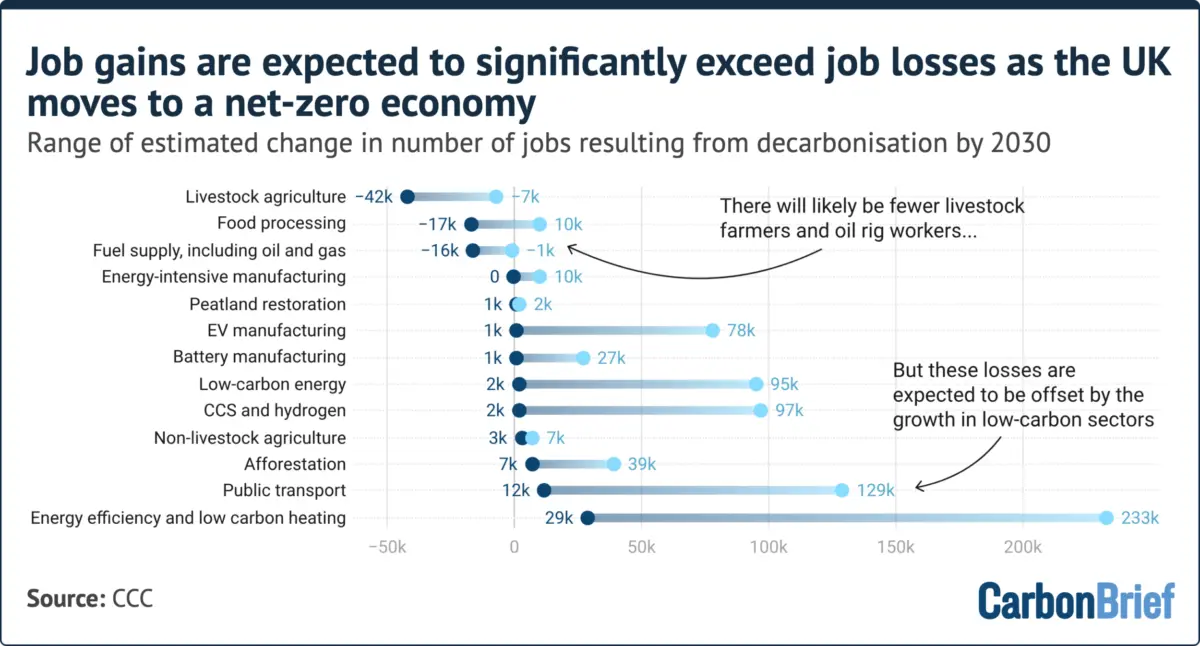
Economic arguments leveled against the policy—such as claims that net-zero is "killing the economy" or costing trillions of pounds in public funds—fly in the face of empirical data. Official economic bodies, including the Climate Change Committee and the Office for Budget Responsibility, indicate that the net cost of achieving net-zero is a small fraction of GDP and vastly cheaper than the catastrophic economic damages of unchecked climate change. Furthermore, independent economic analysis from groups like CBI Economics shows that the UK’s net-zero economy already generates billions in gross value added and supports hundreds of thousands of high-wage jobs. Employment data across sectors like coal, steel, and oil and gas demonstrate that long-term job declines in these industries began decades before net-zero legislation was enacted, driven by global market shifts rather than domestic climate policy.

Energy Costs
Energy affordability is a cornerstone of Reform UK’s political messaging, with leadership frequently arguing that renewable energy and green policies are the primary drivers of skyrocketing household and industrial bills. In reality, extensive energy research highlights that surging global gas prices—exacerbated by international conflicts and supply disruptions—have been the overwhelming driver of high electricity and domestic heating bills in recent years. Because the UK’s power grid remains heavily reliant on gas-fired generation to set wholesale electricity prices, consumers have been uniquely exposed to international fossil-fuel shocks.

Conversely, data consistently shows that renewable energy sources like wind and solar help insulate consumers by driving down wholesale prices during periods of peak fossil-fuel volatility. Claims that upgrading the electricity grid to accommodate a clean energy transition will cost trillions of pounds grossly exaggerate infrastructural estimates provided by national system operators, which emphasize that maintaining a fossil-fuel-based system would carry comparable or higher overall economic burdens when fuel costs are factored in. Furthermore, proposals by party leadership to underground all transmission cables or levy punitive windfall taxes on renewable energy generators are heavily criticized by engineering and economic experts, who note that undergrounding is several times more expensive than overhead lines and that retrospective taxes on clean energy would severely undermine vital private sector investment.

Oil and Gas
Reform UK frequently advocates for a revival of the UK’s domestic oil and gas sector through new North Sea drilling licenses and the introduction of fracking, arguing that increased fossil fuel supply will naturally lower prices much like it has in the United States. Energy experts and geological data point out that these comparisons are fundamentally flawed. The UK has already extracted approximately 90% of its economically recoverable North Sea oil and gas reserves, leaving the basin in a state of permanent geological decline that cannot be reversed by issuing new licenses.

In contrast, the United States benefits from vast, easily accessible shale formations and unique domestic market dynamics where natural gas is frequently an abundant byproduct of more valuable oil extraction. The UK’s historical production peak occurred decades ago, and its modest output exerts virtually no influence on globally traded commodity prices. Consequently, pursuing new drilling licenses or attempting to establish a domestic fracking industry—which faces widespread public opposition, strict regulatory hurdles, and limited geological viability—would fail to lower energy bills or restore the UK to a net exporter of energy.

Impacts and Adaptation
Rather than pursuing emissions reductions, Reform UK leadership frequently argues that the UK should focus solely on adapting to a changing climate, framing adaptation as a cheap and practical alternative to mitigation. Scientific assessments from the IPCC and the Climate Change Committee emphasize that adaptation and mitigation are not mutually exclusive alternatives; both are urgently required. There are hard limits to adaptation, and as global temperatures rise past critical thresholds, the severity of climate impacts will outpace the ability of nations to protect themselves through defensive measures alone.

The economic costs of climate inaction are already mounting across the UK. Severe weather events, prolonged droughts, and record-breaking summer heatwaves have cost the economy billions of dollars in agricultural losses, infrastructure strain, and healthcare disruptions. While comprehensive adaptation measures—such as expanding water storage, upgrading flood defenses, and improving heat resilience—are vital, they must be paired with aggressive global emission reductions to prevent catastrophic economic and societal damage in the decades ahead.

Clean Energy
Debates surrounding the deployment of clean energy technologies often feature claims regarding foreign ownership, safety, and land use. While a significant majority of the UK’s offshore wind capacity is owned by international companies, this reflects the privatised nature of the broader energy market, where foreign investors similarly hold large stakes in North Sea oil and gas infrastructure. Regardless of ownership, the physical generation of electricity from wind and solar farms directly lowers wholesale power prices and reduces the nation’s dependence on imported fossil fuels.

Concerns raised by political figures over the safety of green technologies—such as battery energy storage systems or the environmental impact of large solar installations—are similarly contradicted by empirical safety data and land-use analyses. Statistical evaluations consistently place wind, solar, and nuclear power among the safest methods of electricity generation in human history, boasting casualty rates orders of magnitude lower than fossil fuels. Furthermore, ground-mounted solar farms require a negligible fraction of the country’s total land area, pose no realistic threat to national food security, and are frequently integrated with agricultural practices through agrivoltaic systems.

As the UK navigates its long-term energy transition, the empirical consensus from scientific bodies, economic forecasters, and energy regulators underscores that a modernized, electrified economy powered by renewables remains the most viable path toward energy security, environmental sustainability, and long-term economic stability.