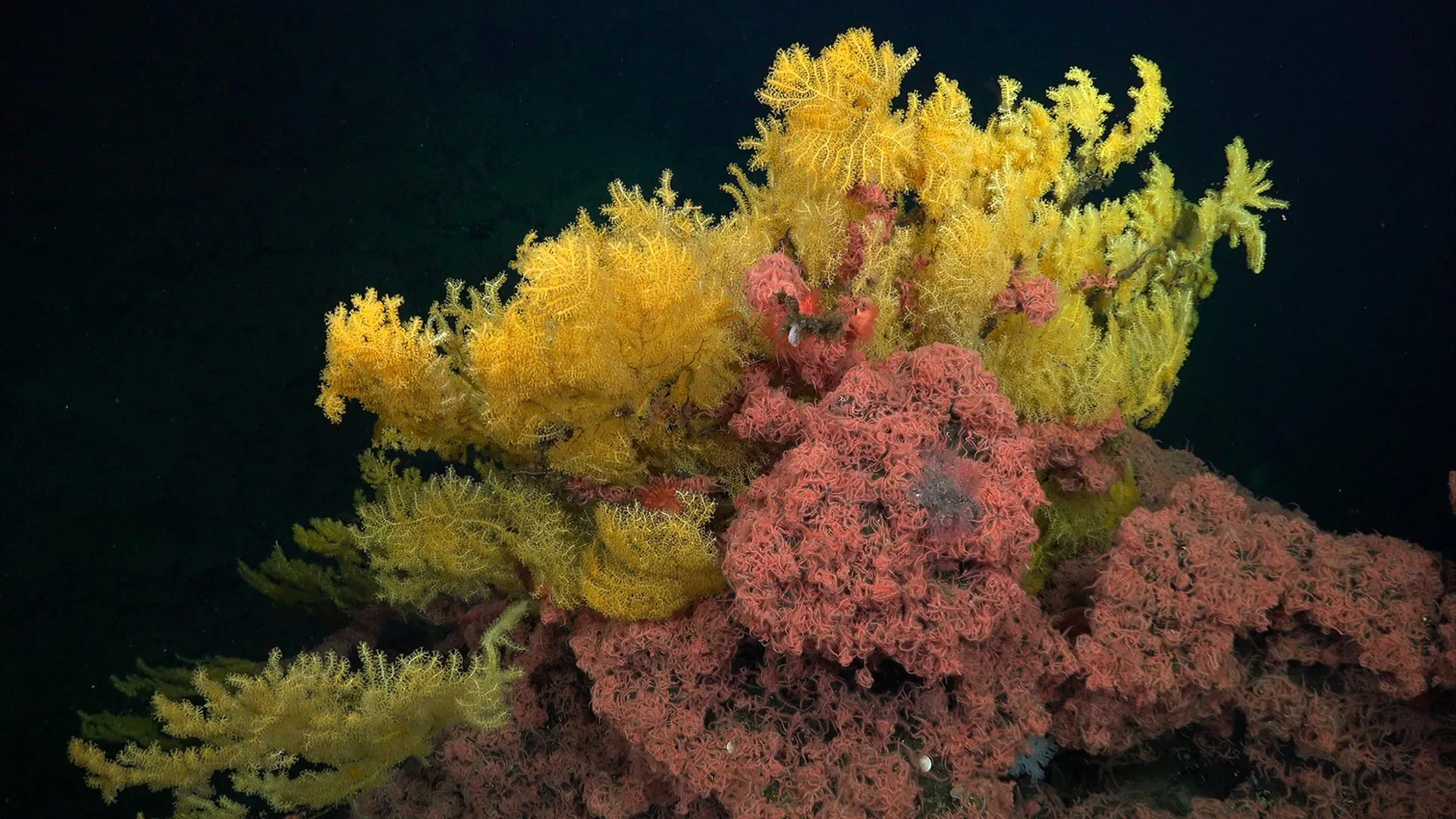
Deep beneath the surface of the Pacific Ocean, off the coast of Costa Rica, marine scientists surveying remote underwater mountains have made a remarkable discovery that is bridging the gap between cutting-edge marine biology and high fantasy. Researchers exploring the rugged slopes of deep-sea seamounts have identified a brand-new coral species that is so physically and genetically distinct from any known group that it required the creation of an entirely new scientific family to properly classify it.
The striking organism, characterized by a bright yellow hue and an intricate, branching, tree-like architecture, was found dwelling in the twilight zone of the ocean, specifically between 360 and 529 meters below the surface. The detailed findings of this deep-sea expedition have been officially published in the open-access scientific journal ZooKeys, shedding new light on the vast, largely uncharted biodiversity that thrives along the underwater ridges and tectonic margins of Central America.
Some colonies of this remarkable new coral grow to impressive heights, stretching more than a meter tall as they anchor themselves to the steep, rocky underwater terrain. The specimens that enabled this groundbreaking classification were meticulously collected using the advanced capabilities of SuBastian, a state-of-the-art remotely operated vehicle. These operations took place during a series of rigorous scientific expeditions conducted in 2019 and 2023. The missions were launched aboard the dedicated marine research vessels Falkor and Falkor (too), both of which are owned and operated by the prestigious Schmidt Ocean Institute. These targeted voyages focused heavily on exploring the clustered seamounts situated near Isla del Coco as well as the broader underwater Pacific margin belonging to Costa Rica.
A Golden Coral Among Fields of Stars
During the initial submersible dives, researchers noted that the newfound coral was particularly abundant on exposed rocky outcrops. In these areas, dense carpets of brittle stars blanketed nearly every available square inch of the substrate. Against this shimmering, star-like backdrop of echinoderms, the vibrant yellow branches of the coral appeared to emerge directly from the dark ocean floor, resembling glowing golden trees standing amidst a vast celestial field.
This ethereal underwater vista provided profound inspiration for the scientific nomenclature eventually chosen for the discovery. The newly established genus has been designated as Laurinque, a term derived directly from "Laurinquë," which translates to "golden tree" in Quenya. Quenya is one of the complex Elvish languages invented by renowned author J.R.R. Tolkien for his legendary mythologies, including The Lord of the Rings and The Silmarillion. The researchers selected this specific name to honor the coral’s brilliant yellow pigmentation and its majestic, arboreal growth form.
Complementing the genus, the species name chosen for the organism is elenya, which translates to "stellar" or "of the stars" in the same Elvish tongue. This designation directly acknowledges the dense, glittering populations of brittle stars that persistently swarm the immediate surroundings of the coral colonies. Together, the chosen genus and species names pay homage to what the participating researchers described as an almost mystical, Tolkien-esque landscape hidden away in the permanent darkness of the deep ocean floor.
DNA Reveals a New Coral Family
While discovering a visually striking organism is always a major milestone in marine biology, determining precisely where the creature fits within the complex evolutionary family tree of marine life proved to be a far more complicated puzzle than the scientists initially anticipated. When the research team first approached the classification process, they sequenced three standard genes that are commonly relied upon by taxonomists to accurately identify and categorize various types of corals.
However, instead of pointing cohesively toward a single established group or family, each of the three individual genes yielded completely conflicting signals, pointing toward entirely different and unrelated families. Because those preliminary molecular results were profoundly inconsistent, the team realized that standard identification methods would be insufficient to solve the mystery. To cut through the genetic confusion, the researchers turned to phylogenomics—an advanced methodological approach that allows scientists to compare hundreds of genes simultaneously rather than relying on just a few isolated markers.
This broad, high-resolution genetic analysis finally pierced through the ambiguity and clarified the true evolutionary position of the organism. The comprehensive data conclusively demonstrated that the species does not belong to any previously recognized coral family known to science. Instead, it represents a completely distinct and isolated evolutionary lineage. While phylogenetic analysis indicates it is most broadly related to the family Eunicellidae, its unique genetic markers and anatomical characteristics diverge deeply enough to justify the formal establishment of a brand-new family, which the researchers named Laurinqueidae. Alongside this major taxonomic elevation, the team also established the new genus Laurinque specifically to house this unique species.
Dr. Odalisca Breedy of the Universidad de Costa Rica, who served as the lead researcher on the scientific study, reflected on the lengthy and surprising journey of discovery. "I saw the octocoral garden for the first time in 2019 and I was impressed by the beauty of the landscape, which inspired, later the elvish name of the taxa," Dr. Breedy explained. "I thought the species could belong to a known family and genera, but after the preliminar morphological analysis I realised that it was something very different that I could not match with the known taxa."
She continued to credit the collaborative effort required to finally unlock the secret of the specimens, noting, "In 2023 we collected more samples and thanks to the exhaustive molecular analyses made by my colleagues, Cathy McFadden, Catalina Murillo and Andrea Quattrini, we were able to determine the taxonomic placement of the stunning species, in one of the most enigmatic sites."
Costa Rica’s Deep Sea Still Holds Surprises
Dr. Breedy led the intricate research initiative alongside an esteemed international team of scientific collaborators. Financial and logistical backing for the expeditions was generously provided by the Schmidt Ocean Institute, while additional funding for the analytical work was secured through a targeted research grant from the National Geographic Society.
This significant taxonomic find adds to a rapidly expanding catalog of previously undocumented marine species discovered during recent surveys of Costa Rica’s complex underwater mountain chains. It serves as a stark reminder of just how much of the deep ocean remains entirely unexplored and scientifically unmapped, even though deep-sea environments cover roughly two-thirds of the total surface area of our planet.
Ecologically, complex underwater habitats like the coral gardens discovered off Costa Rica are widely recognized by marine scientists as highly vulnerable marine ecosystems. Because of their intricate, three-dimensional physical structures, these coral formations provide essential shelter, feeding grounds, and breeding habitats for a vast array of other deep-sea organisms. Consequently, they function as vital epicenters of biodiversity in abyssal environments that humanity is only just beginning to observe, understand, and protect.