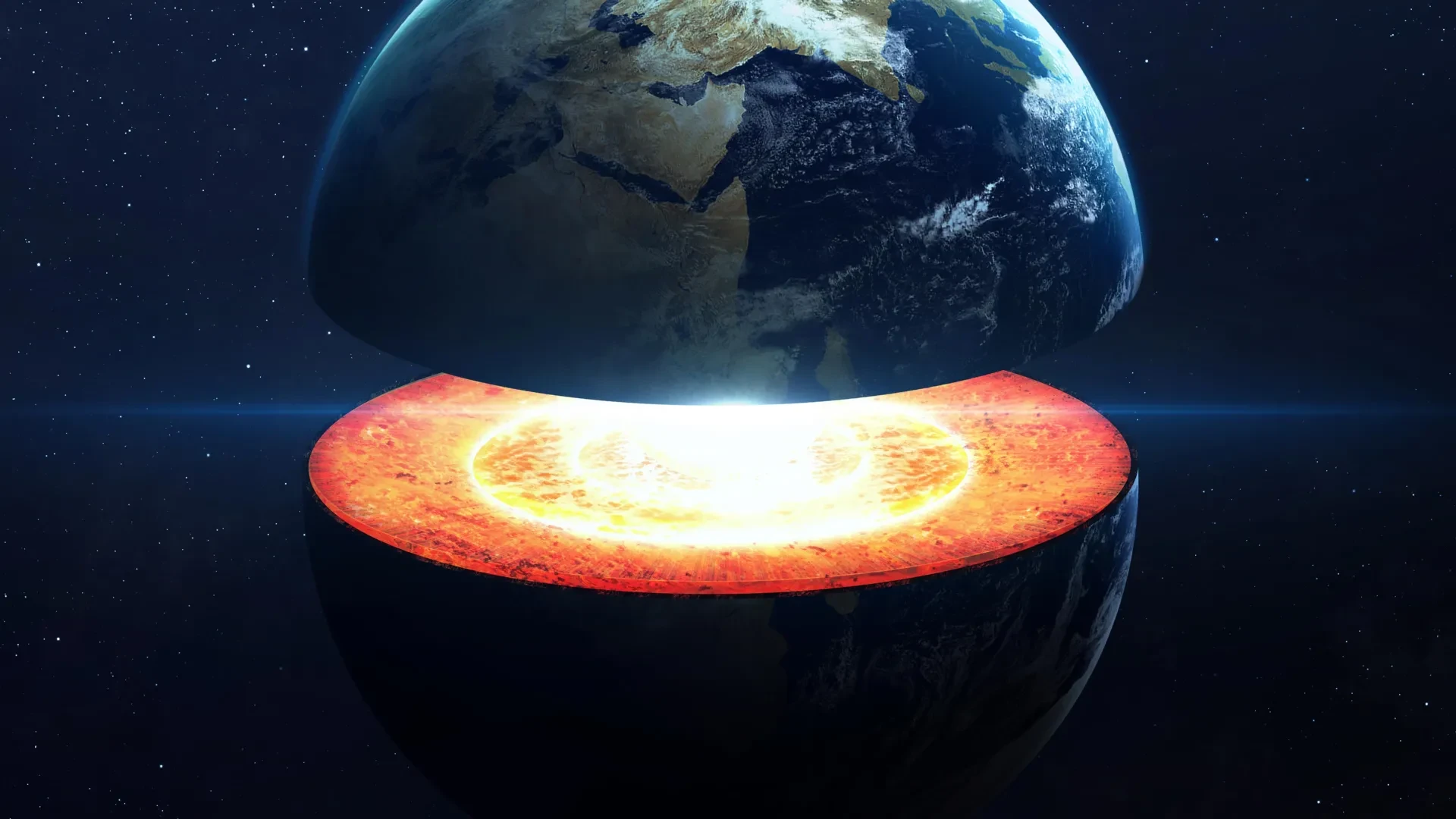
A remarkable geological specimen recovered from the rugged terrain of Papua New Guinea has upended conventional scientific understanding of the fiery depths beneath the Earth’s crust. Unearthing an unexpected temperature profile preserved within a single ancient rock, an international team of researchers has revealed thermal anomalies that directly challenge existing models of how tectonic plates descend into the planet’s interior.
The study, spearheaded by a dedicated research group at the University of Göttingen, centers on a unique rock that embarked on a hellish, subterranean journey more than 90 kilometers—approximately 56 miles—beneath the Earth’s surface roughly four million years ago. As this mineral traveler plunged into the mantle, it recorded a volatile thermal history. Rather than adhering to the smooth, predictable heating curves traditionally mapped out by geophysicists, the rock experienced surprisingly high temperatures at shallower depths before transitioning into an environment defined by a relatively cooler subduction profile.
The profound implications of this discovery reach far beyond the borders of Papua New Guinea, touching upon fundamental questions regarding how heat is distributed deep inside the Earth and how massive slabs of crust behave as they are relentlessly dragged downward. The groundbreaking findings were formally detailed in the scientific journal Nature Geoscience, drawing attention from geologists and seismologists worldwide who rely on thermal models to understand the inner workings of our dynamic planet.
A Strange Discovery Deep Beneath Earth’s Surface
To understand the magnitude of the Göttingen team’s discovery, one must look to the very framework of our planet’s geology. The Earth’s outer shell is not a single, unbroken layer; rather, it is fragmented into a mosaic of enormous tectonic plates that drift continuously across the softer, semi-fluid mantle below. These grinding plates are the architects of the planet’s surface, building mountain ranges where they collide and tearing continents apart where they pull away from one another.
When two tectonic plates converge, a dramatic and violent process often ensues. One plate, typically denser or older, is forced downward, sliding beneath its neighbor and plunging deep into the Earth’s interior. This monumental geological conveyor belt is known as subduction. Subduction zones are among the most dynamic and dangerous environments on Earth. They are intimately linked to the most powerful earthquakes ever recorded, capable of triggering devastating tsunamis, and they fuel the explosive volcanic arcs that ring regions like the Pacific Ocean’s notorious Ring of Fire.
Beyond their destructive potential, subduction zones act as the planet’s ultimate recycling plants. Over millions of years, they help regulate Earth’s climate by dragging surface materials—including carbon dioxide trapped in sediments and oceanic crust—deep down into the mantle, where these elements are eventually reprocessed and outgassed back into the atmosphere through volcanic activity.
The extreme pressures generated within these subduction trenches can radically alter the mineralogy of rocks, transforming ordinary basalt and other materials into a dense, crystalline rock known as eclogite, characterized by striking red and green hues. It was one such rock, originating from the geological complexity of Papua New Guinea, that caught the attention of the international research team. Utilizing a battery of sophisticated analytical techniques, the scientists peered into the microscopic architecture of the specimen to read its deep-earth diary.
Nested deep within the host minerals of the rock, researchers struck geological gold: tiny, microscopic crystals of coesite. Coesite is a specialized, ultra-high-pressure polymorph of silica—essentially quartz that has been crushed under unimaginable tectonic forces. This mineral can form exclusively under the extreme pressures found deep within the Earth’s upper mantle. As the rock underwent its metamorphic transformation, these fragile coesite crystals became securely trapped within other minerals, acting like natural time capsules that preserved pristine geochemical evidence of the hostile environment through which the rock had traveled.
By meticulously analyzing these microscopic clues, the research team was able to reconstruct the extraordinary trajectory of the rock. They determined that the specimen had been dragged down to a depth of at least 90 kilometers beneath the Earth’s surface. At this subterranean depth, it encountered blistering temperatures reaching approximately 800 degrees Celsius, or roughly 1,472 degrees Fahrenheit. Yet, as fascinating as this destination was, it was the rock’s earlier itinerary that provided the true shock to the scientific community.
An Unexpected Shift From Hot to Cold Subduction
As the geoscientists worked backward to reconstruct the complete temperature history of the Papua New Guinea rock, they uncovered a chronological puzzle that defied established geological dogma. According to their data, when the rock had descended to a depth of approximately 45 kilometers—about 28 miles underground—it had already heated up to a staggering 700 degrees Celsius, or 1,292 degrees Fahrenheit.
This realization exposed a striking thermal anomaly. At half of its maximum downward journey, the rock was already within a mere 100 degrees Celsius of its ultimate, deepest temperature, even though it still had another 45 kilometers of treacherous descent ahead of it.
This profile flew in the face of existing geophysical models. Traditional subduction zone models predict a much more gradual and linear distribution of heat, where rocks warm up steadily and proportionally as they sink deeper into the earth. Instead, this specimen appeared to have endured an anomalously hot thermal regime at relatively shallow depths before transitioning into an environment characterized by a comparatively cooler temperature progression farther down. Although the absolute temperature of the rock did continue to increase with depth, the rate of warming slowed down dramatically—far lower than what standard thermodynamic models would dictate for a descending slab.
Dr. Jan Schönig, a researcher at the Geoscience Center of the University of Göttingen, highlighted the counterintuitive nature of the findings. "Finding this change from hot to cold subduction was unexpected as this contradicts our current thermal models of subduction zones," Schönig explained, emphasizing how the unique mineralogy of the Papua New Guinea sample forced the team to rethink long-standing assumptions.
While geologists have occasionally recovered anomalous rocks that hinted at unexpectedly high temperatures in the past, this discovery marks a significant milestone. It is the first time researchers have successfully reconstructed such a sharp, definitive transition between entirely distinct thermal regimes as a single rock migrated downward from shallow crustal levels to profound mantle depths.
What Could Explain Earth’s Hidden Heat Mystery?
Confronted with a thermal history that breaks the rules of conventional geodynamics, the international research team set out to investigate the physical mechanisms that could account for this hidden heat anomaly. They have since put forward several plausible hypotheses to explain how a subducting slab could undergo such a sharp shift in temperature gradients.
One leading possibility centers on the intense mechanical friction and deformation occurring along plate boundaries. It is conceivable that tectonic plates generate substantially more heat at relatively shallow depths than scientists have historically estimated. As immense slabs grind against one another under the weight of overlying continents, the resulting shearing forces could produce localized bursts of intense frictional heating, artificially spiking the temperatures of rocks caught in the suture zone before they sink deeper into the cooler core of the subduction channel.
Another compelling explanation involves the evolutionary age and maturity of the subduction zone itself. It is possible that the specific subduction system in Papua New Guinea had simply not existed long enough, geologically speaking, to establish the stable, cooler thermal conditions predicted by steady-state models. A young subduction zone might retain residual heat from the surrounding mantle or the initial tectonic rearrangement, creating a hotter upper corridor through which sinking rocks must pass.
The researchers note that these two processes are not mutually exclusive. It is entirely likely that a combination of intense frictional shear heating and the youthful thermal maturity of the subduction zone worked in tandem to produce the rock’s unique and perplexing thermal signature.
Unraveling these complex temperature dynamics is far more than an academic exercise. Subduction zones are the engines driving some of the most powerful and destructive geological phenomena on our planet. By refining thermal models to account for these newly discovered heat patterns, scientists hope to gain a sharper lens through which to evaluate the mechanics of major earthquakes and the triggers behind violent volcanic eruptions.
Furthermore, a more precise understanding of subduction zone thermodynamics has profound implications for global geochemical cycles. In particular, the long-term carbon cycle—which acts as the Earth’s ultimate climate thermostat by cycling carbon between the atmosphere, oceans, and the deep mantle—relies heavily on the behavior of descending slabs.
By shedding light on how thermal conditions fluctuate as tectonic plates sink into the abyss, the Papua New Guinea discovery provides geoscientists with a vital new diagnostic tool. It opens up fresh pathways to investigate how subduction systems have operated over millions and even billions of years, offering a clearer picture of the relentless forces that continue to shape and reshape the Earth beneath our feet. The research was made possible through financial backing from the German Research Foundation.