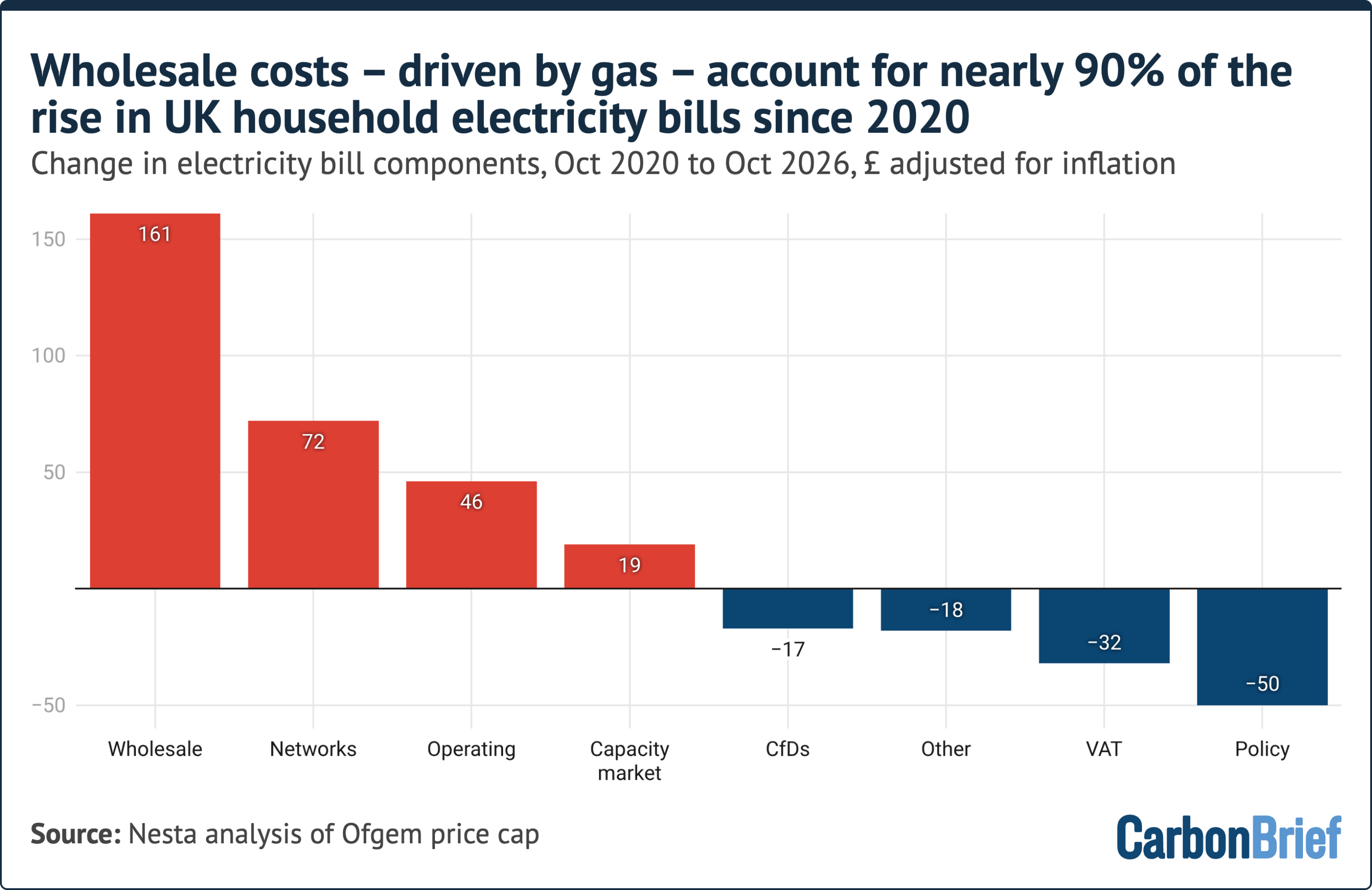
A dramatic surge in wholesale costs, driven almost entirely by expensive natural gas, is responsible for nearly 90 per cent of the rise in UK household electricity bills since 2020, according to comprehensive new data.
The figures, shared with analysts by the sustainable futures think tank Nesta, provide a clear empirical breakdown of what is actually inflating household energy expenses across the United Kingdom. According to the research, wholesale gas costs are also behind the vast majority—specifically 77 per cent—of the cumulative increase in direct household gas bills over the same period.
This new analysis challenges a persistent narrative that has steadily taken root across UK media outlets and political discourse. For years, critics of environmental policy have blamed the nation’s legally binding net-zero carbon targets for driving up household energy costs. However, Nesta’s findings firmly contradict this notion, demonstrating that renewable energy policies and green transitions are not the primary culprits behind high domestic bills.

Andrew Sissons, director for sustainable future at Nesta, points out that the net-zero strategy is actually playing a protective role. Far from inflating costs, the transition to green energy is helping to shelter Britain from the extreme financial impact of expensive international gas markets.
Sissons explains that rising global gas prices, rather than net-zero ambitions, have driven the vast majority of the recent surge in Britain’s energy bills. He highlights that the UK remains uniquely and particularly exposed to these market shocks because more than 80 per cent of British households are connected directly to gas mains. Furthermore, the wider electricity grid continues to rely too heavily on gas as the marginal unit that sets wholesale power prices.
This economic reality comes into sharper focus following recent government approvals. The UK administration recently granted official authorization for the development of the Jackdaw gas field in the North Sea, despite earlier official admissions that the project would do nothing to lower consumer energy prices.
Another Gas Crisis
The latest figures arrive on the heels of mounting international pressure on energy markets. Earlier, energy analysts reported that two-thirds of the rise in electricity bills since the onset of the 2022 global energy crisis could be directly attributed to high gas prices.
Now, amid ongoing conflict and instability in the Middle East, wholesale gas prices have climbed back to their highest levels since Russia’s invasion of Ukraine in 2022. Wholesale gas prices recently stood at approximately 220p per therm, which translates to roughly £75 per megawatt-hour. This exceeds the average wholesale gas price recorded throughout the volatile year of 2022, which sat at 210p per therm or £72 per megawatt-hour.
When accounting for inflation, a typical UK annual household electricity bill rose by £180 by the final quarter of the year, relative to the baseline period in the fourth quarter of 2020. Nesta’s analysis reveals that a striking 90 per cent of that increase—amounting to £161—is directly tied to wholesale costs dictated by the price of gas.
In stark contrast to widespread public perceptions, renewable energy mechanisms are actually working to suppress bills. Contracts for Difference (CfDs), which support low-carbon electricity generation, are currently shaving £17 off electricity bills under the prevailing price cap.
Additionally, the government has actively reduced policy costs for electricity by shifting 75 per cent of legacy renewable support schemes onto general taxation, formally ending the Energy Company Obligation efficiency scheme, and temporarily removing value-added tax on energy supplies.
Network costs have added £72 to typical household bills since 2020. The lion’s share of this network increase—some £46—is attributable to essential capital investments in the high-voltage electricity transmission network, often described as the motorways of the national power grid.
By contrast, only £21 of the rise in network costs relates to balancing the physical system. This includes constraint payments made to wind farm operators to temporarily power down turbines, alongside the simultaneous cost of firing up gas-fired power plants when local grid capacity proves insufficient.
Although wind constraint payments frequently command extensive coverage across national newspapers and broadcast media, total system balancing costs make up a very minor component of household expenditures. In total, balancing costs account for just £35, or roughly 4 per cent, of a typical £858 annual household electricity bill.

Energy supplier operating costs have also risen, adding £46 to bills since 2020. While underlying regulatory figures do not break down these operational increases in granular detail, analysts believe the rise is largely driven by the growing burden of household energy debt across the consumer base. Meanwhile, supplier profit margins remain strictly capped at 2.5 per cent of overall bills by regulatory oversight.
Breaking the Link
One of the most notable trends identified in the analysis is that household electricity prices have climbed far less rapidly than direct gas bills since the onset of the Middle Eastern conflicts. Higher levels of clean-energy generation are gradually helping to break the direct link between the two energy vectors.
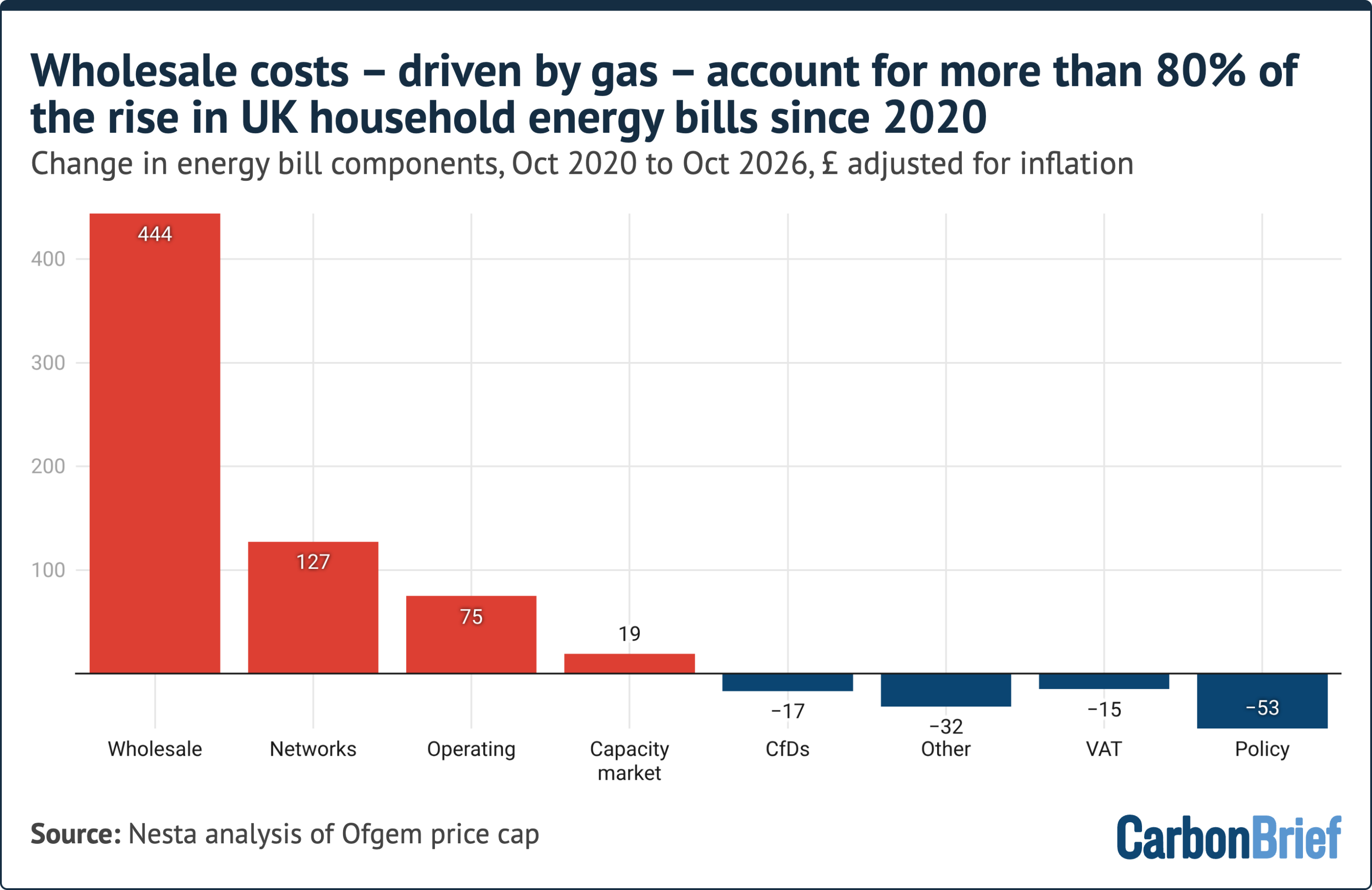
Since 2020, household gas bills have increased by £368 in real terms. Nesta’s breakdown shows that 77 per cent of this increase—or £283—is driven strictly by wholesale gas costs.
When combining both electricity and gas, total dual-fuel bills for a typical household have risen from an annual average of £1,175 in October 2020 to £1,723 in October, representing an overall increase of 47 per cent. Wholesale costs driven by high gas prices account for £444, or 81 per cent, of this total real-terms increase.
Meanwhile, the real-terms rise of £127 in network costs includes £72 for electricity transmission, distribution, and balancing, alongside £55 dedicated to maintaining and upgrading the gas distribution grid. According to industry bodies like the Energy Networks Association, up to 80 per cent of all investments in electricity grids are strictly required to maintain existing, aging assets, with only the remainder directed toward the physical expansion needed for net-zero goals.
Government social and environmental policy costs have followed a downward trajectory. In October 2020, these policies accounted for £183, or 16 per cent, of a typical dual-fuel bill. By the time of the autumn price cap, that figure had dropped significantly to £114, representing just 7 per cent of the total bill.
Wholesale costs now comprise the largest share of the current price cap at £757, or 44 per cent. Network costs represent the second-largest component at £417, or 24 per cent, followed closely by supplier operating costs at £291, or 17 per cent.
Sissons emphasizes that while modernizing and upgrading the national grid involves significant investment, those price tags are completely dwarfed by the financial volatility unleashed by rising international gas prices.
He notes that the country’s expanded renewable power generation and CfD supports have allowed electricity bills to begin decoupling from soaring gas prices during recent geopolitical crises.
Moving forward, Sissons argues that addressing the root cause of high energy costs requires encouraging households to transition toward clean electricity, electric vehicles, and heat pumps, moving away from fossil-fuel cars and gas boilers. By intentionally growing domestic electricity demand, the government can distribute infrastructure upgrade costs more widely across a larger consumer base. This strategy, experts suggest, offers Britain its most viable path to insulating winter energy bills from global geopolitical turmoil.
As policymakers prepare for the upcoming national budget, media reports suggest the chancellor is considering targeted interventions to help vulnerable households and businesses navigate ongoing financial pressures. With wholesale gas prices remaining stubbornly high, energy market observers warn that household bills could face another sharp upward adjustment under upcoming price caps.