Methane remains a formidable force in the global climate equation. As the second-largest contributor to global warming trailing only carbon dioxide, this potent greenhouse gas traps heat within the atmosphere with striking efficiency. While CO2 lingers for centuries, anchoring long-term climate disruption, methane operates on a vastly different timeline. Its lifespan is remarkably short, fading from the atmosphere after just a few decades.
This distinct temporal profile makes curbing methane emissions—which stem primarily from agriculture, fossil fuel operations, and waste management—one of the most powerful and immediate levers humanity possesses for limiting near-term global warming. Yet, despite its critical role, current international climate strategies and integrated assessment models frequently overlook methane as an independent variable. Instead, policies often focus exclusively on carbon dioxide or combine all greenhouse gases into a single, homogenized metric known as "CO2 equivalent."
A new study published in Communications Earth & Environment argues that this blanket approach obscures both the unique challenges and the immense opportunities tied to methane’s high warming potential and short atmospheric lifetime. Led by an international team of researchers, the study offers a radically different perspective: "decoupling" CO2 and methane reductions. By taking absolute global warming limits as the starting point, the researchers demonstrate how policymakers can determine the exact level of methane cuts required to keep planetary heating in check.
The findings deliver a stark warning. Even under the most ambitious existing national net-zero targets, a failure to aggressively reduce methane emissions will push peak global warming beyond 1.85 degrees Celsius above pre-industrial levels. To successfully limit peak warming to well below 2 degrees Celsius, net-zero carbon dioxide targets must be actively and stringently complemented by targeted methane reduction strategies.
The Flaws of the "CO2 Equivalent" Metric
To understand why traditional climate modeling often falls short, one must examine how greenhouse gases are measured and compared. Converting emissions of methane and other gases into CO2-equivalent emissions is a standard practice designed to create a single, manageable number. This practice allows scientists and policymakers to compare different gases, evaluate various mitigation options, and design unified climate targets.
However, the conversion process is fraught with complications. Asking how much methane corresponds to one tonne of CO2 is conceptually similar to asking how many portions of spaghetti equal a chicken. While meals can be compared according to their calorie counts, protein content, or financial cost—making each metric convenient for a specific purpose—no amount of spaghetti is genuinely the same as a chicken.
The same principle applies to atmospheric emissions. Because methane and carbon dioxide possess drastically different atmospheric lifetimes and radiative forcing properties, any conversion metric is valid only for a narrowly chosen time horizon and a specific baseline. Depending on the underlying assumptions baked into these calculations, methane mitigation can either appear as an urgent, immediate priority or be framed as almost unnecessary.
Scientists currently rely on a variety of metrics to convert greenhouse gases—including methane, nitrous oxide, and hydrofluorocarbons—into CO2 equivalents. Integrated assessment models (IAMs) then use these conversions to generate future emissions scenarios. Because these models combine CO2 and methane emissions into a single trajectory, the independent impact of methane emission cuts is difficult to isolate in existing forecasts.
Furthermore, IAM-generated scenarios are typically driven by cost optimization, assuming that mitigation decisions follow the most economically efficient path. Combinations of CO2 and methane emission pathways that deviate from pure cost-effectiveness are entirely unrepresented, even though real-world climate policy is complex, fragmented, and rarely cost-optimal. Consequently, only a handful of countries—notably Japan, Mexico, and South Korea—have formally specified standalone methane mitigation targets within their broader climate frameworks.
A Fresh Approach to Climate Modeling
To bypass the limitations of the CO2-equivalent framework, the new study treats carbon dioxide and methane emissions as entirely independent entities. Rather than selecting a single conversion metric, the researchers suggest that governments and organizations establish a definitive limit on peak global warming first. From there, working backward from their existing net-zero targets, they can determine the minimum compatible methane reduction target required to stay within that warming boundary.
Because companies and nations worldwide have adopted varying net-zero frameworks—some focusing exclusively on CO2 while others encompass all greenhouse gases—the research investigates necessary methane reductions for both types of goals. The analysis simulates scenarios where entities deliver steady, linear emissions reductions on a direct path to net-zero.
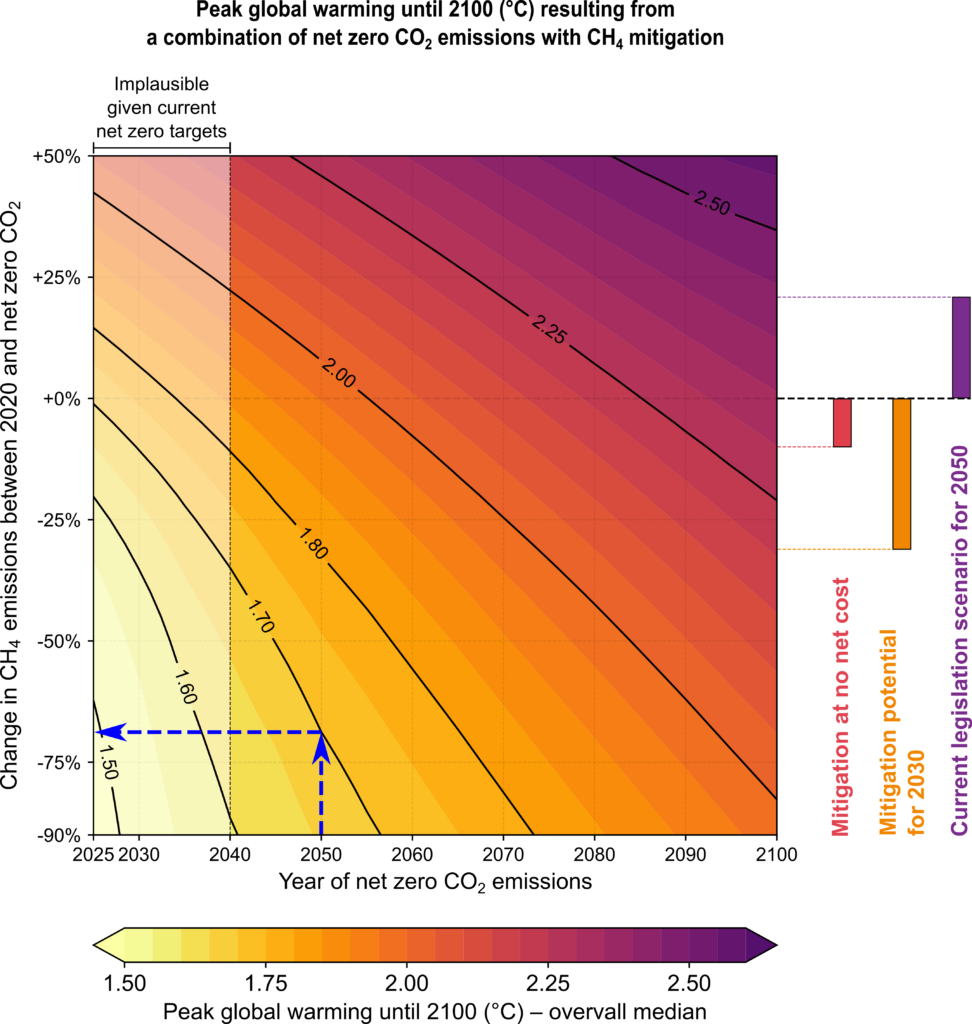
Using a streamlined climate model, the researchers systematically combined various methane and greenhouse gas mitigation pathways starting in 2025, calculating the resulting peak warming for each combination. The data reveals a clear relationship: peak global warming depends heavily on both the target year for achieving net-zero CO2 and the percentage reduction in global methane achieved along the way.

For instance, to limit peak warming to 1.7 degrees Celsius under a scenario where global CO2 reaches net-zero by 2050, methane emissions must fall by at least 69 percent relative to 2020 levels. If an organization or country has adopted a broader 2050 net-zero target that covers all greenhouse gases rather than CO2 alone, methane emissions must still drop by 63 percent.
In stark contrast, under current global policies, methane emissions are projected to increase by approximately 20 percent by 2050 compared to 2020. The study finds that this business-as-usual pathway would guarantee peak warming exceeding 2 degrees Celsius by 2050, even if global carbon dioxide emissions successfully reach net-zero by that same deadline.
The research also demonstrates that if methane emissions remain stagnant at 2020 levels and net-zero CO2 is delayed until 2040 or later, global warming will surpass 1.85 degrees Celsius. This level of heating significantly exceeds what scientific consensus considers consistent with the Paris Agreement’s ambition to hold temperature increases to "well below" 2 degrees Celsius.
Conversely, cutting methane emissions by roughly one-third—aligning with the 2030 targets established under the Global Methane Pledge—could reduce peak global warming by 0.15 degrees Celsius. Notably, one-third of that cooling effect (0.05 degrees Celsius) could be achieved through interventions that involve no net financial cost whatsoever, such as repairing leaky fossil fuel infrastructure and capturing fugitive emissions.

Reassessing the Remaining Carbon Budget
These findings carry profound implications for the global carbon budget—the total amount of cumulative CO2 emissions that can be released while still remaining below a specific global warming threshold.
The landmark 2021 climate science report from the Intergovernmental Panel on Climate Change (IPCC), alongside a 2023 study published in Nature, estimated that by 2025, the remaining carbon budget for holding warming to 2 degrees Celsius would be approximately 1,000 to 1,150 billion tonnes of CO2. However, the new study points out that these foundational estimates are predicated on the unstated assumption that methane emissions will naturally decline by 27 to 35 percent by 2050 relative to 2020.
Under alternative frameworks such as the GWP* metric, where methane emissions are adjusted solely to maintain "no additional warming," the remaining carbon budget shrinks dramatically. Under this constraint, the best estimate for a 2-degree carbon budget contracts by roughly 30 percent, dropping to approximately 750 billion tonnes of CO2.
Most alarming is the study’s conclusion regarding stricter temperature targets. If future methane emissions are not cut at all, the researchers suggest that the remaining carbon budget for limiting global warming to 1.7 degrees Celsius has effectively already been exhausted.

Ultimately, the analysis underscores that managing peak global warming is not solely a carbon dioxide problem. By demonstrating how methane-specific targets can refine and strengthen existing net-zero commitments, the research highlights that complementing decarbonization efforts with stringent, deliberate methane cuts is an indispensable requirement for keeping planetary heating within safe boundaries.