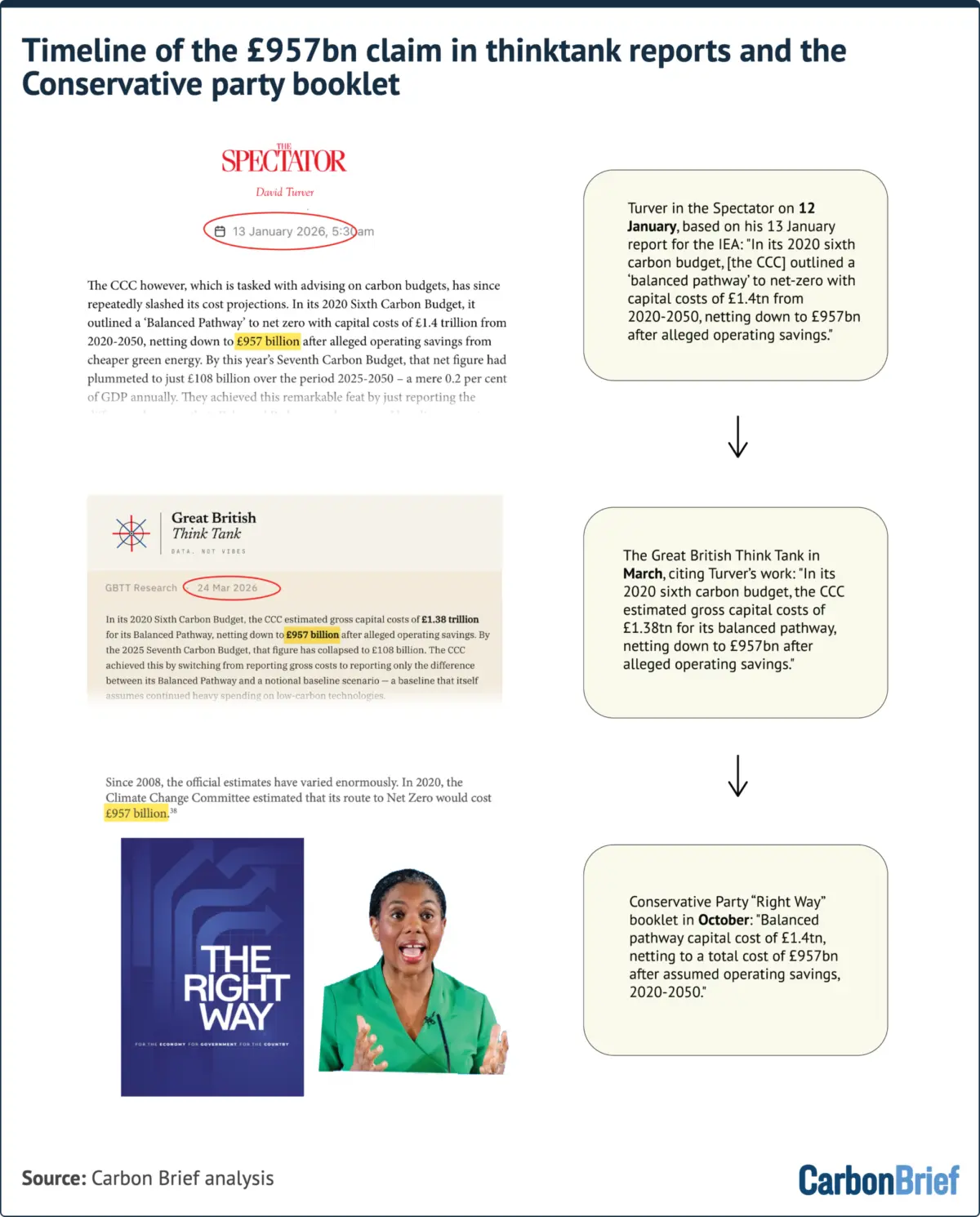
A recent policy booklet published by the UK’s opposition Conservative Party features a prominent financial figure regarding the "cost of net-zero" that appears to have been mistakenly doubled due to a foundational spreadsheet error.
The policy document, titled "The Right Way" and framed as a "common sense" guide for the party, argues that what citizens ultimately desire is a government competent enough to solve the problems for which it takes responsibility. Within its pages, a specific section asserts that sophisticated modeling should never serve as a substitute for grounded political judgment. As part of this argument, the document disparages various external estimates regarding the true financial cost of achieving the UK’s legally binding net-zero carbon emissions target.
However, in making its case, the Conservative document incorrectly claims that the government’s official independent adviser, the Climate Change Committee (CCC), previously estimated the total cost of reaching net-zero to be close to £1 trillion. Specifically, the booklet states: "In 2020, the CCC estimated that its route to net-zero would cost £957bn."
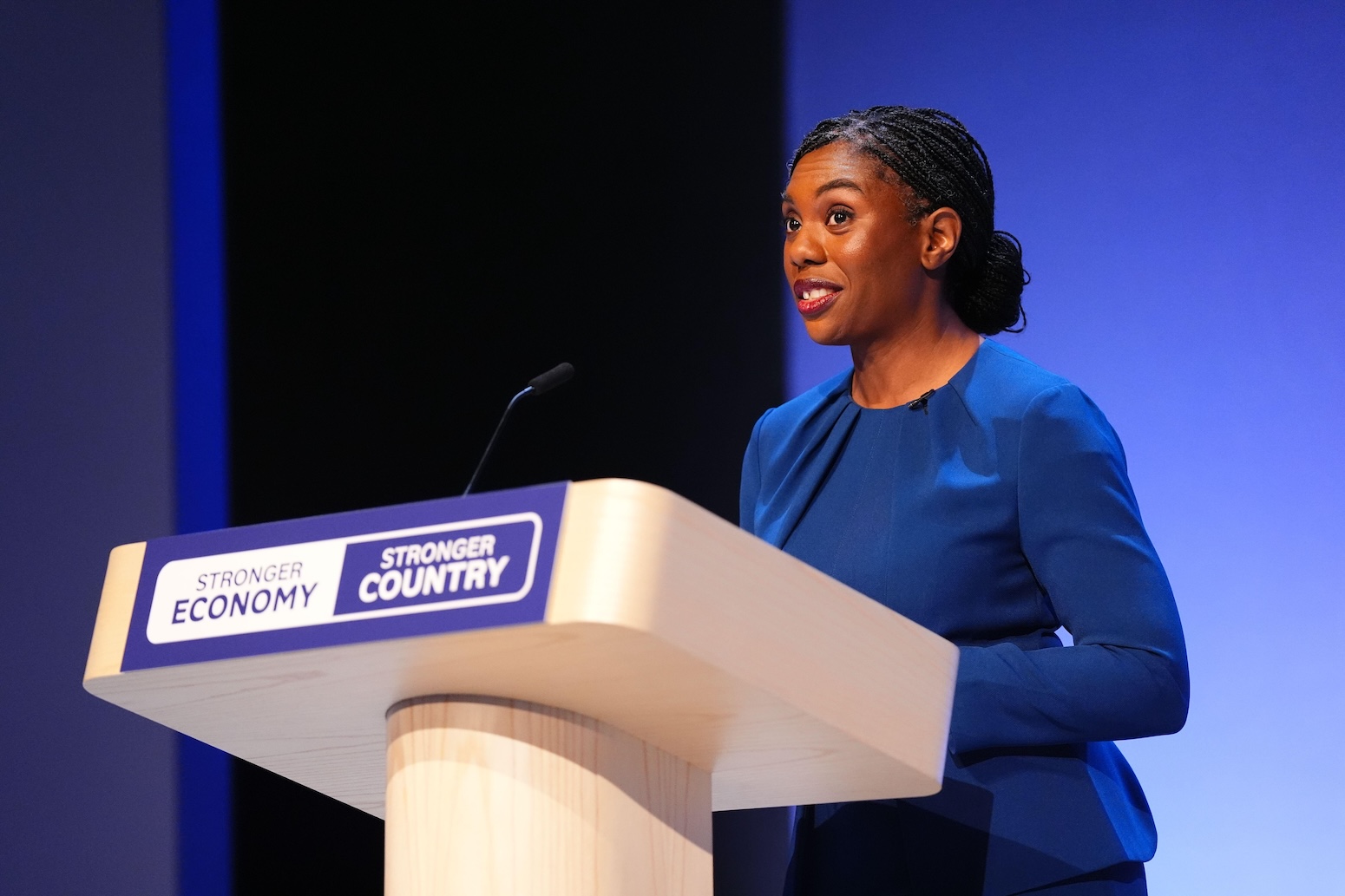
In reality, the CCC’s official 2020 estimate was precisely half that amount—totaling £478bn. Furthermore, the committee revised its figures downward last year, publishing a reduced net cost estimate of £108bn, a decrease largely driven by the rapidly falling costs associated with electric vehicles and advancing green technologies.
Tracing the Spreadsheet Error
The erroneous £957bn figure cited by the Conservative Party appears to originate from an accidental double-counting mistake in an earlier third-party report that drew data directly from a public spreadsheet published by the CCC in December 2020.
The spreadsheet in question was designed to accompany the CCC’s landmark Sixth Carbon Budget. It contains a detailed table outlining the additional capital investments required to build a net-zero economy over a 30-year span from 2020 to 2050. These projected capital expenditures—referred to as CAPEX—range from expanding low-carbon electricity generation capacity to installing domestic heat pumps and scaling up the electric vehicle market.
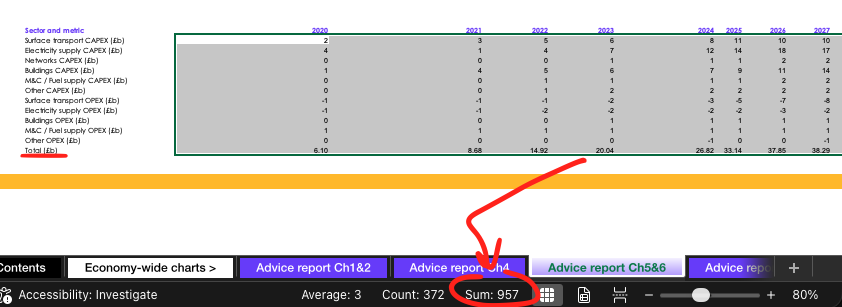
When calculated across the entire three-decade period, these additional capital investments add up to roughly £1.38tn. However, the document also accounts for operational savings—referred to as OPEX—which are projected to reach £0.90tn over the same timeframe. When these operational savings are subtracted from the required capital investments, the combined net figure across the 2020 to 2050 period amounts to the actual CCC total of £478bn.
The confusion arose because the CCC’s 2020 spreadsheet included not only the individual annual sectoral CAPEX and OPEX figures, but also an extra row providing combined annual totals. It appears that an analyst reviewing the data inadvertently added all of these numbers together without realizing that the annual totals were already embedded in the sheet, thereby counting both costs and savings twice.
This double-counted calculation yielded the exact £957bn figure that eventually found its way into the Conservative Party’s official policy booklet.
At the time of its original publication in late 2020, the CCC emphasized that the genuine net cost of £478bn amounted to less than 1% of the United Kingdom’s total Gross Domestic Product over the 30-year timeline. The committee also pointed out that while the initial capital investment required would be substantial, it would ultimately generate massive operational savings through reduced fossil-fuel imports and could even boost overall GDP by approximately 2% through green growth and innovation.
Subsequent updates from the advisory body have only reinforced these economic projections. In 2025, the CCC updated its investment cost and operating savings estimates to £670bn and £562bn respectively, leaving a revised net total of £108bn between 2025 and 2050—representing less than 0.2% of GDP. Earlier this year, the committee further noted that achieving net-zero emissions would ultimately cost less than enduring a single major fossil-fuel price shock, while delivering broader national benefits valued at £110bn per year.
The Paper Trail of a Mistaken Figure
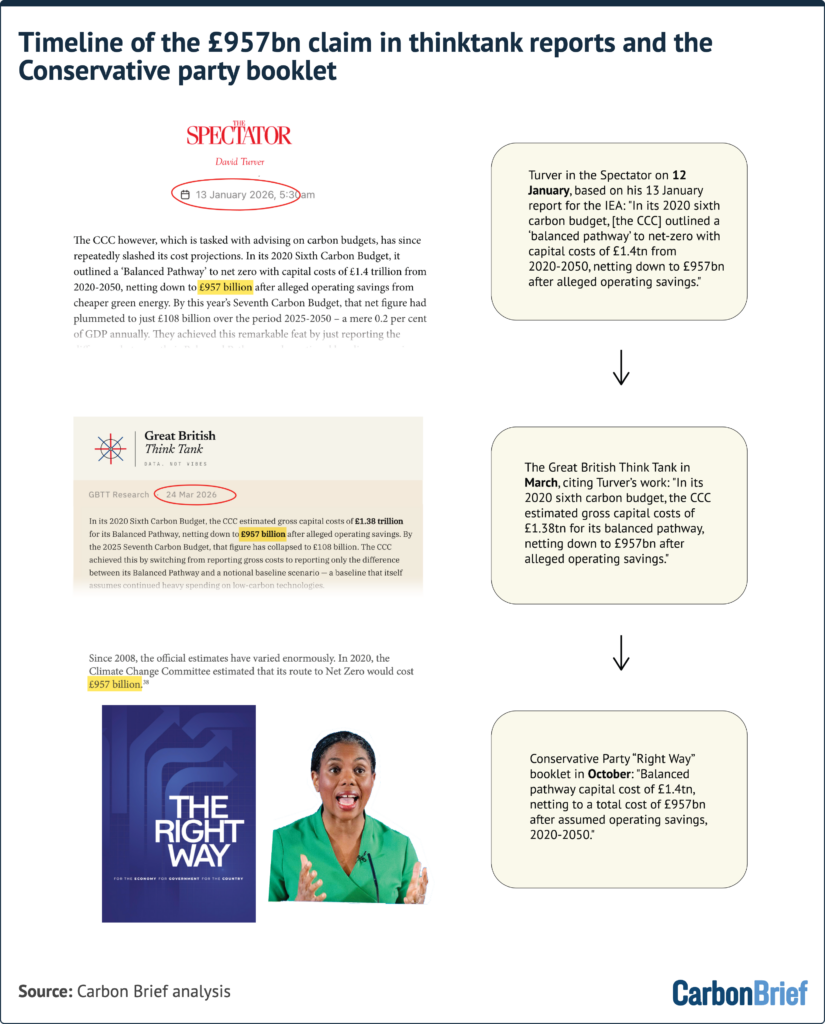
While the Conservative Party’s policy document formally references the CCC’s 2020 advice on the sixth carbon budget as its source, the actual lineage of the £957bn figure can be traced back through a series of recent think-tank publications and online commentary.
The earliest recorded online appearance of the £957bn figure identified by researchers at Carbon Brief dates back to a January 2026 article published by The Spectator. Authored by retired engineer and self-described "accidental energy analyst" David Turver, the piece examined the projected expenses of the government’s climate targets.
Just one day after that article appeared, Turver repeated the mistaken figure in a formal report published by the free-market Institute of Economic Affairs (IEA). That report explicitly cited figure 5.3 from the CCC’s 2020 supporting information charts and data. However, as independent reviews of the underlying spreadsheet demonstrate, the data supporting figure 5.3 totals only £478bn—exactly half of the amount cited in Turver’s paper.
The propagation of the figure did not stop with the IEA report. In March 2026, the erroneous £957bn statistic was adopted and republished by the Great British Think Tank, an organization whose public branding promotes the motto "data, not vibes" and insists that every figure it publishes is rigorously sourced from official public bodies.

By October 2026, the inflated statistic had completed its journey into mainstream political discourse, being formally incorporated into the Conservative Party’s "Right Way" policy booklet. Analysts note that this trajectory highlights the risks of secondary policy research relying on unverified calculations derived from complex public data models without cross-referencing primary institutional conclusions.