More than 40% of children under the age of 10 around the world are already enduring at least 20 additional "heat-stress days" every year as a direct consequence of human-caused climate change. This striking finding comes from a major new attribution study published in the journal Science Advances, which combines sophisticated climate models with granular demographic data to pinpoint precisely which age groups and geographic regions face the heaviest burdens of hot, humid weather.
The research reveals that children up to the age of nine are currently experiencing more additional heat-stress days globally than any other demographic cohort. Furthermore, the analysis warns that as global temperatures continue to rise, children will remain disproportionately vulnerable to extreme heat compared to older generations. Regions experiencing the most severe childhood exposure to dangerous levels of humid heat include south Asia, southeast Asia, and west Africa. Experts note that this heightened exposure is largely driven by a combination of rapidly growing populations and high proportions of young children living in these low-latitude zones.
Lead author Rosa Pietroiusti, a PhD student at the Vrije Universiteit Brussel, emphasizes that these empirical findings carry profound implications for ongoing global discussions surrounding climate justice. She points out that the children living in developing nations who are bearing the brunt of these escalating heat burdens are precisely those who have contributed the least to historical greenhouse gas emissions.

Understanding Humid Heat
High temperatures pose severe risks to human health, a reality underscored by recent historical events. For instance, the blistering heatwaves that swept across Europe during the summer months have been linked by researchers to tens of thousands of excess deaths. This recent trauma builds upon landmark scientific assessments from recent years, including a prominent 2021 study warning that children born in the 21st century will face unprecedented exposure to weather extremes over their lifetimes compared to their parents and grandparents.
Subsequent research conducted by the same scientific team demonstrated that more than half of all children born in 2020—representing roughly 62 million people—will experience unprecedented lifetime exposure to severe heatwaves, even under optimistic scenarios where global warming is successfully capped at 1.5 degrees Celsius. This latest research extends those findings by proving that younger populations are already confronting greater exposure to dangerous humid heat than adults under current warming conditions.
Extreme heat becomes uniquely hazardous when paired with high atmospheric humidity. Under normal circumstances, the human body regulates its internal temperature by producing sweat, which cools the skin as it evaporates. However, as humidity levels rise, the air becomes saturated, rendering sweat evaporation far less effective and trapping heat within the body.
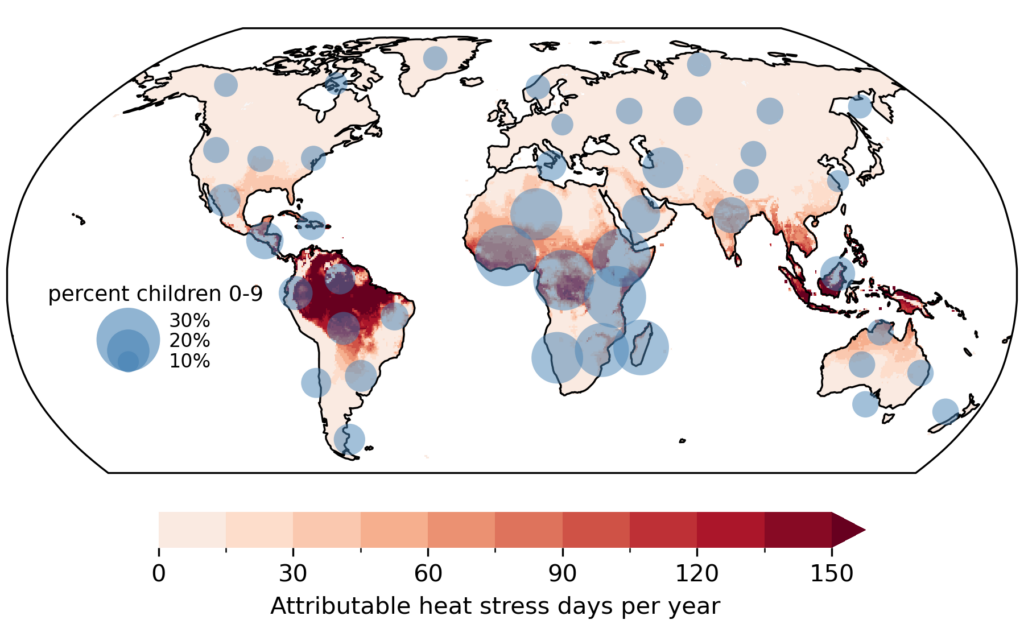
To quantify this phenomenon, the research team utilized the indoor wet-bulb globe temperature—a comprehensive metric that incorporates both ambient temperature and humidity. The study defines a "heat-stress day" as any 24-hour period where the wet-bulb globe temperature exceeds 28 degrees Celsius, the universally recognized threshold for moderate heat stress.
By employing advanced climate models, the researchers simulated global temperature patterns under present-day conditions, anchoring their baseline to the climate of 2023, during which human activity had already driven approximately 1.3 degrees Celsius of global warming. They calculated the average annual number of heat-stress days recorded in every country and contrasted these figures against simulated pre-industrial climate baselines devoid of human-caused warming. By comparing the two datasets, the authors isolated the exact number of "extra" or attributable heat-stress days driven directly by anthropogenic climate change.
The results show that low-latitude countries situated in the tropics record the highest frequency of these extra heat-stress days. For example, individuals residing in Côte d’Ivoire currently endure an average of 112 heat-stress days annually, with roughly half of those days directly attributable to human-driven climate change. By contrast, a country like Germany registers an average of just 0.1 heat-stress days per year under current climatic conditions, though nearly all of that minimal figure is linked to global warming.
Pietroiusti explains that these lower European figures reflect the study’s precise parameters. The research concentrates strictly on extreme humid heat at levels rarely experienced across Europe. Furthermore, due to the resolution limitations of the global climate data, the models do not capture local urban heat island effects, which can significantly intensify local heat stress in dense metropolitan areas and create disparities with what residents actually feel on the ground.
Inequality and Vulnerability
Extreme heat impacts populations unevenly, with children, adults over the age of 65, and individuals with pre-existing medical conditions or physical disabilities facing the greatest physiological risks because their bodies struggle more effectively to regulate core temperatures.
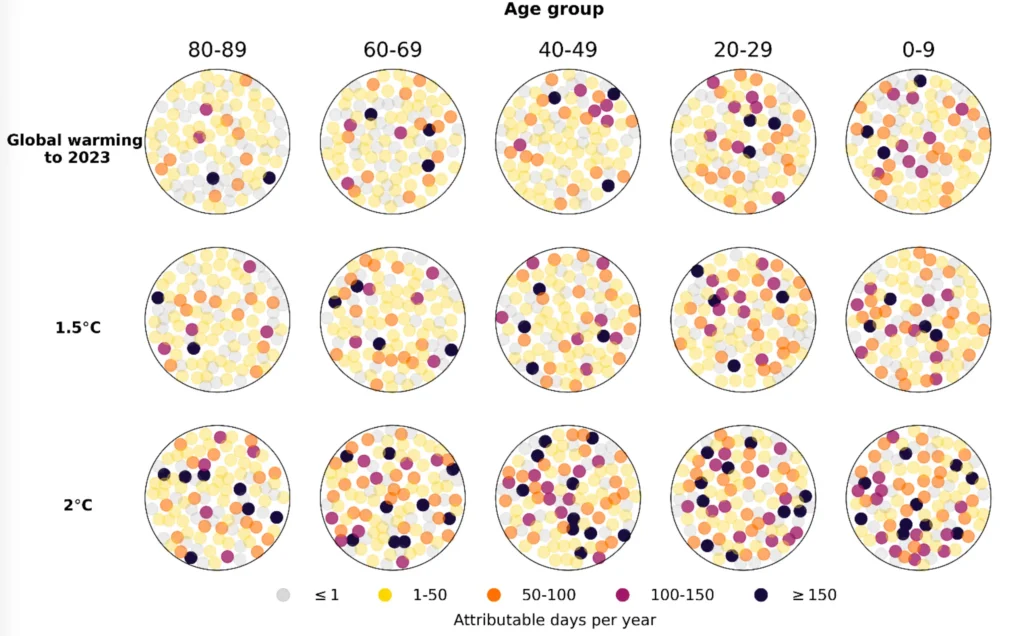
By integrating gridded demographic datasets to map the age structure of every country, the study’s authors calculated precisely how many individuals within distinct age cohorts are exposed to climate-driven extra heat days. Globally, the numbers reveal that 583 million children under the age of 10 live through at least 20 attributable heat days every year, representing 44% of all children in that age bracket. By comparison, approximately 190 million people aged 60 to 69 face a similar frequency of attributable heat days, accounting for 30% of their respective age cohort.
This disparity stems primarily from two main factors. First, the global population currently features more young people than older generations, with roughly 1.3 billion children under 10 compared to 0.6 billion adults aged 60 to 69. Second, countries across Africa and Asia feature rapidly expanding populations with high concentrations of young children, whereas many cooler nations in the northern hemisphere tend to have aging populations.

Expanding their analytical scope, the researchers projected future exposures under 1.5-degree and 2-degree Celsius warming scenarios, utilizing population estimates from standard socioeconomic pathways. These projections indicate that global population will peak above nine billion in the latter half of the 21st century, with the vast majority of growth concentrated in low-latitude regions, particularly sub-Saharan Africa.
In the present-day climate, 11% of children under 10 experience 100 or more extra heat-stress days annually due to climate change. Under worlds warmed by 1.5 degrees and 2 degrees Celsius, that proportion climbs to 13% and 23%, respectively. For adults aged 60 to 69, the share experiencing 100 or more extra heat-stress days rises from 6% currently to 9% under a 1.5-degree scenario and 17% under a 2-degree warming trajectory.
While the study relies on the wet-bulb globe temperature as a well-established metric, Pietroiusti notes that the metric was not explicitly designed to measure impacts on children. She stresses that a vital next step for the scientific community involves bridging climate science and public health expertise to develop metrics tailored to capturing the specific health and educational impacts that children experience during prolonged heat events.
External experts have praised the methodological rigor of the study while offering nuanced perspectives on vulnerability. Dr. Qinqin Kong, a postdoctoral researcher in medicine and health policy at Stanford University who was not involved in the research, noted that the study provides timely quantitative evidence for ongoing debates regarding climate justice, children’s rights, and intergenerational equity. However, Kong suggested that the paper may understate the relative vulnerability of older adults.

Kong explained that elderly populations often face compounding social vulnerabilities, such as living alone, having limited mobility, and encountering barriers to accessing air conditioning or emergency assistance during heat emergencies. He also highlighted that societies in mid-latitude regions like Europe and North America are often less physiologically adapted to heat, pointing out that Europe exhibits a substantial relative risk of heat-related mortality due to lower rates of air conditioning adoption, unacclimatized populations, and urban designs that inhibit efficient heat dissipation.
Similarly, Dr. Daniel Vecellio, a researcher at the University of Nebraska who also did not participate in the study, observed that children represent a largely understudied cohort in climate literature. Nevertheless, Vecellio expressed cautious optimism, noting that children often demonstrate strong behavioral adaptations to extreme weather, and populations experiencing chronic exposure to high heat may develop better physiological acclimatization over time.
Pietroiusti concluded by emphasizing that global reporting on extreme weather events has historically suffered from a geographic bias favoring wealthier nations. Large-scale disaster databases frequently underrepresent heatwaves in regions like Africa due to a scarcity of local news coverage and formal institutional reporting. Studies driven by comprehensive global climate data are crucial for bridging these information gaps and reinforcing the urgent ethical imperative of addressing climate change on behalf of populations that have contributed the least to the crisis.