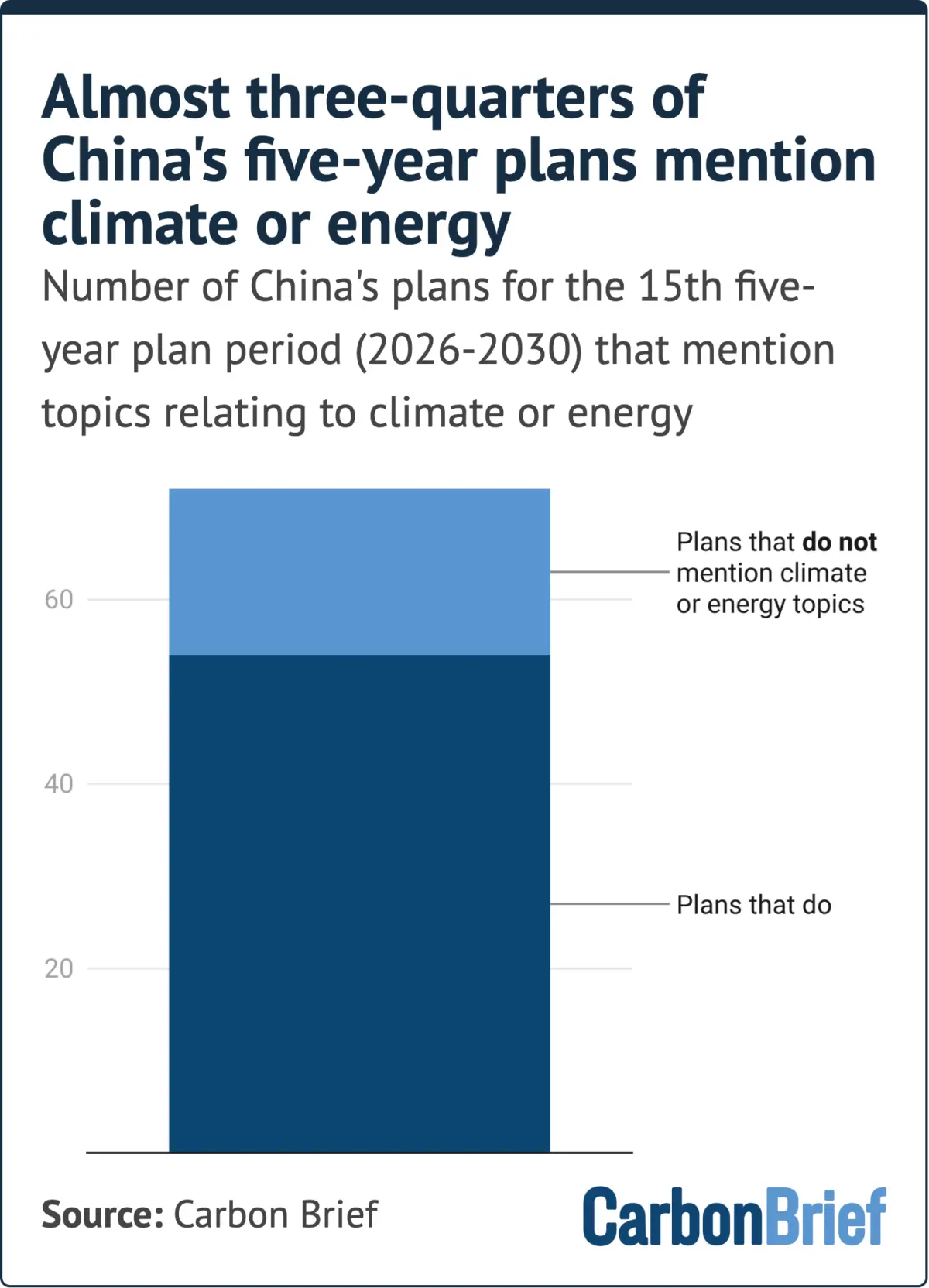
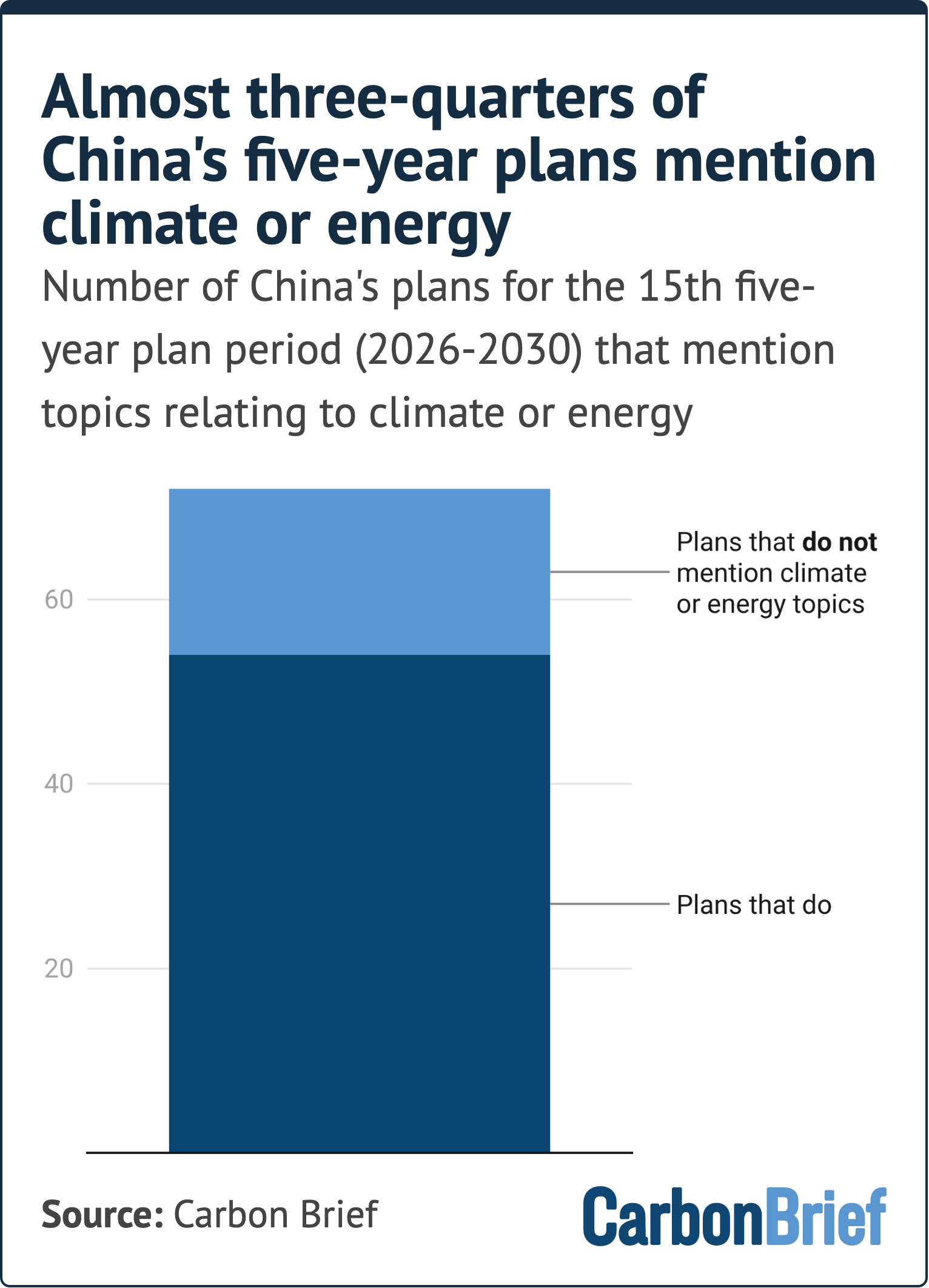
Nearly three-quarters of the 72 five-year plans published by China this year include explicit policies or targets related to climate change and energy, according to a comprehensive new analysis by Carbon Brief.
Five-year plans serve as a cornerstone of China’s complex policymaking machinery, acting as vital signposts that signal national priorities and establish binding and non-binding targets for the coming years. The highest-level document in this hierarchy, the 15th five-year plan, covers broader economic and social development for the 2026-2030 period and was officially published in March 2026 during the country’s prominent annual political gatherings. Following the release of this overarching blueprint, the Chinese government has steadily rolled out a series of thematic five-year plans at the national level that home in specifically on climate and energy transitions. These specialized documents span critical sectors, including renewable energy deployment, direct responses to climate change mitigation, and the management and evolution of traditional fossil-fuel industries.
To gauge the true depth of Beijing’s environmental commitments, Carbon Brief researchers combed through all available public 15th five-year plans issued by central government ministries. The findings reveal that 54 out of the 72 plans published so far incorporate specific climate policies or targets. Furthermore, the vast majority of national-level plans that are not inherently connected to climate change or energy production still manage to weave in varying degrees of climate-related directives, illustrating how deeply sustainability goals have penetrated ordinary bureaucratic planning.
Using the Tracker: Navigating China’s Policy Landscape
Five-year plans are deployed across China to guide economic and social development systematically. The overarching master plan is published every five years in March, outlining top-tier goals across all societal and economic issues. In the months and years that follow, sectoral and thematic plans are progressively released, focusing on everything from the coal industry and electric vehicles to accounting methodologies and tourism.
While it remains unclear how many total plans will eventually be released for this five-year cycle, analysts understand that the most crucial foundational documents concerning climate and energy have likely already seen the light of day. This current five-year period is viewed by international observers and domestic policymakers alike as exceptionally critical for climate action, as it directly covers the crucial years building up to China’s official pledge to peak its carbon dioxide emissions before 2030.
The tracker compiled by researchers breaks down these policies by examining primary goals, which are formally known in Chinese policy documents as major expected or binding targets. These goals encompass a blend of numerical benchmarks and qualitative policy directions. For instance, within the overarching master plan, numerical primary targets include an objective to slash carbon intensity—defined as emissions generated per unit of gross domestic product—by 17% across the five-year timeframe.
These quantitative benchmarks, alongside other prominent commitments announced prior to March 2026, such as the pledge to drive greenhouse gas emissions down to between 7% and 10% below peak levels by 2035, form the bedrock for subsequent policymaking. However, it is the sectoral and thematic five-year plans that provide the granular targets and specialized operational directives necessary to implement these broad ambitions on the ground.
The Overarching Plan and Core Climate Blueprints
The overarching 15th five-year plan, unveiled during the major political leadership meetings in Beijing, establishes the baseline climate and energy targets that China aims to achieve by 2030. Building upon this central framework, several core thematic plans have been released by powerful government departments, including the National Development and Reform Commission, the Ministry of Ecology and Environment, and the National Energy Administration.
These core documents outline quantitative targets and strategic policy directions tailored to specific industrial and environmental transitions. Among them are specialized blueprints addressing the creation of new-type energy systems and power grids, green and low-carbon industrial development, renewable energy expansion, and national responses to climate change. Other core plans focus tightly on traditional sectors, detailing trajectories for the coal industry as well as oil and gas development, alongside high-growth technology sectors like smart and connected new-energy vehicles.
In addition to traditional industrial and energy strategies, several plans address environmental protection, ecological conservation, and public welfare. These include documents dedicated to building a "Beautiful China," enhancing eco-environmental monitoring, managing integrated transportation services, and advancing national meteorological development. Non-numerical primary goals embedded in these plans often task agencies with significantly enhancing capabilities for forecasting and warning systems against extreme weather, or achieving major progress in complex Earth system forecasting.
Action Plans and Peripheral Sectoral Strategies
Beyond standard five-year plans, China has also published several policy documents covering the 2026-2030 window under the guise of five-year "action" or "implementation" plans. These include targeted directives such as the national meteorological disaster prevention plan, specialized action plans for peaking carbon emissions during the 15th five-year plan period, work plans focused on energy conservation and carbon reduction within public institutions, and implementation guidelines promoting the coordinated transformation of digitalization and greening.
At the same time, a wide array of peripheral five-year plans—spanning sectors traditionally disconnected from heavy industry or energy production—have integrated green and low-carbon policies into their operational mandates. These include plans governing urban renewal, agriculture, emergency response systems, employment, port modernization, traditional Chinese medicine, cultural heritage preservation, public health, the circular economy, tourism, and solid waste pollution control.
Additional peripheral strategies touch upon diverse domains such as soil and groundwater protection, forestry and grassland resource management, disease prevention, the postal industry, intellectual property rights, civil aviation, banking reform, and information communications. Even smaller industries, ranging from light manufacturing and textiles to publishing, crop production, and livestock development, now incorporate sustainability guidelines into their long-term administrative frameworks. Through this sweeping integration, China’s climate and energy agenda is systematically embedded across virtually every tier of national governance and economic planning for the decade.