Text classification has long remained a cornerstone of natural language processing, yet real-world applications frequently grapple with the friction of raw text arriving in multiple, unpredictable languages. Before feeding incoming data into a downstream classification model, engineers traditionally faced the formidable challenge of normalizing all linguistic inputs into a single, unified language. This fragmentation often required complex, multi-system architectures that separated translation services from machine learning workflows, introducing latency, maintenance overhead, and integration hurdles.
Addressing this persistent industry pain point, open-source frameworks are evolving to bridge the gap between traditional machine learning infrastructure and modern generative artificial intelligence. Among these developments, Scikit-LLM has emerged as a notable tool, facilitating the construction of pipelines driven by large language models for specialized tasks such as zero-shot and few-shot classification. Beyond standard categorization, the framework provides custom classes designed to adapt pre-trained models for auxiliary language tasks, most notably machine translation, allowing developers to streamline multilingual text analysis within familiar machine learning paradigms.
Recent technical demonstrations by AI researchers, including work shared by artificial intelligence leader and adviser Iván Palomares Carrascosa, highlight how practitioners can construct an overarching scikit-learn pipeline dedicated to multilingual text classification. By unifying two distinct stages—automated translation followed by zero-shot classification—under the scikit-learn umbrella, data science teams can achieve seamless multilingual processing without the need for extensive traditional training data or complex pre-processing scripts.
Building the Multilingual Infrastructure
Deploying modern machine learning pipelines that rely on large language models often raises concerns regarding operational expenses and API token costs. However, current implementations demonstrate that such architectures can be developed efficiently and cost-effectively by leveraging accessible developer ecosystems. By combining Google Colab with Groq’s high-speed LLM application programming interface, developers can execute sophisticated multilingual classification workflows entirely using free-tier resources.
The implementation process begins within a cloud-based Python environment by installing the Scikit-LLM library and configuring the runtime environment. Rather than routing requests through default commercial endpoints that typically incur per-token charges, developers can redirect the environment to utilize OpenAI-compatible endpoints offered by alternative hardware providers. By retrieving a secure application key and establishing a custom base URL, the pipeline seamlessly interfaces with high-performance, open-weights language models while bypassing traditional cost barriers.
In traditional machine learning workflows, text classification relies heavily on vectorizers that map text numerically, necessitating substantial, balanced sets of historical training data for every targeted category. However, the integration of zero-shot large language model classifiers fundamentally alters this paradigm. Because these models leverage pre-trained semantic understanding, they do not require extensive historical training datasets to learn distinct categories. Instead, developers need only define the unique set of classification labels that the model must recognize, alongside minimal placeholder data to satisfy the structural requirements of standard scikit-learn fitting methods.
For instance, a multilingual training dataset can be constructed using mixed-language examples spanning broad industrial domains such as energy, finance, and healthcare. Sentences written in French, German, and Spanish regarding solar efficiency, wind energy storage, financial market drops, technology stock earnings, and clinical drug trials can be mapped directly to generalized categorical labels. Despite the linguistic diversity and varied subject matter of the input data, the underlying architecture prepares the model to interpret and categorize the incoming streams effectively.
Executing the Two-Stage Pipeline
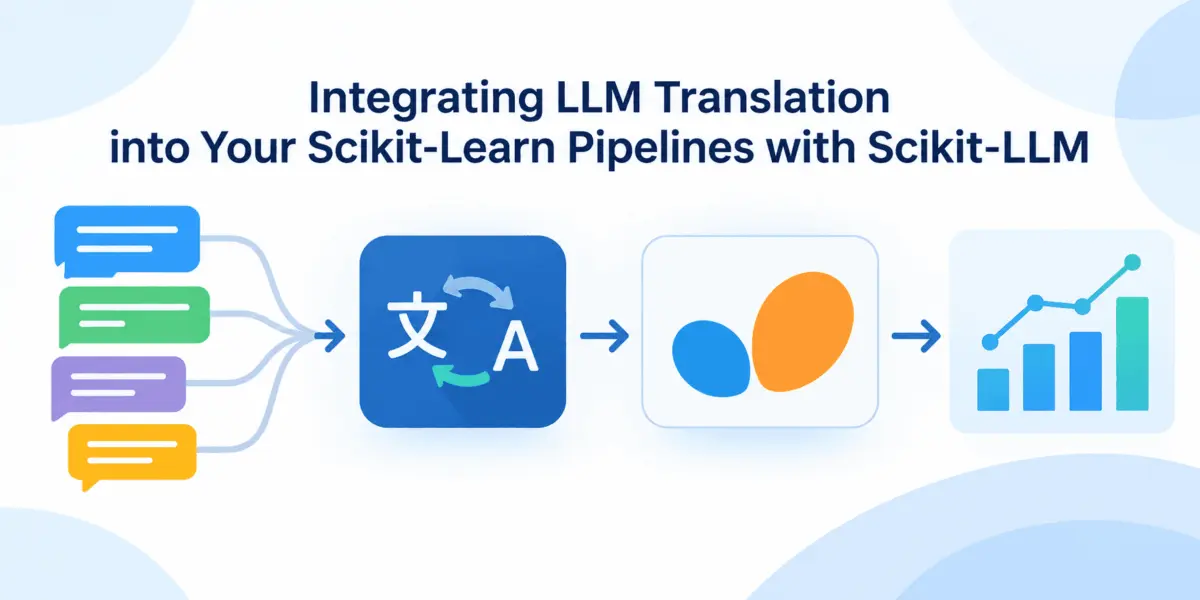
The architectural core of this approach relies on a unified pipeline structure that chains two distinct model-wrapper classes provided by Scikit-LLM. The first stage utilizes a specialized translator class designed to adapt a base large language model for automated translation into a designated common target language, such as English. The second stage employs a zero-shot classification class, which adapts another instance of the base model to interpret the newly translated text and assign the appropriate category without requiring model retraining.
Remarkably, developers can deploy the exact same foundational model architecture across both stages of the pipeline. By applying different task-specific wrapper classes to identical model instances, the system executes translation and classification as sequential, interdependent steps within a single scikit-learn pipeline object. Once the pipeline is initialized, fitting the classifier requires only passing the unique list of target labels alongside minimal placeholder text arrays to comply with standard API conventions.
Before deploying the pipeline to unseen data, engineers can isolate and inspect the intermediate outputs generated by the initial translation stage. Verifying the quality of these translations ensures that nuanced domain-specific terminology—ranging from financial market indicators to medical trial metrics—is accurately converted into the target language before classification occurs. Analysis of training data translations reveals that source sentences in French, German, and Spanish are rendered into fluent, semantically equivalent English statements without altering the core intent of the original documents.
Classifying Unseen Multilingual Data
With the pipeline verified and operational, practitioners can evaluate its performance on entirely unseen multilingual inputs. When fresh documents written in languages such as Italian or Portuguese are introduced to the system, the pipeline executes its automated sequence seamlessly. First, the text is ingested and translated into the unified target language by the initial model wrapper. Immediately afterward, the translated text is passed to the zero-shot classifier, which evaluates the semantic content against the predefined category labels.
Practical evaluations of this approach yield striking results across diverse linguistic inputs. For example, Italian text discussing clinical trials for a new influenza vaccine is accurately translated into English and subsequently classified under the healthcare domain. Similarly, Italian descriptions of sodium-ion batteries designed to store excess wind energy are successfully routed through the translation layer and correctly categorized under the energy sector. Furthermore, Portuguese reports detailing the recovery of technology stocks at the end of trading sessions are translated and accurately assigned to the finance category.
The success of these end-to-end evaluations underscores the viability of combining traditional machine learning pipeline structures with modern generative language models. By automating the normalization of multilingual text as an inherent pipeline step, organizations can drastically reduce the complexity of deploying global text classification systems.
As artificial intelligence continues to integrate deeper into enterprise software development, frameworks that bridge the gap between rigid machine learning pipelines and flexible large language models offer a glimpse into the future of natural language processing. Experts like Iván Palomares Carrascosa continue to advocate for these practical architectures, helping professionals harness real-world AI applications efficiently, securely, and without prohibitive financial overhead.