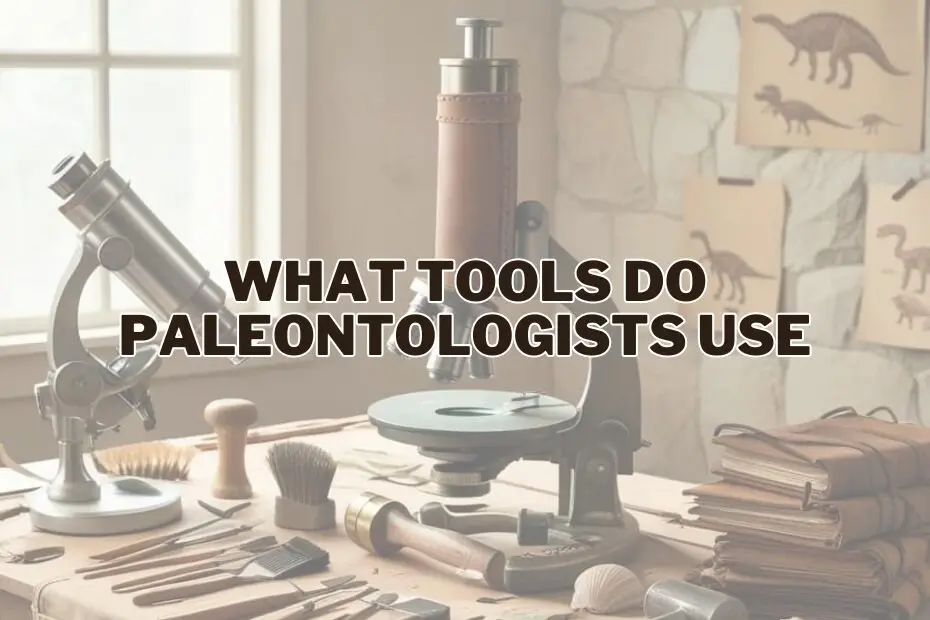
Unearthing the mysteries of pre-history requires far more than serendipity and a casual spade. Recovering remnants of ancient life locked within solid rock is a rigorous, highly disciplined scientific process. From the moment a prospective field site is surveyed to the delicate extraction of fragile specimens millions of years old, paleontologists rely on a specialized array of instruments designed to balance brute physical effort with microscopic precision.
Every artifact, bone, or trace fossil recovered provides a critical piece of Earth’s biological and geological history. However, these fragile specimens are constantly at risk of destruction during the excavation process itself. To mitigate these risks, field scientists deploy a curated toolkit ranging from heavy-duty earth-moving gear to high-precision surgical instruments and digital spatial mappers. Together, these tools allow researchers to break open hard stone, clear away encumbering matrix, systematically log geographic context, and safely package ancient specimens for transport to laboratory environments.
The following comprehensive breakdown examines the essential field instruments that define modern paleontological exploration, detailing how each tool contributes to preserving the fossil record.
1. Rock Hammer
The rock hammer stands as an iconic symbol of geological and paleontological field exploration. Designed specifically for striking stone rather than nails, this specialized tool features a dual-purpose head that serves distinct excavation functions. Paleontologists utilize the hammer to fracture surrounding strata and reveal petrified organic remains hidden deep within rock matrixes.
The flat, blunt end of the hammerhead is engineered to deliver targeted impact along natural bedding planes, effectively splitting layers of sedimentary rock. Conversely, the pointed pick end allows for more localized, precision work when clearing away hard stone near a specimen. Operating a rock hammer effectively is not a matter of sheer force; it requires refined technique, patience, and a practical understanding of rock fracture dynamics to chip away matrix without damaging the underlying fossil.
2. Chisel
When excavations approach sensitive fossilized bone or delicate impressions, direct hammer strikes present an unacceptable risk of fracture. In these scenarios, the chisel becomes an indispensable companion to the rock hammer. By placing the edge of a chisel against target rock layers and tapping gently with a hammer, field workers can direct fracturing forces with extreme precision.
Chisels allow paleontologists to micro-fracture tough rock matrices adjacent to vulnerable specimens, gradually prying open tight seams with minimal structural disturbance. This controlled application of force is vital when extracting fragile specimens that would crumble under unchanneled impacts, ensuring that fine details remain intact throughout the physical isolation process.
3. Brush
Once a fossil is exposed, removing fine particles without scratching or eroding its delicate surface becomes a primary objective. Field brushes are employed throughout every phase of excavation to clear away loose sediment, dirt, and pulverized stone dust.
Paleontologists carry a wide range of brushes tailored to specific tasks. Large, soft-bristled brushes are utilized for sweeping away general overburden and dirt across larger surface areas. Smaller, stiff-bristled brushes are used to clean intricate contours and tight crevices around fragile bone structures. Using a brush demands patience and light touch, as reckless cleaning can strip away fragile micro-structures or loose fragments. Consequently, brushes remain foundational tools for preserving a fossil’s physical integrity during field prep.
4. Trowel
For intermediate digging tasks where a full-sized shovel is too coarse and a dental pick is too slow, the hand trowel serves as a versatile workhorse. Featuring a short handle and a flat or slightly curved metal blade, the trowel allows for controlled soil removal near active excavation surfaces.
Unlike larger earth-moving equipment, a trowel enables researchers to scrape away thin horizontal layers of soil systematically. This technique helps identify subtle changes in sediment color or texture that often signal an approaching fossil horizon. Its maneuverability makes it an optimal tool for working in tight quarry spaces, offering a balanced combination of efficiency and safety when digging around sensitive materials.
5. Sifter
Not all significant paleontological finds consist of massive, intact skeletons; micro-fossils such as small teeth, isolated scales, and tiny bone fragments are equally vital for reconstructing ancient ecosystems. To recover these minute remains, paleontologists rely heavily on field sifters.
A sifter consists of a framed wire mesh screen used to filter excavated dirt, sand, and loose matrix. As loose soil passes through the mesh, larger particles and potential fossil fragments are retained on top for close inspection. This simple yet critical tool ensures that small but scientifically valuable evidence is not mistakenly discarded with the loose fill dirt during active site clearing.
6. Pickaxe
When field sites are encrusted under dense, heavily consolidated rock layers, lightweight hand tools are often insufficient for initial site access. Under these challenging conditions, paleontologists turn to the pickaxe to break through resistant upper strata and clear heavy overburden.
Featuring a heavy double-headed steel head mounted on a long handle, the pickaxe delivers the kinetic energy required to break up hard, unyielding formations. Because of the immense force it generates, field researchers use pickaxes strictly for gross excavation—removing non-fossiliferous upper rock layers to reach the deeper fossil-bearing horizons beneath. Careful application is essential to stop pickaxe work well before reaching the target fossil zone.
7. Field Notebook
While physical extraction tools isolate specimens, documenting contextual data is equally important for scientific validity. A fossil stripped of its geological context loses much of its research value. The field notebook serves as the primary repository for real-time observational data collected during an expedition.
Researchers use field notebooks to record detailed notes on site stratigraphy, sediment characteristics, surrounding environmental features, weather conditions, and preliminary identification remarks. Documenting exact depth, matrix type, and field numbers in real time preserves the contextual provenance of every artifact. These physical records ensure that laboratory researchers can accurately reconstruct the exact conditions under which a specimen was originally preserved and discovered.
8. Measuring Tape
Precision spatial measurement is vital when documenting a fossil quarry or individual excavation pit. Paleontologists utilize measuring tapes to record the exact dimensions of exposed specimens, establish site grids, and log the relative distances between disparate finds.
Accurate measurement data allows scientists to construct detailed grid maps of excavation sites, recording the spatial orientation and depth of every recovered item. This structural mapping helps researchers interpret how an organism was buried and assess whether multiple scattered bones belong to a single individual or represent a mixed depositional accumulation.
9. GPS Unit
Modern paleontological expeditions incorporate digital mapping technology to establish global spatial coordinates for every discovery. Handheld Global Positioning System (GPS) units are standard field equipment used to mark the exact geographical locations of active dig sites and individual specimen discoveries.
GPS units capture precise latitude, longitude, and elevation data, providing an unalterable spatial record for scientific archives. This high-precision location data ensures that researchers can map the geographical distribution of ancient species across vast landscapes. Furthermore, recorded GPS coordinates enable research teams to navigate back to exact excavation points years or decades later for follow-up studies.
10. Hand Lens
Field identification often hinges on microscopic anatomical features that are invisible to the naked eye. The hand lens—a compact, high-magnification magnifying glass housed in a protective casing—is an essential tool for close-range visual inspection in the field.
Paleontologists use hand lenses to examine fine surface textures, micro-fractures, and structural patterns on exposed rock or suspected fossils. This immediate, high-resolution viewing capability helps researchers distinguish true fossilized organic material from mineral concretions or non-biological rock formations, guiding immediate decisions on whether to proceed with delicate extraction.
11. Plaster Bandages
Once a fragile fossil is fully exposed and isolated on a pedestal of rock, it must be protected against the physical stress of transport from the field site to a preparation facility. To safeguard vulnerable specimens, paleontologists encase them in heavy-duty protective jackets using plaster bandages.
The process involves covering the exposed specimen with protective layers of wet tissue or foil, followed by strips of burlap or canvas soaked in plaster. As the plaster bandages set and dry, they form a rigid, impact-resistant outer shell around the fossil and its surrounding matrix matrix. This plaster jacket shields the delicate specimen against vibration, shock, and structural collapse during transport across rough terrain.
12. Awl
When working directly against fragile bone surfaces trapped within tight rock matrices, field preparators require slender, pointed tools that afford maximum fine control. The awl—a sharp, steel-pointed instrument mounted on an ergonomic handle—is tailored for this level of detailed mechanical work.
Paleontologists use awls to pick, scrape, and flake away tiny fragments of rock matrix immediately adjacent to delicate fossil structures. Acting much like a precision pick, the awl allows the user to apply controlled, localized pressure to pop matrix away from hard bone surfaces without using broad hammer strikes. This makes it an essential tool for intricate excavation work in confined spaces.
13. Dental Pick
Borrowed directly from the medical field, dental picks are among the most precise hand instruments used in paleontological field preparation. Featuring fine, angled steel points, these picks enable meticulous cleaning and micro-excavation along highly sensitive fossil surfaces.
Dental picks are routinely deployed when working on delicate structural features, such as fragile skull sutures, small tooth rows, or paper-thin fish bones. Their fine tips allow researchers to clean out tiny crevices and isolate minute fragments that larger tools would pulverize. In terms of hand-operated field equipment, dental picks offer the highest level of physical control during fine excavation work.
14. Shovel
Before delicate, precision extraction can begin, large volumes of sterile surface soil, sand, or gravel must be cleared away from the excavation zone. The standard shovel is the primary heavy-duty tool used for moving high volumes of bulk dirt quickly.
Paleontologists rely on shovels to excavate access trenches, clear collapsed hillside debris, and remove non-fossiliferous upper soil layers (overburden). While it lacks the delicate precision required near actual fossil horizons, the shovel is indispensable for doing the heavy manual lifting necessary to expose target rock formations safely and efficiently.
15. Compass
Determining the precise physical orientation of a fossil within its original sedimentary layer provides critical clues about ancient environmental conditions. Paleontologists use magnetic field compasses to measure the direction, strike, and dip of target rock strata, as well as the alignment of fossilized remains.
Logging the directional orientation of bones can reveal ancient current flows, river transport directions, or wave actions that acted upon an organism after death. By capturing these orientation vectors in the field, researchers can infer vital details about ancient taphonomic processes and depositional environments, adding deep ecological context to physical discoveries.
Frequently Asked Questions
What are the most common tools used by paleontologists?
The most widely used field tools include rock hammers, chisels, soft brushes, hand trowels, and plaster bandages. These core instruments enable researchers to break open matrix, excavate soil safely, clean specimens, and package fragile finds for safe transport.
Why do paleontologists use a GPS unit in their work?
GPS units allow field scientists to record the exact geographic coordinates and elevation of fossil discoveries. This precise spatial data is critical for mapping the distribution of ancient species, integrating finds into regional geological maps, and relocating sites for future research.
How do plaster bandages help in paleontology?
Plaster bandages are applied wet over exposed fossils and allowed to harden into a rigid, protective shell or jacket. This casing stabilizes fragile, fractured fossilized material within its original rock matrix, protecting it from damage caused by shock and vibration during transport back to the laboratory.
What is the role of a field notebook in paleontology?
A field notebook provides an official, real-time record of all contextual data at an excavation site. Scientists use it to record spatial coordinates, stratigraphic profiles, environmental conditions, and detailed descriptions of each find, preserving the vital scientific context of every specimen.
Why is a brush necessary for fossil excavation?
Brushes allow researchers to clear away loose sediment, dirt, and rock dust without scratching or applying destructive force to fragile fossil surfaces. Different sizes and stiffness levels are used to clean broad surface areas or detail intricate anatomical structures safely.