An area of the Amazon rainforest roughly the size of the US state of New Jersey has remained standing since Luiz Inácio Lula da Silva assumed the presidency of Brazil, according to a comprehensive analysis by Carbon Brief. The findings highlight the profound impact of political leadership on the world’s most vital tropical ecosystem, even as a fiercely contested upcoming presidential election threatens to undo these hard-won conservation gains.
Lula secured the presidency in the 2022 election by defeating the incumbent far-right leader Jair Bolsonaro, taking charge of a nation that encompasses nearly 60% of the entire Amazon rainforest. Under Bolsonaro’s administration, environmental protections were systematically sidelined, agency budgets were slashed, and regulations were weakened to champion the nation’s powerful agribusiness sector. The result was a dramatic surge in forest loss. However, following Lula’s return to power, deforestation dropped sharply, driven by a renewed national commitment to environmental enforcement, and is now projected to hit its lowest level on record.
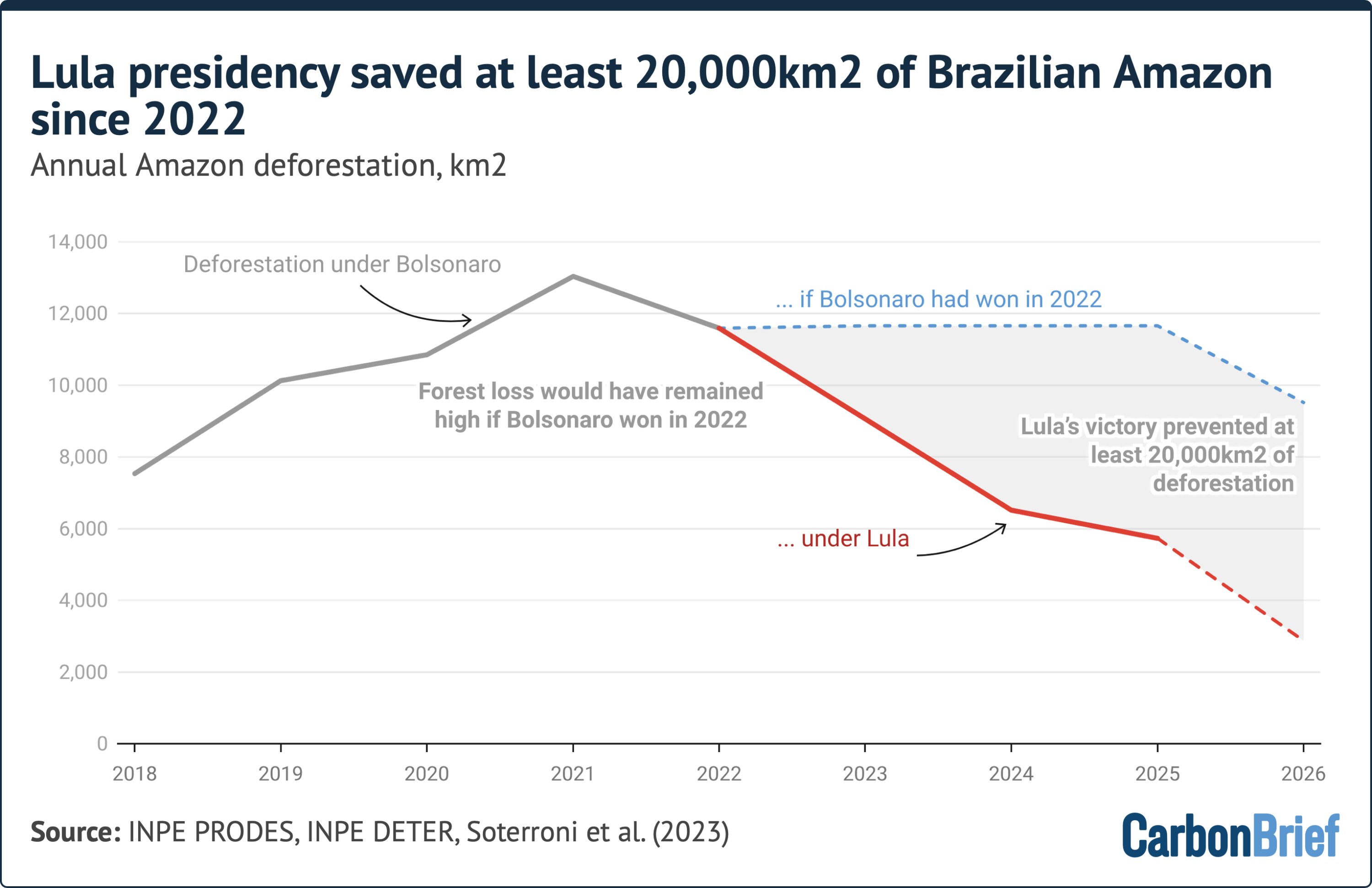
As another critical presidential election approaches, Lula finds himself locked in a tight race against Flávio Bolsonaro, a senator for Rio de Janeiro and the son of the former president. The younger Bolsonaro has embraced a political platform with anti-environmental policies strikingly similar to those of his father. Carbon Brief’s analysis suggests that at least 20,000 square kilometers of deforestation have been successfully avoided since Lula took office and prioritized the protection of the Amazon.
The analysis is underpinned by robust modeling developed by an international team of researchers, contrasting actual outcomes with an alternative scenario in which Brazil’s flagship Forest Code legislation—which requires landowners to preserve and restore forest on their private properties—was left unenforced. This unforced scenario serves as a direct proxy for the governance style witnessed under Jair Bolsonaro. Environmental experts consulted by Carbon Brief emphasize that this estimate is likely conservative, noting that actual deforestation under continued far-right leadership could have soared much higher due to the powerful political signals sent to illegal loggers and wildcat miners.
With Lula and Flávio Bolsonaro currently tied in opinion polls, the outcome of the upcoming election is expected to profoundly shape the environmental trajectory of Brazil, the world’s fourth-largest greenhouse gas emitter, where national emissions are overwhelmingly driven by land-use change and deforestation.
"Brazil is Back"
During Jair Bolsonaro’s presidential term from 2019 to 2022, the administration actively cultivated the support of Brazil’s agricultural lobby, overseeing an unprecedented spike in the destruction of the Amazon. Bolsonaro weakened federal environmental agencies, sidelined civil servants, and emboldened illicit activities while publicly attacking Indigenous and environmental communities. Consequently, the Forest Code was left largely unpoliced.
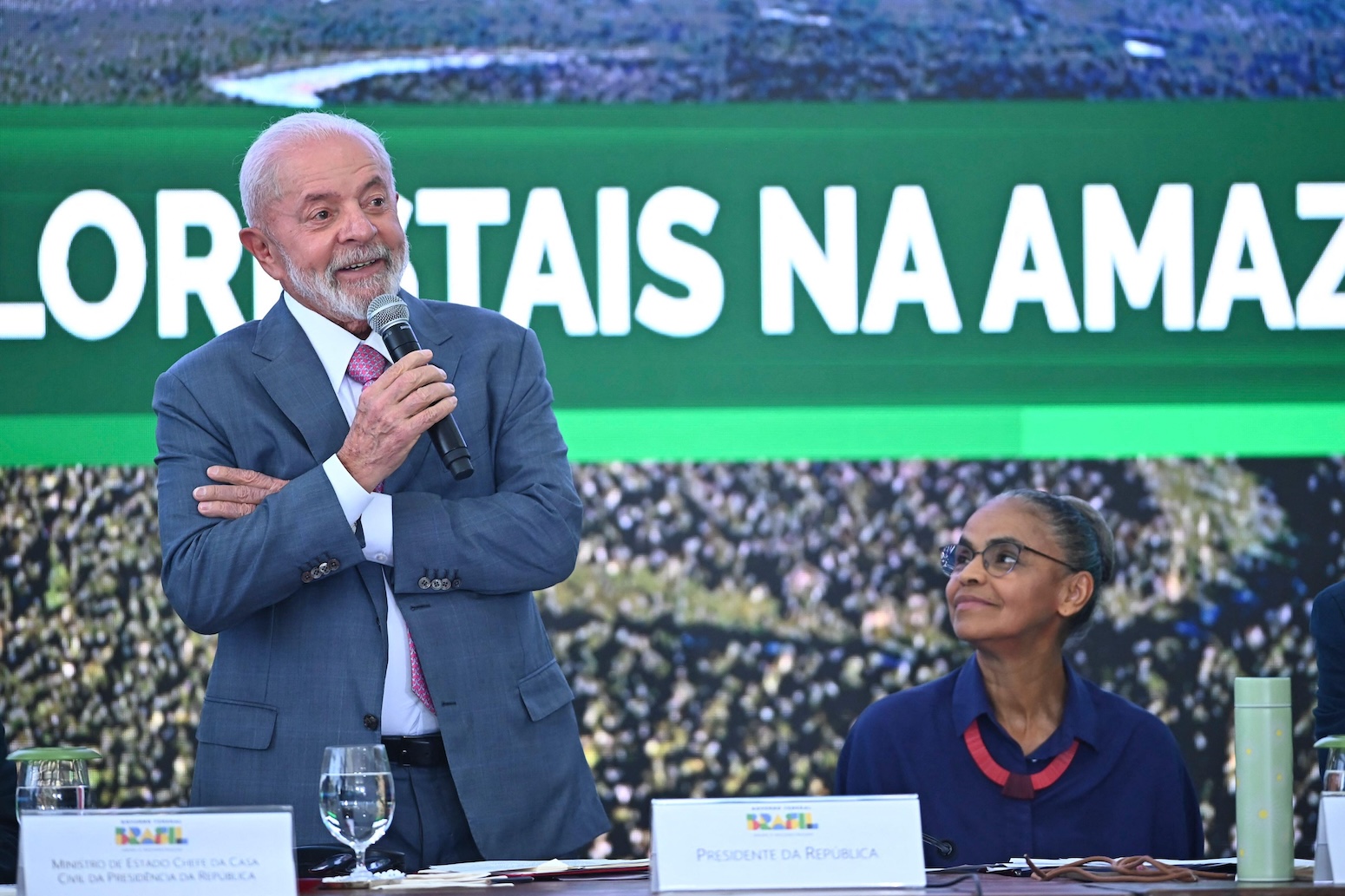
Upon reclaiming the presidency, Lula launched a sweeping reversal of these policies, promising to achieve zero deforestation by 2030 and boldly declaring to the COP27 UN climate summit that "Brazil is back." Under the leadership of celebrated environmentalist and Environment Minister Marina Silva, the administration reinstated the Action Plan for the Prevention and Control of Deforestation in the Legal Amazon, drastically scaling up federal enforcement and policing across the region.
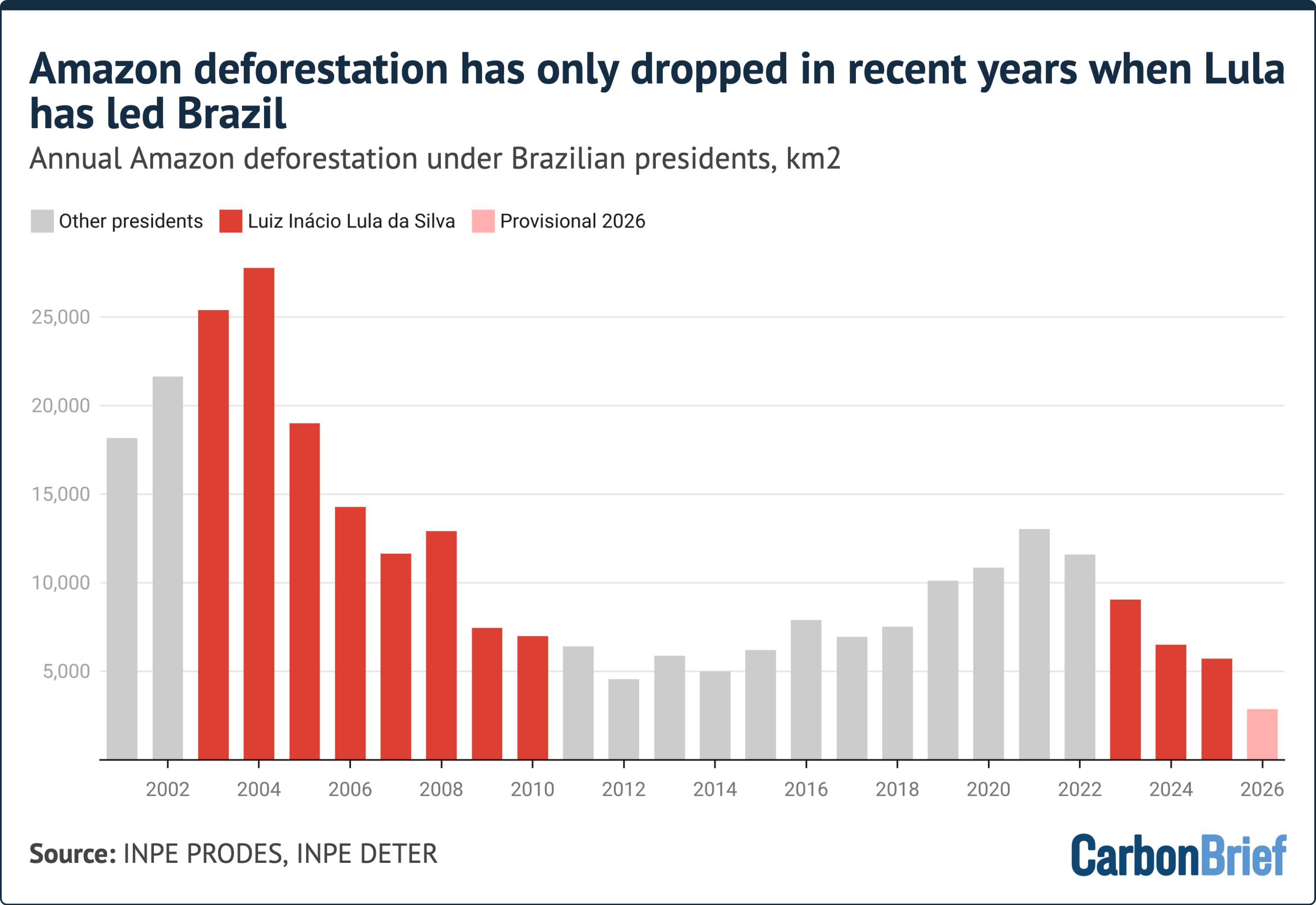
These measures yielded immediate dividends. Annual Amazon deforestation more than halved, plunging from 11,594 square kilometers per year in 2022 down to 5,731 square kilometers by 2025. While official government records spanning August 2025 to July 2026 are still pending full consolidation, preliminary real-time satellite alerts indicate a deforestation figure of 2,874 square kilometers. Although final figures typically adjust upward, experts maintain that total Amazon deforestation for 2026 could register its lowest level since official monitoring began in 1988.
A New Jersey-Sized Forest Saved
The comparison between actual outcomes and the modeled "no forest code" scenario underscores the tangible value of political intervention. The estimated 20,000 square kilometers of Amazon forest preserved under Lula’s tenure is roughly equivalent to the land area of Wales, Belize, Slovenia, or the state of New Jersey.
The analytical framework relies on research published in 2023 examining the role of nature-based solutions in achieving net-zero emissions in Brazil. The modeling utilizes the GLOBIOM-Brazil framework, developed by researchers from the University of Oxford, the International Institute for Applied Systems Analysis, and Brazil’s National Institute for Space Research.
Dr. Aline Soterroni, a researcher at the University of Oxford who spearheaded the 2023 analysis, explained that the rapid reversal observed under Lula demonstrates how swiftly deforestation rates can respond to decisive political will. However, she cautioned that the model’s baseline scenario is relatively conservative because it assumes deforestation would remain high rather than escalate exponentially. It also does not fully capture the explosive potential of illegal clearing driven by total institutional collapse.
Other experts corroborate this assessment. Claudio Angelo, international policy coordinator at the Brazilian Climate Observatory, noted that a Bolsonaro victory in 2022 would have likely triggered deforestation rates far exceeding those seen during his first term. The political signaling, Angelo argued, would have unleashed an unprecedented surge in wildcat mining and illegal land grabs, compounding previous legislative efforts by lawmakers like Flávio Bolsonaro to dismantle the Forest Code from within Congress.
High Stakes at the Ballot Box
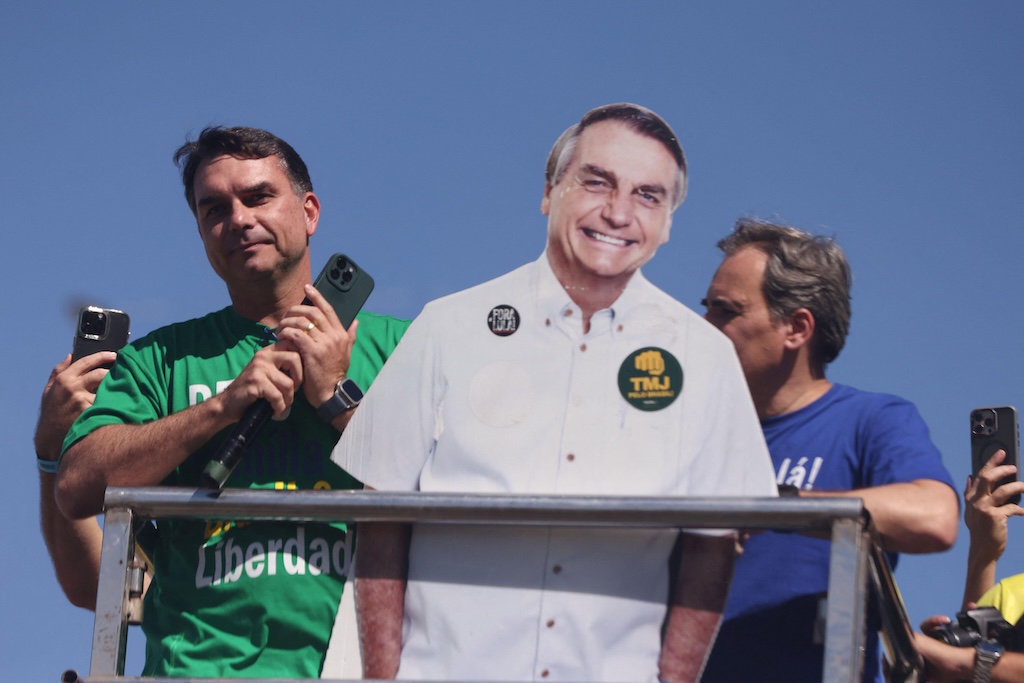
With Jair Bolsonaro currently imprisoned following his conviction for plotting a coup after losing the 2022 election, his son Flávio has stepped into the political fray as the standard-bearer for the right. Among a crowded field of 13 candidates, Lula and Flávio Bolsonaro have emerged as the clear frontrunners, running neck-and-neck in opinion polls ahead of the first round of voting on October 4. If no candidate secures a majority, a runoff election is scheduled for October 25.
If Lula secures another term, analysts anticipate the continuation of his administration’s "zero deforestation by 2030" agenda. Historical data indicates that significant reductions in Amazon deforestation have consistently aligned with Lula’s three terms in office, setting him apart from other political leaders in recent Brazilian history.
Conversely, experts warn that a victory for Flávio Bolsonaro—a noted climate skeptic who has pledged to advance his father’s pro-agribusiness and mining agenda—would trigger a devastating reversal. Dr. Patricia Pinho, deputy science director at the Amazon Environmental Research Institute, stated that the nation cannot afford another four years of escalating forest destruction and rising violence against Indigenous populations. Dr. David Lapola, an ecologist at the University of Campinas, warned that a right-wing victory would throw Brazil’s climate and conservation commitments "in the trash bin," noting that decades of environmental policy built over generations can be dismantled by a hostile executive branch in a matter of months.
Electoral evaluations by the Climate Observatory underscore these stark contrasts. Lula’s policy platform contains 16 detailed and positive environmental commitments, centering on his 2030 zero-deforestation pledge and national emissions reduction targets of 59% to 67% below 2005 levels by 2035. In contrast, Flávio Bolsonaro’s platform features numerous anti-environmental proposals. Although his campaign has pledged to halt illegal deforestation by 2029, environmental analysts remain deeply skeptical of the pledge, given his previous legislative efforts to weaken the Forest Code and legalize extractive industries within protected zones.
Beyond the presidency, the geopolitical landscape of the entire region hangs in the balance. Experts note that if right-wing leaders consolidate power across neighboring South American nations such as Bolivia, Colombia, Ecuador, and Peru, up to 95% of the wider Amazon basin could soon fall under the jurisdiction of governments prioritizing resource extraction over ecological preservation.
Broader Pressures on the Rainforest
Regardless of who occupies the presidential palace, the Amazon faces additional structural threats in the years ahead. Among the most pressing concerns is the effective collapse of the Amazon soy moratorium, a landmark voluntary agreement signed by major grain traders pledging not to purchase soybeans grown on land deforested after 2008. Widely hailed by conservation groups as one of the most effective supply-chain policies ever enacted, the moratorium prevented an estimated 18,000 square kilometers of deforestation during its first decade. However, major agricultural traders withdrew from the pact, raising fears of up to 14,000 square kilometers of additional deforestation by 2036.
Simultaneously, the composition of the Brazilian Congress remains a critical battleground. Right-leaning parties, including the Liberal Party associated with the Bolsonaros, retain substantial legislative power, frequently clashing with the executive branch. Recent legislative battles—such as the congressional override of presidential vetoes on controversial development legislation—highlight the ongoing friction between lawmakers and environmental advocates.
As voters head to the polls to elect a new president, governors, and members of Congress, the future of the Amazon hangs in the balance. Analysts emphasize that the election will determine whether environmental protection is viewed as a fundamental societal necessity or merely a disposable political preference, with consequences that will reverberate far beyond the borders of Brazil.