Abacus.AI has officially introduced the Smaug family, a collection of three open-weight models fine-specifically tuned for complex agentic workloads and multi-step automated operations. Available publicly on Hugging Face, the new release addresses a fundamental industry hurdle: transforming state-of-the-art language models into reliable, long-horizon agents capable of retaining context, interacting with external tools, and executing extended workflows without breaking down.
The development of the Smaug lineup stems from operational shortcomings experienced within Abacus.AI’s own engineering environment. When deploying general-purpose models for advanced automation, tasks frequently took hours to complete, demanded massive context management across various stages, and required constant tool invocations from disparate documents, APIs, and databases. Standard language models often grew inefficient over extended workflows, suffering from degraded prompt caching and a tendency to veer off-target after multiple execution cycles.

According to researchers at Abacus.AI, bridging the gap between a standard chatbot and a functional enterprise agent is fundamentally a training challenge rather than a prompting issue. Rather than trying to bandage underlying model weaknesses through prompt engineering or superficial weight adjustments, the engineering team applied a unified fine-tuning methodology directly to three distinct open-weight base models. By maintaining a consistent recipe across varying architectures and scales, the researchers sought to evaluate how standardized agentic training impacts different foundational floors.
Understanding the Smaug Lineup and Base Architectures
The Smaug series consists of three distinct models, each chosen to occupy a specific point on the capability-efficiency curve. The first, Smaug Flash, is built upon the DeepSeek V4 Flash 0731 architecture, boasting 304 billion parameters and optimized for speed and cost efficiency in always-on enterprise agent environments. The second, Smaug Mini, utilizes the Qwen3.8-27B architecture with 28 billion parameters, targeting multimodal operations, compact deployments, and one-off tasks. The third and largest is Smaug Agentic, a massive 2.8-trillion-parameter Mixture of Experts (MoE) model built on Moonshot AI’s Kimi K3, tailored for frontier-scale, long-horizon coding tasks.
Despite utilizing three very different foundational bases, all three models were trained using a shared methodology that combines human-curated traces from real-world agentic workflows with synthetic data grounded in challenging edge cases. The training data undergoes strict filtration to remove instances that merely exploit scoring criteria, ensuring the models are rewarded for genuine problem-solving rather than superficial format compliance.
Smaug Flash Delivers Massive Gains in Agentic Coding
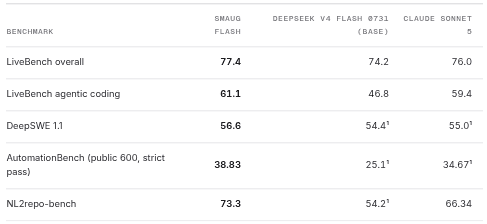
Smaug Flash demonstrated the most dramatic benchmark improvements in the lineup, particularly in areas where its base model historically exhibited the widest performance gaps. The base DeepSeek V4 Flash architecture is recognized for speed and affordability, but it has historically been prone to confusion and loops during long-context tool utilization.
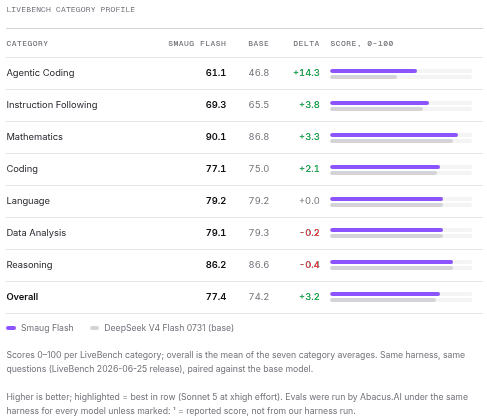
Testing on LiveBench highlighted the precision of the fine-tuning approach. Smaug Flash achieved a significant 14.3-point jump in agentic coding, rising from 46.8 to 61.1, representing the largest single-category delta across the entire Smaug series. Additional improvements included a 13.7-point increase on AutomationBench and a 19-point gain on NL2Repo-Bench. These substantial increases illustrate the model’s ability to successfully close capability gaps in the exact production workflows for which it was engineered, occasionally outperforming comparable proprietary models like Claude Sonnet 5 in specific tool-use evaluations despite minor trade-offs in isolated reasoning categories.
Smaug Mini Outperforms Frontier Models in Compact Deployments
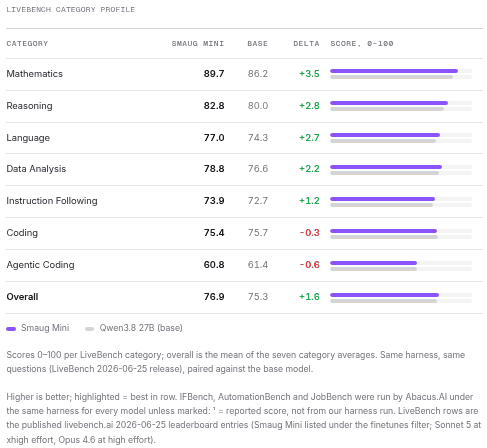
Smaug Mini offers a different narrative within the series, leveraging its compact 28-billion-parameter size to deliver outsized performance in multimodal tasks, instruction following, and tool utilization. Because its base model, Qwen3.8-27B, was already robust in coding-style applications, Smaug Mini’s largest benchmark gains were concentrated elsewhere, registering notable increases in Mathematics and Reasoning.

While its agentic coding score experienced a marginal dip compared to the base model, Smaug Mini outperformed several advanced closed models on IFBench, AutomationBench, and JobBench. Notably, its performance on JobBench demonstrated a 17.1-point gain over the base architecture. This divergence highlights a recurring theme in agent evaluation: benchmark categories measure specific, isolated capabilities, and a minor reduction in one area does not preclude a model from achieving high performance in practical, real-world execution.
Smaug Agentic Focuses on Behavioral Endurance at Scale
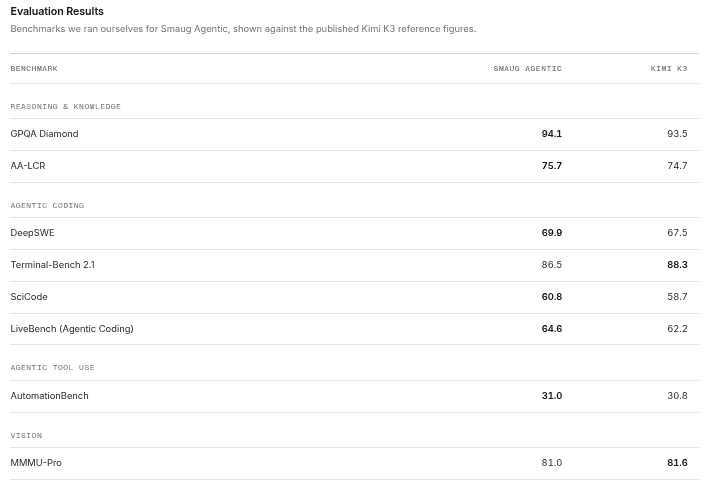
As the largest model in the lineup, Smaug Agentic yielded the smallest benchmark score deltas over its Kimi K3 base, but delivered critical improvements in operational stability and behavior. The research team noted that the behavioral transformation achieved by the fine-tuning process was significantly more substantial than the raw numeric changes suggest.
While the base model marginally outperformed the fine-tuned version on specific evaluations like Terminal-Bench 2.1 and MMMU-Pro, Smaug Agentic solved a more pressing reliability problem. In rigorous testing across 113 agentic coding tasks spanning over seven hours of continuous operation, the model executed a median of 78 agent steps per task with zero infrastructure errors and zero timeouts. At frontier scale, the primary achievement of the fine-tuning was not chasing higher benchmark scores, but eliminating the behavioral breakdowns that typically plague models during extended multi-step execution loops.
Evaluating Practical Utility Beyond Benchmarks
The release of the Smaug family underscores the importance of evaluating open-weight models against specific production workloads rather than relying solely on generalized benchmark metrics. Because the training methodology specifically targets the historical weaknesses of each base architecture, the resulting models exhibit distinct performance profiles tailored to different deployment requirements.
For organizations demanding sustained, long-context tool use and repeated API interactions across hours-long workflows, Smaug Flash provides robust automation capabilities. For teams requiring a nimble, multimodal model capable of fitting onto a single GPU while still beating larger proprietary alternatives in instruction following and job-level automation, Smaug Mini presents a viable option. Meanwhile, for enterprise environments requiring deep, frontier-scale reasoning over hundreds of sequential steps without infrastructural failure, Smaug Agentic demonstrates the behavioral endurance necessary for mission-critical deployments.
Ultimately, the Smaug series demonstrates that applying a uniform, rigorous agentic fine-tuning recipe yields highly variable outcomes depending on the structural constraints of the underlying base architecture. By transparently detailing both the significant capability gains and the isolated performance trade-offs, Abacus.AI provides developers with a clear framework for selecting and evaluating open-weight models for complex, real-world agentic applications.