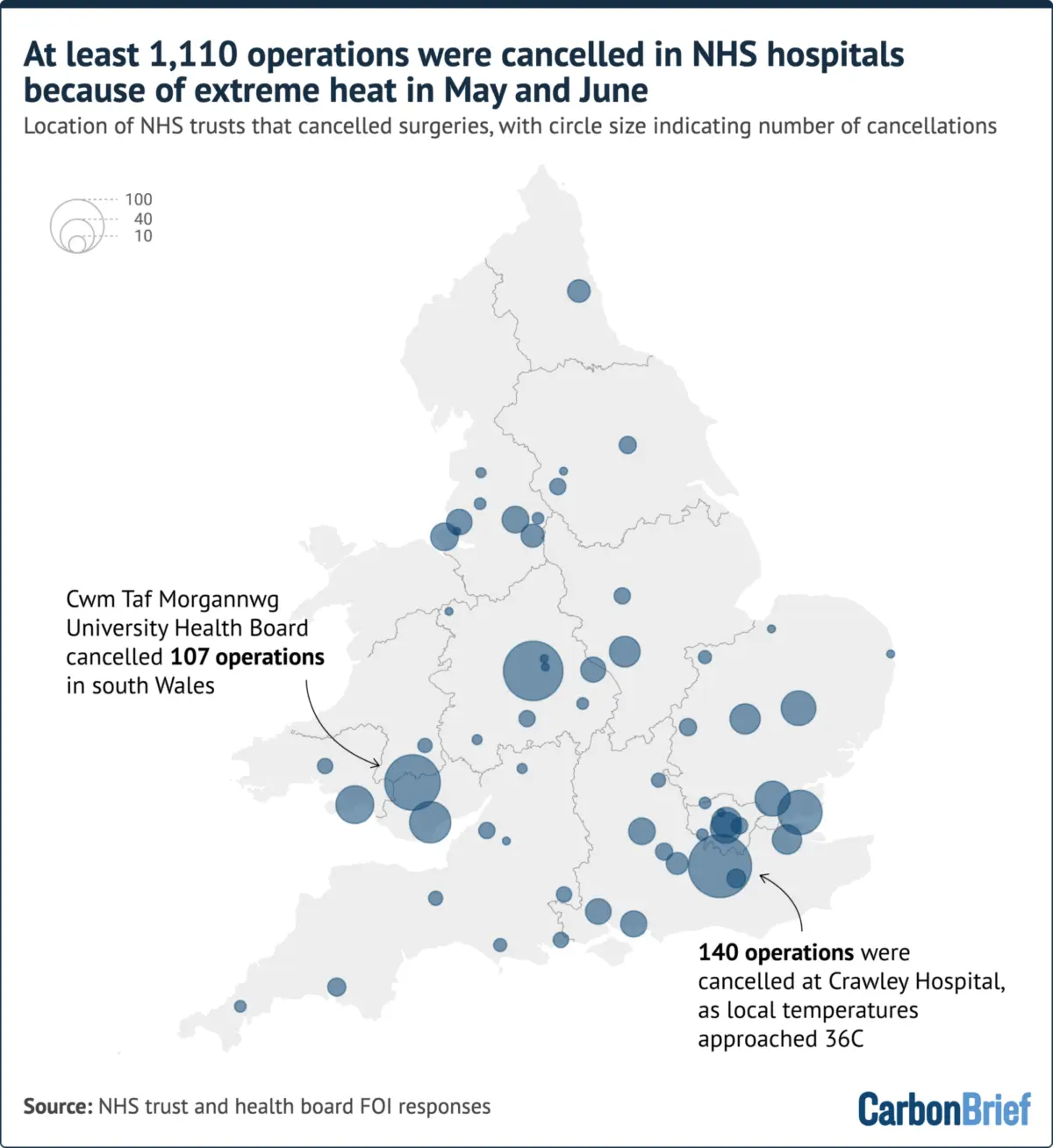
More than 1,000 operations at National Health Service (NHS) hospitals were abruptly cancelled due to extreme temperatures during the UK’s record-breaking heatwaves in May and June, an exclusive Carbon Brief investigation can reveal.
The widespread surgical disruptions, which affected institutions from southern England to south Wales, underscore a growing vulnerability within the nation’s healthcare infrastructure as human-induced climate change drives more frequent and intense summer heat. According to the investigation, the cancellations included 167 orthopaedic surgeries—such as routine knee and hip replacements—alongside critical procedures for heart conditions, eye ailments, and skin cancers. Most alarmingly, the data shows that at least 10 emergency surgeries meant for immediately life-threatening conditions had to be halted because operating theatres became dangerously hot.
To uncover the true scale of the disruption, Carbon Brief submitted Freedom of Information (FOI) requests to 140 NHS trusts and health boards across England and Wales that manage hospitals with surgical facilities. Out of those queried, 59 trusts and health boards responded with confirmed data detailing a staggering 1,110 heat-related cancellations across a combined 17-day period during the amber and red heat-health alerts issued on 22–28 May and 18–27 June.

Geographically, the brunt of the cancellations was concentrated in regions experiencing the most punishing temperatures. Surrey and Sussex, south Essex, parts of London, and south Wales emerged as major hotspots. For instance, the Surrey and Sussex Healthcare NHS Trust reported the highest single total with 140 cancellations, all occurring within the surgery unit at Crawley Hospital as local temperatures soared toward an intense 36 degrees Celsius. Similarly, the Cwm Taf Morgannwg University Health Board in south Wales logged 107 heat-related cancellations.
Experts warn that such severe ambient temperatures pose a direct and multifaceted threat to patient safety and clinical efficacy. Less than half of the NHS trusts approached provided granular details regarding heat-related surgical cancellations, and industry understanding suggests that many hospitals fail to routinely record these specific disruptions. Consequently, the figure of over 1,000 cancelled operations is almost certainly a significant underestimate, yet it offers an unprecedented look into a surgical system that public health researchers have previously described as poorly prepared for heatwaves.
Overheating Operations and Strained Facilities
The record-shattering heatwaves that repeatedly swept across the UK have already been linked by health authorities and scientific bodies to thousands of excess deaths. Extreme ambient heat notoriously triggers a cascade of physiological complications, aggravating pre-existing respiratory, cardiovascular, and kidney diseases, while simultaneously placing unprecedented pressure on emergency departments. News outlets throughout the summer reported on NHS facilities buckling under the strain, with Accident and Emergency departments facing record patient demand, hospital wards reaching dangerously hostile temperatures, and vital medical equipment failing due to thermal stress.

Among these cascading crises, hospitals were repeatedly forced to make the difficult decision to postpone scheduled operations or, in more extreme instances, abandon procedures midway through because operating theatres had transformed into intolerably hot environments. Of the trusts that provided comprehensive datasets detailing all surgery cancellations during the heatwave windows, approximately 7% were directly attributed to the heat. This additional friction compounds pre-existing systemic challenges within the NHS, including severe staff shortages and a chronic lack of available hospital beds.
While the vast majority of the affected procedures were elective operations—meaning they were planned in advance and not immediately life-saving—the human and clinical toll remains high. The cancelled roster included at least eight heart operations and seven skin-cancer removals. Furthermore, the data captured 18 individual surgeries that had to be abandoned mid-procedure because the operating environment deteriorated beyond safe operational limits.
Dr Dmitri Nepogodiev, a public health researcher specialising in surgery at the University of Birmingham, noted that while hospitals will naturally prioritise time-sensitive, life-threatening interventions, every single cancellation inflicts considerable emotional distress and erodes the quality of life for patients. "Behind all of these statistics are real people who have probably already been waiting a long time," he remarked.
Richard Egan, an endocrine surgeon and national clinical director within NHS Wales, emphasized the damaging ripple effects that multi-day surgical halts have on ever-growing waiting lists. "That’s a significant impact on waiting lists," Egan said. "For every week that patients are waiting on a waiting list, their condition could get worse and deteriorate."

The Technical Realities of Overheating Theatres
When asked to specify the reasons behind the cancellations, the vast majority of NHS trusts simply reported that their surgical theatres were "too hot and humid," occasionally citing direct concerns over elevated infection risks or the mutual overheating of vulnerable patients and clinical staff.
Underneath these generalized explanations lies a complex engineering failure. Dr Ed Robinson, an NHS anaesthetist, explained that modern operating theatres are meticulously engineered clinical environments reliant on sophisticated ventilation systems designed to dilute airborne contaminants, clear out chemical fumes from medications, and manage volatile anaesthetic gases.
"We have generalised airflow systems that make the air in theatre flow outwards to adjacent areas, so pathogens and fumes get carried away from the patient into non-clinical areas," Robinson said. "When it gets to a certain heat, those systems can fail."

These specialized mechanical units are equally responsible for regulating internal heat and humidity. When they break down or become overwhelmed by external ambient temperatures, maintaining sterile conditions and guaranteed patient safety becomes impossible, forcing clinicians to pull the plug on scheduled lists. Out of the responses gathered, 48 specific cases explicitly pointed to air conditioning or ventilation units that had completely broken down or proved incapable of sustaining appropriate thermal thresholds.
Tim Lane, a urological surgeon and president of the Royal College of Surgeons of England (RCS England), explained that extreme heat exerts an extra physical strain on patients, compounding surgical risks. If the air inside an operating theatre becomes excessively humid, airborne moisture can condense on surgical instruments, thereby elevating the risk of post-operative infections. Furthermore, extreme internal climates create grueling conditions for medical personnel who are often required to wear heavy personal protective equipment (PPE).
Orthopaedic surgeons, for instance, frequently wear lead-equivalent protective aprons because of continuous exposure to intraoperative X-ray imaging, with little opportunity to leave the sterile environment to cool down. "So if the ventilation system is not working, you’re going to overheat, and that’s going to affect your ability to concentrate and perform a safe operation. You just wouldn’t start under those conditions," Robinson noted.
In addition to human exhaustion, extreme temperatures compromise physical materials. Specialized medical equipment and pharmacological agents are strictly validated for use within specific temperature ranges. For example, the specialized bone cement utilized to firmly anchor knee and hip replacements can set prematurely at elevated temperatures, rendering it unusable.
A Broader Challenge of Infrastructure Resilience
The revelations follow a troubling body of research, including a study published in the wake of the UK’s historic 40C heatwave in 2022, which concluded that surgical services across the country were severely underprepared for sustained hot weather. That study found that ambient room temperatures could not be actively controlled in roughly two-fifths of NHS operating theatres.
With summer temperatures regularly reaching unprecedented highs, health secretary Yvette Cooper recently stated that the NHS must adapt to warm-weather pressures with the same strategic foresight traditionally reserved for winter planning. However, researchers point out that there is no singular remedy for an issue rooted in complex, multifactorial vulnerabilities.
Many NHS hospitals occupy aging estates that were constructed decades before modern climate projections accounted for frequent extreme summer heatwaves. While government advisory bodies such as the Climate Change Committee have recommended that all healthcare facilities maintain safe, climate-appropriate temperatures by 2035, and the UK’s national adaptation programme mandates that NHS infrastructure integrate climate resilience into new building projects, years of reported underinvestment have left many sites grappling with deteriorating properties and outdated mechanical technology.
In response to this summer’s severe disruptions, the government announced an allocation of £32 million drawn from a broader £1.5 billion capital spending programme aimed at reinforcing hospital resilience against extreme weather, with specific ring-fenced funds dedicated to upgrading cooling and ventilation systems.
RCS England president Tim Lane emphasized that while healthcare professionals continually demonstrate resourcefulness to keep services functioning, temporary coping mechanisms are no substitute for foundational modernization. "NHS staff work incredibly hard to adapt, often reorganising services and finding practical solutions to keep care running," Lane said, "but resilience alone cannot compensate indefinitely for outdated infrastructure or sustainability."