The Sun does far more than provide Earth with its daily share of light and heat. Two recent NASA-funded studies suggest that events from the Sun’s distant past may have profoundly influenced Earth’s climate in unexpected ways, ranging from helping to drive ancient global temperature shifts to keeping a young, dim planet warm enough to sustain liquid water and, ultimately, the beginnings of life.
One of these new studies, conducted by researchers at NASA’s SHIELD (Solar Wind with Hydrogen Ion charge Exchange and Large-Scale Dynamics) center—part of the agency’s DRIVE (Diversify, Realize, Integrate, Venture, Educate) Science Centers initiative—examines how the heliosphere has moved through the Milky Way over vast stretches of time. The heliosphere is the immense, protective bubble produced by the Sun that completely surrounds our solar system. The researchers discovered that changes in the galactic environment immediately surrounding this protective shield may have directly altered environmental conditions on Earth.
Meanwhile, a separate study led by a NASA scientist explores another ancient and enduring scientific puzzle: how a much dimmer young Sun managed to keep Earth warm instead of letting it freeze solid. The findings of this second study suggest that powerful solar eruptions and superflares may have played a critical role in generating strong greenhouse gases within Earth’s early, primordial atmosphere. Together, these investigations highlight a deeply interconnected history between our home planet, the Sun, and the broader galaxy.
The Sun’s Journey Through the Milky Way
Earth’s climate has undergone dramatic transformations over tens of millions of years. Throughout the planet’s deep history, major ice ages have periodically lowered global average temperatures by several degrees, while other eras have brought prolonged, repeated swings between warmer and colder conditions.
For generations, scientists have investigated factors such as subtle changes in Earth’s orbital geometry, fluctuating greenhouse gas levels, shifting ice coverage, and other internal planetary mechanisms to understand these historical shifts. However, new research now suggests that changes in the broader interstellar environment surrounding our Sun may have also played a crucial, underappreciated role in shaping these terrestrial changes.
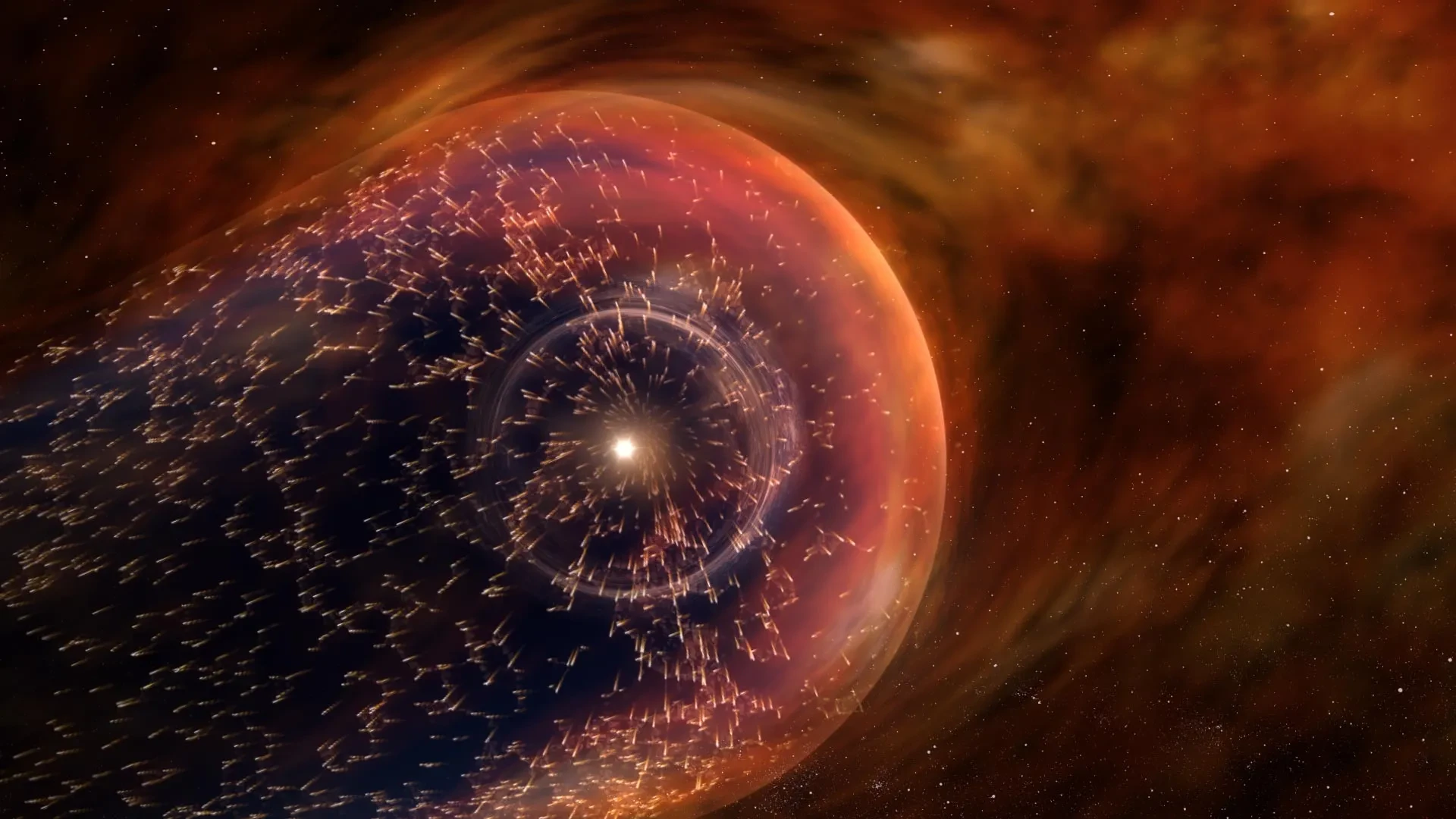
The entire solar system is enclosed within a protective region created by the Sun, functioning somewhat analogously to how Earth is surrounded by its own protective atmosphere. This region, known as the heliosphere, is formed as charged particles in the solar wind continuously stream outward from the Sun in every direction, pushing back against the interstellar medium and creating a vast magnetic bubble.
Reconstructing the Sun’s Galactic Path
This entire heliosphere travels through space as it orbits the center of the Milky Way. Over the course of the Sun’s 4.6-billion-year lifetime, the solar system has drifted through a wide variety of distinct galactic environments, encountering different types of gas, dust, and radiation fields.
In a study published in the Annual Review of Astronomy and Astrophysics, researchers affiliated with NASA’s SHIELD center utilized advanced computer simulations to reconstruct the heliosphere’s historical trajectory through the galaxy. Their results indicate that some of the interstellar regions the solar system encountered during its travels may have produced measurable, lasting changes on Earth.
Merav Opher, SHIELD’s principal investigator based at Boston University, alongside her colleagues, simulated encounters between the solar system and extremely cold, dense regions filled with interstellar gas and dust. Their work indicates that the Sun passed through such environments at least three times during the past several million years.
During these encounters, enormous interstellar "cold clouds" may have pressed against the outer boundaries of the heliosphere with enough force to dramatically compress the protective bubble. According to the team’s simulations, the heliosphere may at times have shrunk to a size significantly smaller than Earth’s current orbit, temporarily leaving our planet exposed outside of the Sun’s usual protective shield.
When Earth May Have Lost Its Solar Shield
The modeled interstellar encounters occurred approximately 2 to 3 million years ago, 6 to 7 million years ago, and 13 to 14 million years ago. If the heliosphere contracted as profoundly as the computer simulations suggest, Earth’s upper atmosphere would have been directly exposed to a very different, harsher interstellar environment during those specific windows of time.
Remarkably, the timing of these modeled events lines up closely with independent geological evidence. Heavier elements and isotopes commonly associated with interstellar dust—such as iron-60—have been discovered in deep-sea sediment cores, layers of Antarctic snow, and lunar samples, all corresponding directly to these specific geological epochs.
These historical episodes of heliosphere collapse may also help researchers explain long-standing mysteries regarding ancient climate patterns. In the simulations, exposing Earth’s upper atmosphere to a dense, cold cloud of galactic hydrogen significantly increased atmospheric water vapor and altered chemical conditions in the upper atmosphere. Those high-altitude effects eventually propagated downward, influencing climate dynamics closer to Earth’s surface.
These results raise the intriguing possibility that the solar system’s routine passages through the colder, denser arms of the Milky Way contributed meaningfully to long-term climate changes on Earth, potentially even helping to trigger major ice ages.
Building a Digital Twin of the Heliosphere
NASA funds SHIELD as one of several specialized centers designed to advance the study of heliophysics. As a DRIVE Science Center, SHIELD brings together interdisciplinary researchers with diverse areas of expertise, distinct modeling methods, and wide-ranging scientific perspectives to tackle complex problems.
One of the center’s primary long-term goals is to build a highly detailed model, often referred to as a "digital twin," of the heliosphere. This sophisticated computational model will help scientists better understand how the Sun’s protective bubble responds dynamically when it encounters hostile features such as dense interstellar clouds or high-pressure galactic shockwaves.
Studying the history, evolution, and structural integrity of our habitable solar system could also provide invaluable clues about how life managed to emerge and evolve on Earth. In the future, this foundational knowledge may assist researchers in identifying other distant star systems capable of supporting habitable worlds.
The Mystery of the Faint Young Sun
While one group of researchers looks outward toward the galaxy, a second recent study focuses on a different, more localized problem involving the Sun’s early history and its impact on our young planet.
Vladimir Airapetian, a scientist at NASA’s Goddard Space Flight Center in Greenbelt, Maryland, and his collaborators investigated how early Earth managed to remain warm enough to maintain liquid water when the young Sun produced significantly less energy than it does today.
Approximately three billion years ago, the Sun was only about 70% as bright as it is in the modern era. Based purely on that reduced solar output and lower energy delivery, Earth should theoretically have been locked in a permanent deep freeze, covered entirely in global ice sheets.
However, geological evidence tells a completely different story. Stable liquid water existed on Earth long before that era, as evidenced by ancient marine sediments and water-worn rock formations. The glaring contradiction between a relatively warm early Earth and a cooler, dimmer Sun is widely known throughout the scientific community as the Faint Young Sun paradox.
A Violent Young Sun May Hold the Answer
Scientists searching for a resolution to this paradox often examine young stars elsewhere in the Milky Way that closely resemble what our Sun was like in its infancy.
These stellar "toddlers" are far more magnetically active and volatile than mature, stable stars like our modern Sun. Observations captured by NASA’s retired Kepler space telescope demonstrate that young, Sun-like stars can produce enormous superflares on a nearly daily basis, sending torrents of high-energy particles racing outward through interplanetary space.
If the young Sun behaved in a similar, violent manner, Airapetian proposes that these energetic particle streams could have triggered cascading chemical reactions in Earth’s early atmosphere that effectively helped to warm the planet.
To test this hypothesis, Airapetian’s research team recreated conditions believed to closely resemble the atmosphere of early Earth inside a specialized, sealed laboratory chamber. The researchers combined molecular nitrogen, ammonia, carbon dioxide, and carbon monoxide in proportions mimicking primordial atmospheric models. They then bombarded this chemical gas mixture with high-energy protons to accurately simulate the continuous stream of energetic particles generated by solar superflares.
Superflares Could Have Created a Powerful Greenhouse Gas
The simulated particle bombardment in the laboratory produced several significant chemical changes, most notably the formation of nitrous oxide. Nitrous oxide is a potent greenhouse gas that is roughly 300 times more effective at trapping heat than carbon dioxide. The details of this study were published in the Astrophysical Journal Letters.
The generation of this nitrous oxide suggests a viable mechanism by which early Earth could have retained sufficient solar heat to prevent a global freeze. Although intense ultraviolet radiation from the young Sun would have inevitably broken down a portion of these nitrous oxide molecules—splitting them back into baseline nitrogen and oxygen—the researchers found that relatively little of the gas was actually needed to make a substantial difference.
Computer climate simulations showed that if just 10% of the nitrous oxide produced in the laboratory experiment successfully survived atmospheric destruction, it could have raised surface temperatures near Earth’s equator to around 41 degrees Fahrenheit, or 5 degrees Celsius. That critical threshold would have been more than enough to keep global surface temperatures safely above the freezing point of water.
Conditions That May Have Favored Early Life
A cooler but unfrozen Earth may have offered yet another distinct advantage for the emergence of biology. The smaller, surviving concentrations of nitrous oxide and associated chemical byproducts could have ideally supported delicate prebiotic chemical reactions.
Previous chemical research has demonstrated that temperatures only slightly above freezing can actually be far more effective than warmer, highly energetic conditions when it comes to assembling complex chains of amino acids and the fundamental building blocks of ribonucleic acid (RNA).
This indicates that the young Sun’s violent, flare-heavy activity may have done far more than simply prevent Earth from freezing into a lifeless snowball. It may have actively helped forge the precise environmental and chemical conditions favorable to the complex prebiotic chemistry that preceded life itself.
How the Sun Helped Shape Earth
Taken together, these two independent studies highlight just how deeply Earth’s history, climate, and biological potential are connected to the behavior of the Sun.
The solar system’s ongoing movement through the Milky Way may have periodically exposed Earth to shifting interstellar environments capable of driving major long-term climate variations. Billions of years earlier, intense, volatile activity from the young Sun may have provided the atmospheric greenhouse warming necessary to keep the planet habitable when sunlight alone should not have been sufficient.
Earth is unusual in many ways, but it has never existed in isolation as a closed system. It formed within a dynamic star-planet environment and has remained intimately connected to the changing behavior, output, and galactic journey of the Sun throughout its multi-billion-year history. Understanding that complex relationship promises to reveal new clues not only about Earth’s ancient past and climate history, but also about the broader evolution of life and the conditions that might make other planetary systems habitable across the cosmos.