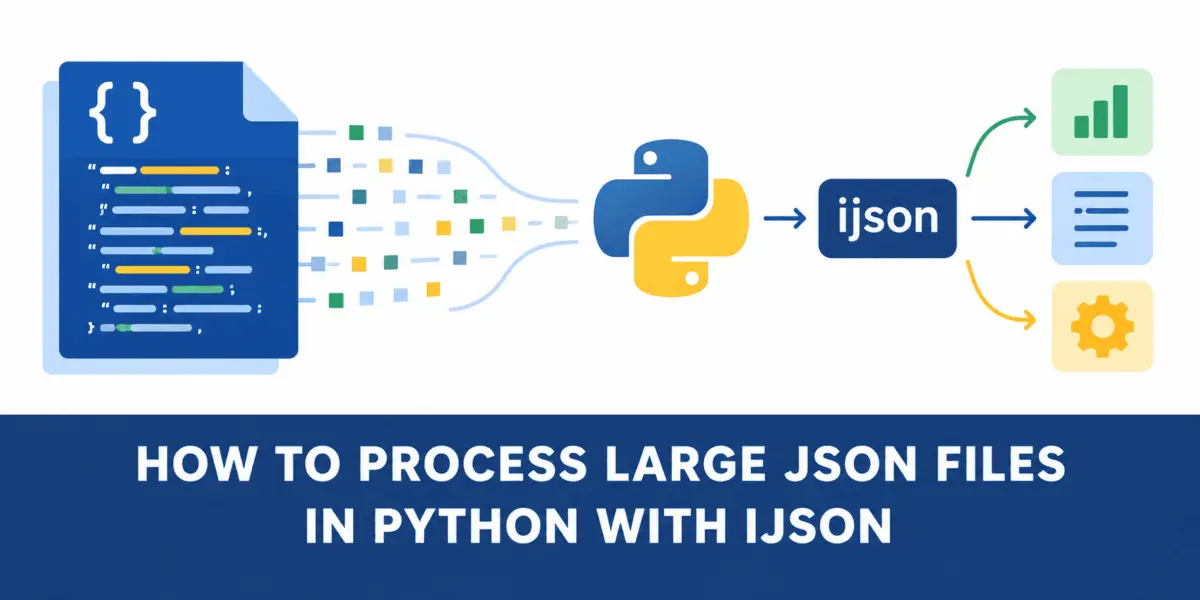
JSON has long been established as one of the most ubiquitous formats for storing and exchanging data across Python applications. For everyday tasks involving moderately sized data files, Python’s built-in json module serves developers reliably, parsing documents cleanly and efficiently into accessible data structures. However, software engineers and data practitioners frequently encounter a critical performance wall when file sizes scale into hundreds of megabytes or gigabytes.
The root of the issue lies in how standard parsing functions operate. Methods like json.load() read an entire JSON document into memory at once, constructing corresponding Python objects—including complex dictionaries, lists, strings, and numerical values—before a single line of data analysis can even begin. Consequently, a file occupying a few hundred megabytes on a hard drive can easily demand several gigabytes of active RAM once fully instantiated in the Python runtime environment.
To address this widespread memory bottleneck, developers are increasingly turning to iterative parsing strategies. Among these tools, ijson has emerged as a premier solution for incremental data processing. By streaming JSON records piece by piece, this iterative parser allows applications to handle massive datasets without exhausting available system memory.
To demonstrate the stark contrast between traditional loading methods and incremental streaming, engineers often turn to robust public datasets, such as the comprehensive San Francisco land-parcel data. Widely utilized in spatial analysis and urban planning experiments, this particular dataset follows the standard GeoJSON FeatureCollection structure, featuring thousands of individual geographic entries containing intricate property descriptions and geometric coordinate arrays.
When evaluating traditional workflows using standard loading techniques, developers typically rely on straightforward scripts to open, read, and iterate through data objects. In the case of the San Francisco parcel dataset, a standard load operation requires Python to ingest the entire file, parse every nested object, and store all geometric coordinates and polygons in memory simultaneously. Even if an analysis only calls for specific textual attributes—such as matching street names or parcel identification numbers—the runtime environment is forced to retain every piece of spatial data included in the document.
Memory profiling experiments highlight the severity of this overhead. When measuring active resource consumption during standard file loading, profiling tools consistently reveal a massive spike in memory usage the exact moment the json.load() function executes. Because every raw JSON key, string, and numeric coordinate must be translated into individual Python objects, the memory footprint balloons far beyond the original size of the file on disk. This discrepancy underscores a vital lesson for software developers: file size on disk does not equate to memory footprint once parsed by conventional means.
In contrast, adopting an iterative streaming approach fundamentally alters how applications interact with large data files. By utilizing incremental parsing functions, developers can bypass the memory-intensive loading phase entirely. Instead of requesting a monolithic data structure, a streaming parser reads the underlying file stream sequentially, isolating specific arrays of interest—such as individual feature items within a collection—and delivering them to the application one record at a time.
This sequential workflow introduces a streamlined operational cycle of reading a single record, processing its attributes, and immediately discarding it from active memory before moving to the next item. As a result, the application’s memory requirements remain stable and minimal, pegged primarily to the size of a single record and the parser’s internal buffer rather than the cumulative volume of the entire dataset.
Comparative performance benchmarks underscore the practical implications of this architectural choice. While traditional loading methods may execute quickly when abundant system RAM is readily available, they introduce significant fragility and scalability risks when system resources are constrained or file sizes continue to grow. Incremental streaming ensures that memory consumption remains decoupled from document size, offering a resilient foundation for data processing pipelines.
Ultimately, the challenges associated with handling large JSON files stem less from the format itself and more from the chosen processing paradigm. As data volumes expand across industries, adopting incremental parsing strategies enables developers to maintain efficient, scalable, and resource-conscious applications capable of handling substantial workloads without straining hardware infrastructure.