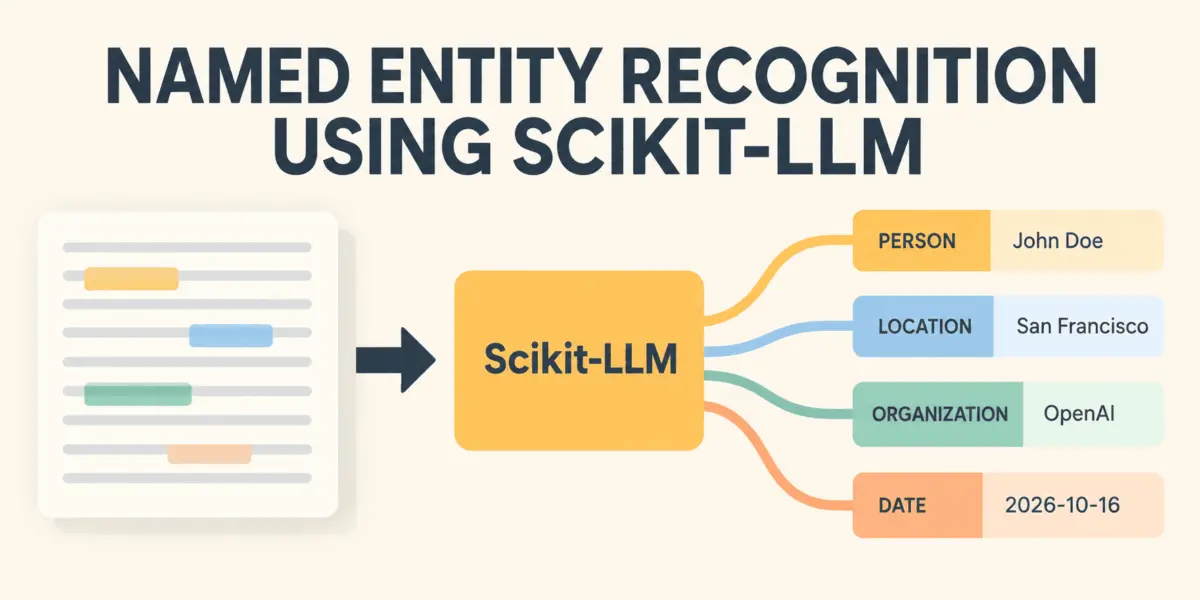
The landscape of natural language processing is undergoing a quiet revolution. For years, extracting structured data from unstructured text—a foundational requirement for everything from data analysis to predictive machine learning—meant navigating the arduous waters of traditional NLP libraries. These legacy systems demanded massive training datasets and grueling fine-tuning cycles simply to recognize custom entities. Today, however, developers and data scientists have access to a more agile paradigm: harnessing the reasoning power of large language models through standardized machine learning pipelines.
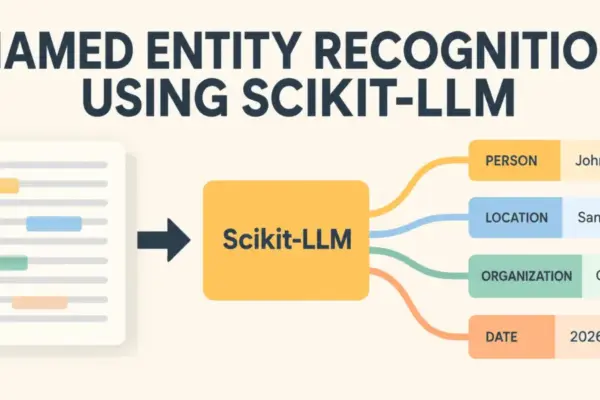
At the forefront of this shift is Scikit-LLM, an open-source framework designed to bridge the gap between traditional scikit-learn workflows and modern LLM capabilities. By integrating LLM reasoning into modular steps, the library enables practitioners to tackle a wide variety of target tasks beyond conventional text classification, opening the door to efficient, highly adaptable custom named entity recognition (NER). Recent demonstrations highlight how combining Scikit-LLM with high-speed API providers like Groq can dramatically simplify the process of transforming messy, raw text into clean, categorized data without the traditional overhead of training models from scratch.
Introduction to Modern Data Extraction Challenges
Structured data extraction remains a cornerstone of modern data analytics. Whether building advanced predictive machine learning models or organizing enterprise documentation, organizations constantly grapple with the challenge of converting unstructured, messy human language into structured formats. Named entity recognition serves as a prime example of this workflow, tasking systems with identifying, extracting, and categorizing relevant pieces of information from continuous streams of text.
Traditionally, achieving high-accuracy NER for domain-specific tasks required significant technical investment. Data teams had to curate extensive annotated corpora, train complex neural architectures, and spend countless hours tuning hyperparameters. These requirements often created bottlenecks, making it difficult to deploy agile solutions for emerging domains or rapidly changing business requirements.
The advent of large language models fundamentally changed this equation. Because LLMs possess generalized reasoning capabilities and extensive semantic knowledge, they can interpret contextual cues and categorize information out of the box. The remaining hurdle, however, has been integration: how to seamlessly incorporate LLM inference into standard, production-ready machine learning pipelines without writing custom boilerplate code for every provider and task. Scikit-LLM was developed to solve precisely this problem, offering a standardized interface that bridges classical machine learning frameworks with state-of-the-art language models.
Running Named Entity Recognition with Scikit-LLM and Groq
Practical implementations of modern AI workflows often prioritize accessibility, speed, and cost-effectiveness. A compelling demonstration of Scikit-LLM’s capabilities involves pairing the library with Groq’s high-speed LLM API, utilizing free-tier models to execute sophisticated entity extraction tasks. By leveraging cloud-based interactive environments such as Google Colab, developers can establish secure API integrations by managing credentials through encrypted secret storage, ensuring that sensitive keys remain protected while allowing the execution environment to communicate seamlessly with external model endpoints.
The technical workflow begins with the installation of the Scikit-LLM library within the development environment. Built upon OpenAI API standards, Scikit-LLM features architectural flexibility that allows developers to override default base URLs. This capability enables seamless integration with alternative, highly optimized inference providers such as Groq, routing requests to fast, cost-efficient endpoints while maintaining standard software design patterns.
Unlike conventional text classification tasks—where models map predefined class labels to text inputs—LLM-driven named entity recognition relies heavily on a structured construct known as an entity dictionary. This dictionary consists of key-value pairs where the keys represent the target categories intended for extraction, and the values provide detailed, descriptive instructions. These descriptions act as semantic guides, directing the underlying language model’s reasoning process and ensuring it understands precisely what criteria define each category within a given domain.
In practical tech-domain scenarios, an entity dictionary might define categories such as executives, corporations, specific hardware or software products, and geographical locations. Alongside this dictionary, practitioners supply a collection of unstructured text samples reflecting real-world discourse. When processed by the system, these inputs challenge the model to parse complex sentences and isolate relevant entities based strictly on the provided guidelines.
The core extraction mechanism relies on specialized estimators within the Scikit-LLM framework, such as the GPTExplainableNER class. When initialized with a compatible pre-trained model—such as open-source offerings hosted on Groq’s infrastructure—and paired with the custom entity dictionary, the estimator executes the extraction pipeline via standard scikit-learn methods like fit_transform(). This method triggers the LLM’s reasoning engine, prompting it to analyze the raw text, evaluate potential matches against the descriptive instructions, and output structured representations of the identified entities.
Parsing and Post-Processing LLM Outputs
While large language models excel at semantic interpretation, their raw output formats can occasionally include verbose reasoning steps, XML-like tagging, or conversational filler that makes direct programmatic consumption challenging. In standard deployments using explainable NER estimators, the raw return values often encapsulate internal reasoning chains, detailing why a particular phrase qualifies as a specific entity type according to the user-defined dictionary.
To transition these rich, explanatory outputs into clean, production-ready data structures, developers typically employ post-processing logic. Because raw model outputs may occasionally present as string-serialized dictionaries or complex tagged strings, robust parsing scripts utilize tools like Python’s abstract syntax tree evaluation or regular expression matching to isolate essential data points. By systematically scanning for designated entity blocks, tags, and values, these post-processing routines strip away extraneous reasoning text and organize the extracted data into clean, categorical dictionaries.
In practical trials involving tech-industry sentences—such as statements regarding executive announcements, hardware product rollouts, and corporate facility locations—this post-processing pipeline successfully distills verbose model responses into concise, highly structured summaries. Executive names, software applications, corporate entities, and municipal locations emerge neatly categorized, demonstrating that minimal pipeline configurations can yield robust, highly accurate results without the need for extensive model fine-tuning.
The Broader Impact on Enterprise Data Workflows
The successful integration of frameworks like Scikit-LLM with accessible LLM endpoints points toward a broader transformation in how organizations approach natural language processing tasks. By lowering the technical barrier to custom named entity recognition, these tools empower data scientists and software engineers to prototype and deploy advanced extraction pipelines in a fraction of the time traditionally required.
As artificial intelligence continues to mature, the emphasis is shifting away from building models from scratch and toward orchestrating existing capabilities through clean, standardized software abstractions. Whether analyzing corporate news, parsing customer feedback, or extracting intelligence from technical documentation, the combination of domain-specific instruction dictionaries, flexible API routing, and lightweight machine learning wrappers provides a powerful blueprint for the future of structured data extraction.
The work done by AI practitioners and thought leaders in streamlining these workflows underscores an ongoing industry trend: making sophisticated AI technology accessible, modular, and immediately applicable to real-world business challenges.