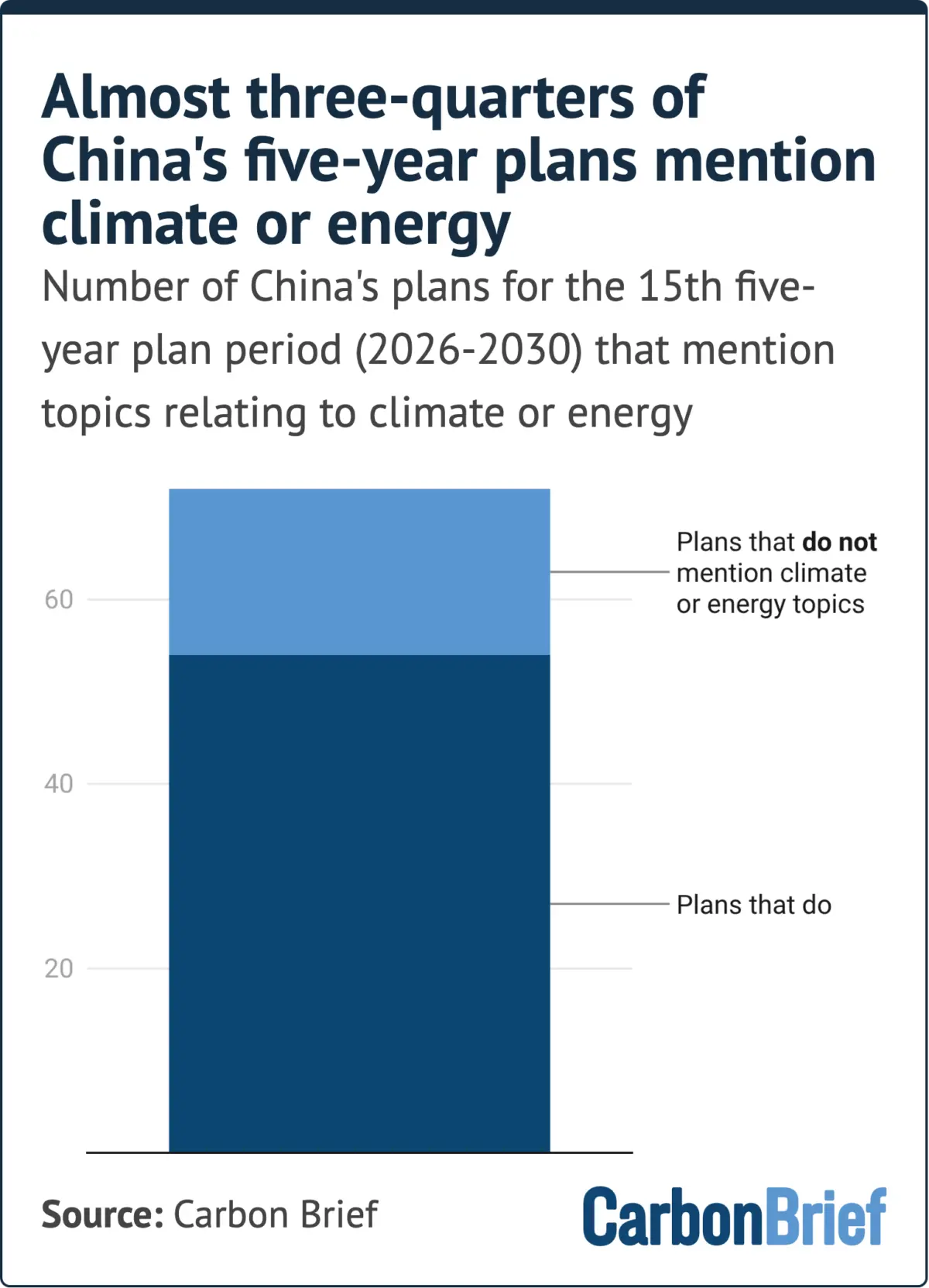
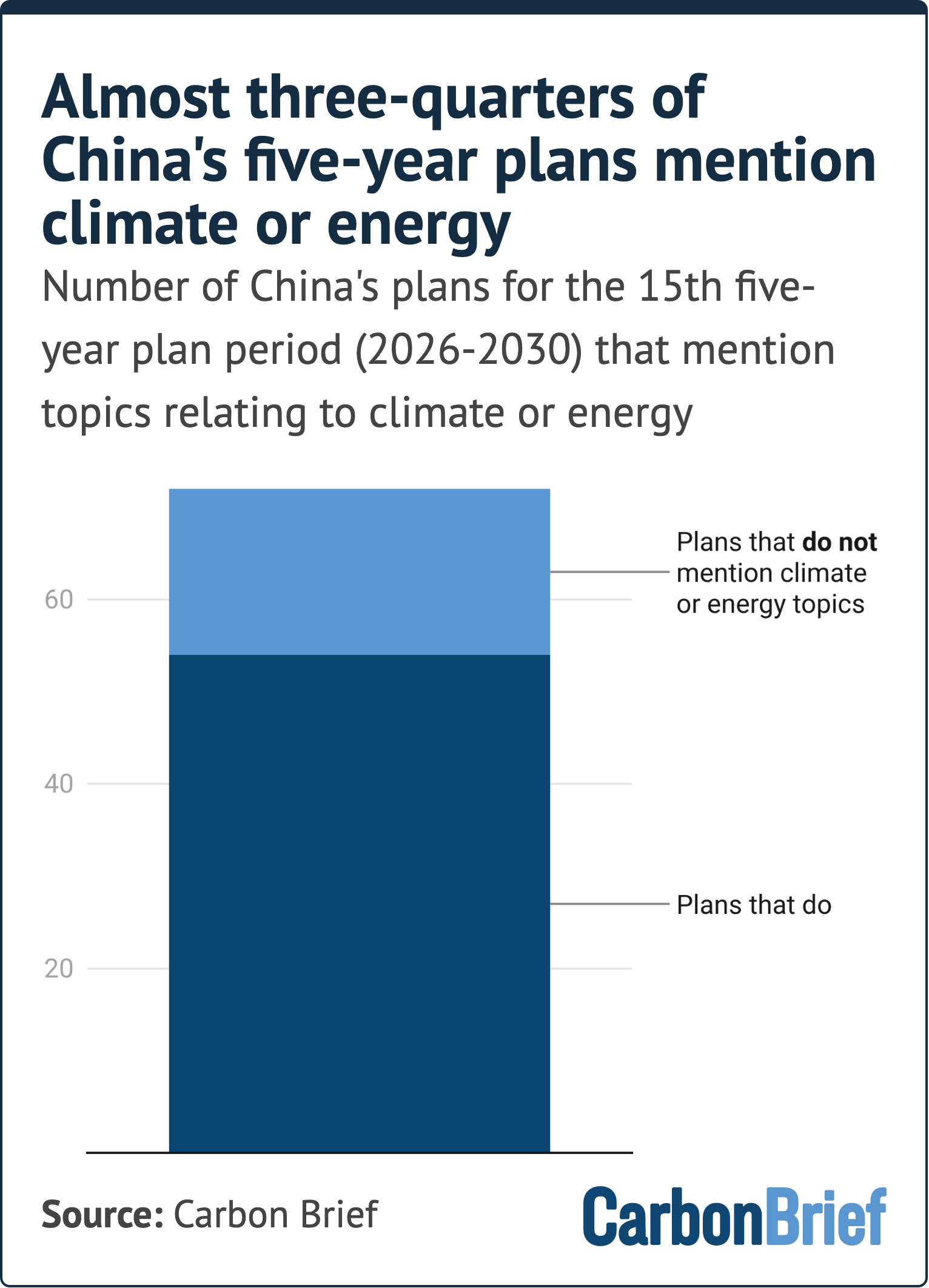
Nearly three-quarters of the 72 five-year plans published by China this year include concrete policies or targets related to climate change and energy, according to a comprehensive new analysis by Carbon Brief.
Five-year plans serve as a cornerstone of China’s complex policymaking apparatus, acting as vital signposts that signal national priorities and establish binding targets for the coming years. The highest-level framework, the overarching 15th five-year plan covering economic and social development for the 2026-2030 period, was officially published in March 2026 during the annual leadership meetings in Beijing. Following this top-level blueprint, the government has progressively rolled out a series of thematic and sectoral five-year plans at the national level, focusing explicitly on critical areas such as renewable energy development, responses to climate change, and the trajectory of fossil-fuel industries.
Furthermore, a significant majority of national-level plans that are not traditionally or directly connected to climate change have also incorporated climate policies, albeit with varying levels of detail. Carbon Brief researchers combed through all available public central-government ministry issuances for the 15th five-year plan period, identifying climate and energy mentions across a broad spectrum of administrative domains. The findings reveal that 54 out of the 72 evaluated plans explicitly integrate climate policies or numerical targets.
This current five-year cycle is widely regarded by domestic and international observers as uniquely critical for global climate action. The 2026-2030 window covers the crucial years leading up to China’s overarching national pledge to peak its carbon dioxide emissions before 2030, alongside commitments to reduce broader greenhouse gas emissions to seven to ten percent below peak levels by 2035.
Using the Tracker and Categorizing Policy Documents
To make sense of this massive corpus of administrative literature, Carbon Brief has developed an interactive tracker that catalogues all 54 relevant plans, detailing their primary goals, numerical targets, notable secondary policies, and providing direct access to official texts or summaries.
The policymaking process in Beijing begins with the overarching macroeconomic plan published in March, which outlines high-level national targets. Over subsequent months and years, specialized ministries—such as the National Development and Reform Commission, the Ministry of Ecology and Environment, and the National Energy Administration—release granular sectoral plans. While the exact total of plans destined for publication in this cycle remains fluid, analysts believe that the most pivotal documents concerning climate and energy have already seen the light of day.
The catalogued plans span an immense range of government activity, stretching from traditional industrial sectors like coal and oil and gas, to emerging tech hubs like electric vehicles, and even touching upon auxiliary sectors such as tourism, accounting methodologies, and urban renewal. Within these documents, researchers divide targets into distinct categories, primarily separating numerical primary targets from qualitative primary goals and secondary policy directives.
Numerical primary targets represent quantifiable metrics designed to hold regional and sectoral authorities accountable by 2030, using 2025 as a baseline. A prominent example within the overarching national plan is the mandatory reduction of carbon intensity—defined as carbon emissions per unit of gross domestic product—by 17% across the five-year span.
Meanwhile, qualitative primary goals establish vital administrative direction without relying strictly on a rigid percentage. For instance, the specialized five-year plan for national meteorological development outlines major qualitative aims, such as significantly enhancing national capabilities for monitoring, forecasting, and early warning systems regarding extreme weather events, while simultaneously driving major progress in comprehensive Earth system forecasting.
The Overarching Plan and Core Climate Strategies
The supreme framework guiding this wave of policy is the 15th five-year plan for national and social development, unveiled during the "two sessions" political gatherings in Beijing. This foundational document establishes the bedrock parameters for China’s green transition, setting the stage for subsequent ministerial directives.
Branching out from this overarching document are core thematic strategies addressing energy systems, ecological protection, and industrial transformation. These include dedicated blueprints for a "new-type energy system," a "new-type power system," renewable energy acceleration, and green industrial growth. At the same time, specific industrial plans for traditional sectors—including coal, oil, and gas—sit alongside forward-looking strategies for smart and connected new-energy vehicles, establishing clear parameters for how heavy industries must adapt or curb their emissions footprint over the decade.
Parallel to traditional five-year plans, Beijing has also issued specialized action plans and implementation blueprints for the 2026-2030 window. These include targeted directives for peaking carbon emissions, boosting energy conservation and carbon reduction within public institutions, preventing meteorological disasters, and driving a coordinated transformation that merges digitalization with green development.
Peripheral Plans Integrating Green Priorities
Beyond dedicated environmental and energy portfolios, a striking feature of China’s current administrative cycle is the integration of green and low-carbon provisions into peripheral plans governing sectors traditionally divorced from climate debates.
Dozens of specialized documents—ranging from agriculture, urban renewal, and forestry management to civil aviation, postal services, health, and tourism—incorporate targeted environmental safeguards or sustainability mandates. For example, plans governing the circular economy, prevention and control of solid waste pollution, and the protection of soil, groundwater, and rural environments introduce localized compliance metrics that align disparate economic sectors with broader national ecological objectives.
Similarly, financial and developmental strategies issued by institutions such as the People’s Bank of China, alongside blueprints for small- and medium-sized enterprise development, information communications, and cultural tourism, feature secondary directives encouraging resource efficiency and low-carbon operational standards. Through this pervasive administrative integration, China’s climate and energy agenda is woven deeply into the daily operations of nearly every level of government administration and industrial oversight.