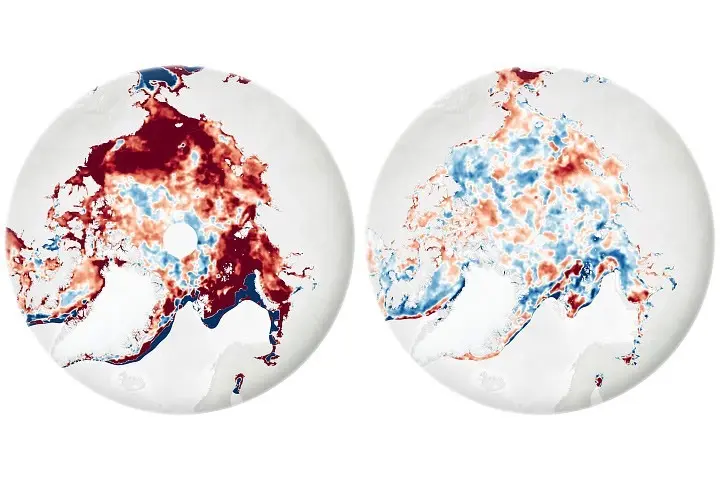
For nearly half a century, the rhythm of the Arctic has been fundamentally disrupted. As global temperatures have climbed, sea ice has reliably melted earlier in the spring and frozen later in the autumn, stretching the duration of the melt season and driving widespread, alarming ice loss across the polar region. This extended exposure to open water has long been considered one of the most visible and consequential markers of a rapidly warming planet.
However, a new NASA-led study reveals a surprising twist in this long-term environmental trajectory. While satellite records show that the Arctic melt season has lengthened dramatically since observations began in the late 1970s, that relentless trend unexpectedly stabilized around 2010.
According to the research, the Arctic sea ice melt season is now roughly 40 days longer than it was in 1979. Yet, the vast majority of that increase occurred prior to 2010. In the years since, the average length of the melt season has remained relatively steady, even amidst significant year-to-year fluctuations driven by shifting weather patterns.
Tracking Decades of Polar Transformation
To uncover these changing dynamics, researchers analyzed a comprehensive record of satellite observations spanning from 1979 to 2023. By tracking the precise timing of when sea ice begins its annual retreat each spring and when it successfully refreezes each autumn, the scientific team was able to map the evolution of the polar climate over more than four decades.
The data revealed that the historical lengthening of the melt season was driven primarily by sea ice freezing later in the calendar year, rather than melting significantly earlier in the spring. As autumn temperatures have risen, the window for ice recovery has narrowed substantially.
"Previously, there was more of this multiyear ice that didn’t melt away each summer," said Linette Boisvert, a co-author on the new study and an ice scientist at NASA’s Goddard Space Flight Center.
With the landscape shifting away from thick, resilient multiyear ice toward a fragile, younger, and thinner ice pack, the dynamics of the region have transformed. "Now that the ice is thinner and there’s less of it, there’s a lot more variability," Boisvert noted. On average, however, the rapid downward spiral in sea ice thickness and extent that characterized the 2000s appears to have paused for the time being.
Unraveling the Arctic Energy Balance
To understand the mechanics behind this stabilization, the research team turned to the Arctic’s energy balance—the complex, net difference between incoming heat absorbed from the Sun, atmosphere, and ocean, and the outgoing infrared radiation emitted back into space.
During the 2000s, a period marked by rapid and severe ice loss, the mechanisms of the polar climate operated in a compounding feedback loop. As early-season melt reduced the extent of the bright white ice cover, it exposed vast expanses of darker ocean water beneath. This dark surface absorbed significantly more solar radiation than reflective ice. The extra stored solar energy delayed the autumn freeze and heavily extended the melt season. During that decade, the red-mapped regions of the Arctic saw the melt season expand by as many as five days per year.
Because much of today’s Arctic ice is younger, thinner, and less structurally robust than the ancient multiyear ice that once dominated the polar basin, it is inherently more vulnerable to day-to-day and year-to-year variations in cloud cover, severe storms, and atmospheric winds.
Since roughly 2010, however, changing cloud patterns have altered this equation. These shifting cloud dynamics have successfully reduced the total amount of direct sunlight reaching specific regions of the Arctic Ocean. Consequently, the melt season has experienced fluctuations from one year to the next, yet it has managed to remain relatively stable over longer, multi-year periods. Lighter color tones on contemporary scientific maps reflect this recent shift, illustrating much more modest rates of change over the past decade and a half.
A New Phase Shaped by Weather and Vulnerability
Earth scientists emphasize that these recent findings do not suggest that broader shifts in the global climate have stopped affecting the Arctic. The region continues to warm at a staggering pace, outstripping the rest of the planet by heating nearly four times faster than the global average. Furthermore, the sea ice that remains today is substantially thinner and less resilient than it was several decades ago.
Instead, the study suggests that the Arctic may have crossed a threshold into a new operational phase. In this current state, short-term annual weather patterns and atmospheric conditions exert a much stronger influence on the duration of the melt season than they did in the past.
"Melt season length is much more dependent on atmospheric effects," Boisvert explained. "They seem to be playing a bigger role because the ice is generally thinner and more vulnerable to begin with."
Researchers caution that this apparent stabilization could easily prove to be temporary. Pockets of thick, multiyear Arctic ice still persist year-round to the north of Greenland and throughout the Canadian Arctic Archipelago. If continued warming leads to the thinning or loss of ice in these remaining strongholds, it could trigger a new wave of rapid sea ice decline, potentially extending the melt season once again.
For now, the study underscores the critical need for continued, high-resolution satellite monitoring of Arctic sea ice and the delicate energy balance that dictates its seasonal growth and decay. Whether the recent decade of stabilization represents a permanent shift in the rhythm of the polar melt season or merely a temporary pause before another rapid acceleration remains an open question for climate scientists worldwide.