Much of today’s ongoing corporate conversation surrounding artificial intelligence focuses intently on models, prompts, and autonomous agents. Yet as enterprises rapidly transition from experimental sandboxes to full operational deployment, industry observations indicate that the biggest hurdle is rarely the raw intelligence of the model itself. Instead, the ultimate test lies in the quality, context, and trustworthiness of the information those advanced systems rely upon to make critical business decisions.
Historically, enterprise data existed primarily to help human decision-makers navigate complex operational landscapes. Today, that exact same corporate data is increasingly being consumed directly by AI assistants and intelligent agents designed to answer complex queries, execute automated tasks, and support broader business operations. As organizations accelerate their AI adoption curves, a fundamental challenge is becoming strikingly clear: artificial intelligence systems require far more than simple access to data. They require access to data they can fundamentally trust. This structural shift is forcing corporate leaders to look well beyond superficial AI capabilities and focus much more closely on the foundational infrastructure that supports them.
The underlying reality is that any AI system can only ever be as effective as the information it ingests. If the underlying corporate data is incomplete, inconsistent, poorly defined, or entirely disconnected from real business context, even the most sophisticated modern AI model can generate answers that sound remarkably credible while ultimately leading users down the wrong strategic path.
This dilemma becomes particularly acute as organizations move past initial experimentation phases and begin embedding AI deeply into live business processes. When an AI tool is merely summarizing general documents or helping corporate employees brainstorm creative ideas, occasional inaccuracies or hallucinations may be entirely manageable. However, when artificial intelligence is actively supporting high-stakes operational decisions, live customer interactions, strict regulatory compliance processes, or long-term strategic planning, trust rapidly transforms into a vital, high-stakes consideration.
For that reason, industry perspectives suggest that the next phase of enterprise AI will not be defined by larger models or increasingly complex prompting techniques. Rather, it will be defined by how effectively organizations manage to provide their AI systems with the trusted context required to operate reliably at scale.
The Enterprise Context Problem
One of the most persistent misconceptions across the technology landscape today is that granting AI access to data automatically creates genuine understanding. In reality, modern enterprise environments are filled with nuanced context that human workers often take completely for granted.
A human employee intuitively knows that two different internal systems may use conflicting definitions for a single customer. They instinctively understand which financial metric should be utilized in a specific departmental report and which version should be avoided entirely. They recognize effortlessly that one dataset is considered authoritative while another was intended strictly for historical reference. These valuable insights are typically built over years, or even decades, of hands-on experience working within the specific ecosystem of a business. Artificial intelligence systems do not automatically possess that institutional knowledge.
Without proper context, AI is left to independently infer meaning from unstructured environments. Sometimes those automated inferences happen to be correct. Other times, they miss the mark entirely. The core operational challenge is that AI tools frequently present both accurate and inaccurate outcomes with the exact same level of unwavering statistical confidence.
This issue becomes even more pronounced inside large, sprawling enterprises where data is heavily fragmented across multiple cloud environments, disparate business units, and legacy operational systems. Years of corporate mergers and acquisitions, uncoordinated technology investments, and constantly evolving business requirements have combined to create highly heterogeneous data landscapes. While human workers gradually learn to navigate those systemic complexities through daily exposure, artificial intelligence requires organizations to explicitly define them.
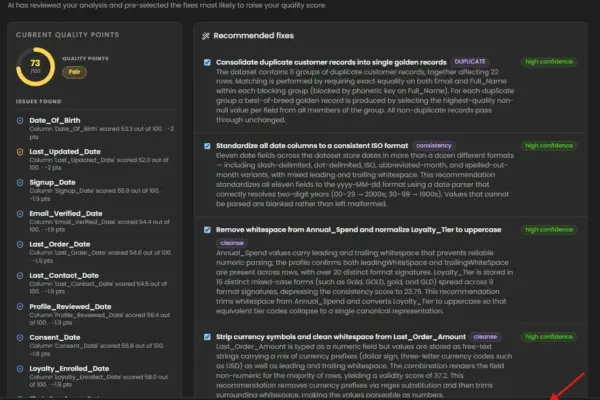
The underlying problem is rarely whether the necessary information actually exists within the corporate network. More frequently, the core issue is whether that information is properly defined, thoroughly governed, and securely connected to the precise business meaning required to support accurate, reliable decisions.
Generative artificial intelligence is, by its very nature, probabilistic. It evaluates a wide array of statistical possibilities and generates responses based strictly on underlying patterns and mathematical likelihoods. While that capability is precisely what makes these modern systems so remarkably powerful, it also introduces an inherent layer of operational uncertainty.
As organizations place progressively greater reliance on artificial intelligence, they desperately require a mechanism that balances that inherent uncertainty with consistency and absolute control. They need a deterministic layer.
A deterministic layer provides the trusted context that AI systems require before taking action on enterprise information. It guarantees that the data being consumed by the AI is supported by crystal-clear business definitions, semantic meaning, data lineage, robust governance controls, and stringent quality standards. Rather than forcing an artificial intelligence system to interpret deep enterprise complexity entirely on its own, organizations provide a structured framework that safely guides those interactions.
This approach is not about limiting the potential of AI. It is entirely about making AI significantly more reliable.
When an autonomous agent requests customer information, revenue metrics, operational performance indicators, or risk measurements, it should not be left to determine what those complex concepts mean independently. It should be fully equipped to reference established business definitions that have already been vetted and agreed upon across the broader organization. It should inherently understand precisely where the information originated, who maintains ownership of it, and whether it meets the strict compliance standards required for a specific operational use case.
In simpler terms, enterprise AI should consume trusted context rather than being forced to invent it.
The Growing Importance of Semantics
As enterprises accelerate their AI adoption strategies, proper semantics are rapidly becoming an indispensable priority.
Many established organizations currently maintain multiple conflicting definitions for the exact same core business concept. Different internal departments frequently interpret foundational terms in distinct ways based entirely on their specific job responsibilities, specialized reporting requirements, or legacy historical processes. A customer, account, supplier, policyholder, or revenue metric may mean one specific thing to the sales team and something entirely different to the finance department.
Human workers frequently compensate for these internal discrepancies through accumulated experience and deep institutional knowledge. People intuitively understand when definitions shift and how they apply differently across various operational contexts. AI systems simply do not possess that distinct advantage.
Without a well-maintained semantic layer, autonomous agents may successfully access the right database tables while still fundamentally misunderstanding what that data actually means. The resulting output may be technically accurate from a data retrieval standpoint while remaining entirely misaligned with the actual business question that was originally asked.
A deterministic foundation helps address this persistent challenge by establishing cross-enterprise consistency. It builds shared, standardized business definitions and provides a common analytical lens through which both human employees and machines can understand underlying information. As artificial intelligence becomes embedded across an increasing number of corporate business functions, this shared operational understanding becomes exponentially more important.
Governance Is No Longer Optional
For many years, data governance was frequently viewed by corporate leadership as little more than a box-checking compliance requirement or a quiet back-office administrative activity. In the modern era of enterprise artificial intelligence, it has firmly transformed into an essential business necessity.
Organizations frequently fixate intensely on how quickly they can deploy new AI capabilities, automate complex workflows, or scale autonomous agents across departments. While those are undoubtedly important strategic objectives, they must be accompanied by equally rigorous considerations regarding data ownership, organizational accountability, and system trust.
Who ultimately owns the specific data being consumed by an internal AI system? What precise quality standards define acceptable data? Which regulatory policies govern its usage? Who is strictly responsible for maintaining and updating those definitions over time as business conditions evolve?
The answers to those critical questions have always mattered to forward-thinking enterprises, but artificial intelligence dramatically amplifies their importance. Once organizations begin allowing AI tools to directly influence high-level business decisions and automated actions, even minor gaps in governance quickly translate into major gaps in institutional trust.
A reliable deterministic layer helps ensure that these vital controls are applied consistently throughout the enterprise. Rather than forcing IT teams to repeatedly redefine business rules across dozens of disparate systems and workflows, organizations can establish trusted definitions once and deploy them uniformly across their entire data and AI ecosystem. This approach successfully reduces internal inconsistency, dramatically improves operational transparency, and builds a much stronger foundation for scaling AI responsibly.
The Future of Enterprise AI
The opening chapter of enterprise artificial intelligence was characterized largely by exploration and experimentation. Organizations explored potential use cases, tested various foundation models, and evaluated what the transformative technology was technically capable of achieving.
The next critical chapter will be defined by operationalization.
As artificial intelligence moves significantly closer to core business processes, long-term success will depend far less on generating impressive technological demonstrations and far more on delivering consistently reliable operational outcomes. Enterprises will increasingly evaluate AI investments based on whether they can reliably support critical decisions, improve internal efficiency, reduce systemic risk, and create measurable business value.
At that pivotal juncture, the corporate conversation naturally shifts away from models and back toward underlying data.
This shift happens not because foundation models stop mattering, but because even the most capable AI system cannot manufacture trust entirely on its own. True trust stems directly from a deep, verifiable understanding of the meaning, quality, lineage, and governance of the information being utilized.
Organizations that recognize this structural shift early on will find themselves far better positioned to transition successfully from isolated AI initiatives to true enterprise-scale adoption. They will possess the foundational infrastructure required to provide consistent context across disparate systems, diverse teams, and complex applications, allowing their artificial intelligence systems to operate with significantly greater confidence and operational reliability.
The broader technology industry will undoubtedly continue to focus heavily on rapid model improvements, faster inference speeds, and increasingly sophisticated autonomous agents. Those developments are critically important and will continue to expand the boundaries of what is possible. However, as artificial intelligence becomes more deeply embedded in day-to-day business operations, organizations must remember that pure intelligence alone is never enough.
The true operational challenge facing modern enterprises is ensuring that artificial intelligence can consistently distinguish between information that is simply available in a database and information that is genuinely trustworthy. That is precisely why the most vital layer in enterprise AI may not be the model itself, but rather the deterministic layer operating safely beneath it.