When an armed individual breaches the secure perimeter of a school, corporate office, or public facility, security personnel and first responders are thrust into a high-stakes scenario where every single second dictates the difference between life and loss. Traditional emergency protocols often rely on human intervention after the fact, leaving a perilous window of time during which occupants must hide, evacuate, or fend for themselves while police mobilize, travel to the scene, and navigate unfamiliar interior layouts.
Enter Brecourt Solutions, an Enfield, Connecticut-based drone security startup that believes the future of active-shooter mitigation lies not in waiting for officers to arrive, but in deploying pre-positioned autonomous technology from within the building itself. Founded by former Navy SEAL Jeff Ross, the company has introduced a sophisticated indoor drone-as-first-responder system known as the iDFR. However, Brecourt is pushing the boundaries of tactical technology even further by developing an unprecedented mechanism: a specialized tool designed to allow its proprietary quadcopter to collide with a suspect’s firearm and render it entirely inoperable through the targeted deployment of rare-earth magnets.
Indoor Drone Security That Targets the Weapon, Not the Person
As security innovators grapple with the complexities of indoor threat mitigation, Brecourt’s approach introduces a distinct tactical philosophy. According to Ross, unlike other proposed indoor security systems that might rely on lethal force or hazardous deterrents, the firearm malfunction device currently under development is engineered to neutralize the tool of violence rather than harm the individual wielding it.
"It’s a non-violent, non-harmful means to stop the most deadly thing that is being utilized in an active-shooter situation," Ross explained during an interview detailing the startup’s ongoing research and development initiatives. "There may be other solutions out there that are talking about potentially hurting people."
While the gun-jamming payload remains in the research and development phase, Ross confirmed that rigorous testing has already demonstrated its effectiveness across a wide cross-section of modern firearms. By focusing on the mechanical vulnerabilities common to the vast majority of civilian-market and tactical long guns and handguns, the startup aims to cover the most prevalent threats encountered in contemporary mass-casualty events.
"We’re able to malfunction AR-style rifles, semi-automatic pistols, pump-action and semi-automatic shotguns," Ross said. "And those are about 95% of the weapons utilized in active-shooter situations."
The conceptual foundation for this unconventional security tool dates back years, rooted deeply in Ross’s military background. During his deployments with the Navy SEAL Teams, he frequently observed how environmental contaminants such as fine desert sand, grime, and corrosive salt water could infiltrate a firearm’s delicate moving parts, causing it to fail catastrophically. Translating those operational field lessons into a domestic security context sparked an ambitious question: What if a device could be built small enough to be mounted onto an agile indoor drone, allowing it to autonomously home in on a shooter’s weapon and force a mechanical stoppage?
How Rare-Earth Magnets Jam a Firearm
The mechanics behind Brecourt’s patented process rely on physics and proximity. When the company’s indoor quadcopter deliberately impacts the targeted weapon, the specialized firearm-malfunction device releases a tightly packed payload of tiny, highly powerful rare-earth magnets.
These micro-magnets are designed to immediately migrate into the bolt-carrier group and other critical internal mechanisms that form the primary working guts of the firearm. Once lodged within the tight tolerances of the weapon’s action, the magnetic interference and physical obstruction prevent the firearm from cycling, effectively jamming it and buying crucial moments for building occupants to escape or for law enforcement to secure the premises.
Ross noted that the reception from prospective enterprise and institutional customers has been overwhelmingly enthusiastic, though security directors naturally want to thoroughly evaluate the system’s efficacy and reliability before committing capital. The startup is currently targeting a timeline that would allow them to commercially offer the firearm-disabling device to the market by the end of next year.

"What we’re seeing from potential customers, there is a lot of excitement around this technology," Ross said. "But as you could imagine, a customer wants to measure the system and the value that it provides."
Company Begins in Basement Workshop
The trajectory of Brecourt Solutions began long before it incorporated as a formal business entity. Ross originally built the early prototypes for the indoor drone security system in his personal basement workshop while still serving in the military, prior to his retirement as a Navy SEAL.
However, the catalyst that galvanized his vision into an urgent commercial mission was the tragic 2022 mass shooting at Robb Elementary School in Uvalde, Texas. During that incident, law enforcement officers faced agonizing delays and tactical hesitation, taking over an hour to make entry and confront the gunman. The tragedy highlighted a glaring vulnerability in modern institutional safety: the dangerously long gap between the onset of a crisis and the physical arrival of armed responders.
Reflecting on how society approaches other types of building emergencies, Ross drew a direct parallel to fire safety infrastructure.
"It got me thinking about how we respond to other emergencies, for example, fires. We have smoke detectors and fire alarms, but we don’t wait for the fire department to arrive," Ross said. "We pre-install and pre-position sprinkler systems that have been shown to reduce casualties, loss of life and damage to facilities."
Driven by this preventive philosophy, Ross and his co-founders formally incorporated Brecourt Solutions in 2023 to bring their pre-positioned immediate drone response architecture to the commercial security market. The company officially launched its flagship iDFR platform at the beginning of this year, marrying nimble indoor drone hardware with advanced computer vision, real-time video streaming, and remote piloting capabilities.
iDFR Platform Expands Beyond Active-Shooter Response
Although the foundational architecture of the iDFR platform was conceived primarily as a defense against active shooters, early interactions with enterprise end-users quickly revealed a broader market demand. Facility managers and security directors made it clear that while active-shooter protection is an absolute necessity, organizations require tools that justify their investment through daily utility.
"We’re looking now at our core competencies and are not just responding to the active-shooter situation, but also patrols, alarm verification and routine inspections," Ross said.
By expanding the platform’s operational repertoire, Brecourt has successfully integrated its technology into the everyday operational workflows of modern facilities. Rather than serving solely as a dormant emergency safeguard designed for catastrophic events that possess an extremely low statistical probability of occurring, the drones now function as active components of routine site security and infrastructure management. This dual-purpose utility bridges the gap between rare emergency readiness and continuous daily value.
Indoor Drones Built for GPS-Denied Environments
Operating uncrewed aerial vehicles inside complex commercial buildings presents significant engineering challenges, chief among them being the absence of Global Positioning System signals. Standard satellite navigation fails indoors, making precise autonomous flight nearly impossible without specialized local infrastructure.

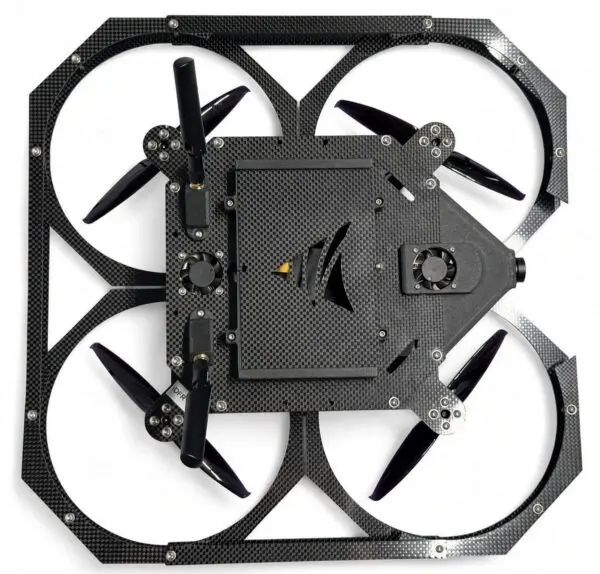
To overcome this, Brecourt engineered its 12-by-12-inch quadcopters to navigate seamlessly within GPS-denied environments by establishing dedicated communication networks deployed directly inside the facility. The compact physical footprint of the drones allows them to maneuver through narrow corridors, offices, and industrial spaces with high agility.
Each drone rests securely on top of an automated charging station, ensuring that the battery remains continuously replenished and the system is perpetually ready for immediate deployment. While individual flight times hover around 20 minutes, the constant trickle-charge station architecture ensures operational readiness around the clock.
The drones feature autonomous takeoff capabilities and precision landing protocols, but once airborne, they are piloted by human operators. By prioritizing low-latency video and control feeds, Brecourt enables human pilots to safely fly the drones from an on-site security operations center or even a remote monitoring facility located across the country.
"If you’re thinking on the critical incident response, we’re a layer within that response core," Ross noted. "If an incident is detected, we integrate with that detection capability on the operations center side."
Customers Demand NDAA Compliance
Brecourt’s primary customer base consists of commercial security firms and enterprises seeking to bolster the physical protection of large-scale facilities such as warehouses, distribution centers, corporate campuses, and major logistics hubs. Looking ahead, the company is also eyeing expansions into large retail operations and high-occupancy event venues where crowd safety and rapid situational awareness are paramount.
A critical selling point for Brecourt in the current procurement landscape is its strict adherence to domestic manufacturing standards. All of the startup’s drones and associated hardware are built in the United States and are fully compliant with the National Defense Authorization Act. Ross noted that this adherence to domestic sourcing has transformed from a secondary consideration into an absolute baseline requirement for corporate and institutional buyers.
"We’re not necessarily focused on the government side, even though we’re beginning to dip our toes into working with different government and federal entities," Ross said. Over recent years, he has observed a profound paradigm shift among commercial clients away from foreign-made security tech and toward systems that satisfy rigorous country-of-origin standards.
"We built everything in-house. We do source the companion computer and motors, but all the high-level assembly happens within our facility," he added. "I think maybe if you asked me a couple years ago if that was as important, I would have said no. But I think it’s important for us to be built in the USA and to procure our equipment from vendors who manufacture in the USA as well."