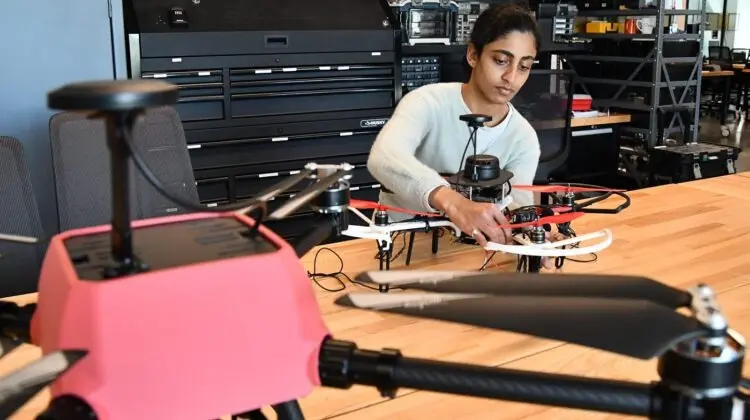
Researchers at the University of Cincinnati are harnessing the power of acoustics to help NASA identify compromised drone motors and propellers before a catastrophic in-flight failure occurs. As the integration of unmanned aerial vehicles into everyday airspace accelerates, ensuring structural and mechanical reliability has become a paramount concern for aerospace engineers and safety regulators alike.
Prissha Chawla, a doctoral student within the UC College of Engineering and Applied Science, is leading this innovative research alongside her academic partners. The team has meticulously recorded the distinct acoustic signatures that drones emit when their components begin to degrade—specifically capturing the subtle audio shifts produced by chipped or cracked propellers, as well as the grating noises of a motor that is damaged or entering early stages of failure.
By converting these raw audio recordings into actionable data, the research team is paving the way for ground station computers to automatically flag a drone as unairworthy before it ever clears the ground. The student researchers are scheduled to present their findings and methodology at the upcoming Modelling, Estimation and Control Conference in Phoenix.
The genesis of the project traces back to 2024, driven by a direct initiative from NASA to develop reliable pre-flight diagnostic methods for identifying motor anomalies. The stakes for this kind of technology are exceptionally high, particularly as the scope of unmanned aviation broadens.
"The project started in 2024 with interest by NASA in detecting problems with motors before a drone took off," Chawla explained, noting the critical safety implications of modern drone operations. "More and more, drones are being used for public safety. You don’t want them to crash."
How acoustic drone damage detection works
While much of the existing research in drone health management relies heavily on onboard telemetry, visual checks, or complex sensor suites, the University of Cincinnati team’s current work focuses squarely on the ground environment. This approach allows for a streamlined integration into existing operational workflows without requiring heavy modifications to the aircraft themselves.
"We’re focusing on pre-flight tests that NASA already runs," Chawla said.
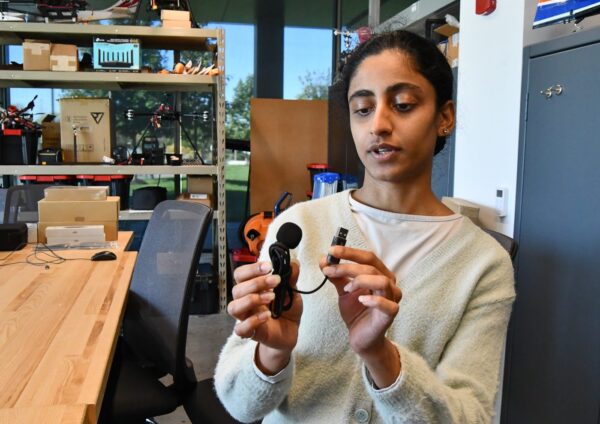
Beyond structural blemishes like chips and hairline fractures in the rotor blades, the acoustic monitoring system is designed to catch hidden mechanical issues. For instance, tiny particles of grit, dust, and other environmental debris frequently find their way into delicate motor bearings during field operations. Over time, this foreign matter can cause internal friction, wear down components, and eventually lead to a complete motor seizure.
Acoustic drone damage detection aims to catch these insidious mechanical faults through subtle deviations in the sound profile a drone produces during initial spin-up, offering a robust alternative or supplement to visual inspections alone, which often fail to catch microscopic fractures or internal bearing wear.
Looking beyond pre-flight assessments, the research team harbors long-term ambitions for the technology. Eventually, the students envision a fully autonomous drone capable of relying on acoustic monitoring in real-time. By continuously listening to its own mechanical output during flight, such an intelligent aircraft could detect damage to its propellers and other critical systems mid-mission, allowing it to autonomously return to base before experiencing a catastrophic structural failure.
Preflight checks for drone-in-a-box systems
As unmanned systems become increasingly automated, the potential applications for acoustic diagnostic tools continue to expand across different deployment models. UC student Luke Busse emphasized that the newly developed damage-detection system could seamlessly integrate into modern, fully autonomous drone-in-a-box architectures.
In these advanced operational setups, drones are housed within weatherproof, automated docking stations. These specialized enclosures handle every phase of the mission lifecycle independently, managing launch, precision landing, battery charging, data upload, and mission scheduling entirely without the need for an on-site human operator to oversee the process.
"In that scenario, it would be great. You could have sensors in the box that provide preflight checks," Busse said, pointing out how acoustic monitoring could serve as an essential gatekeeper for remote fleets operating out of sight and out of reach.
For more information regarding ongoing research and academic programs related to this initiative, interested parties can visit the University of Cincinnati College of Engineering and Applied Science.