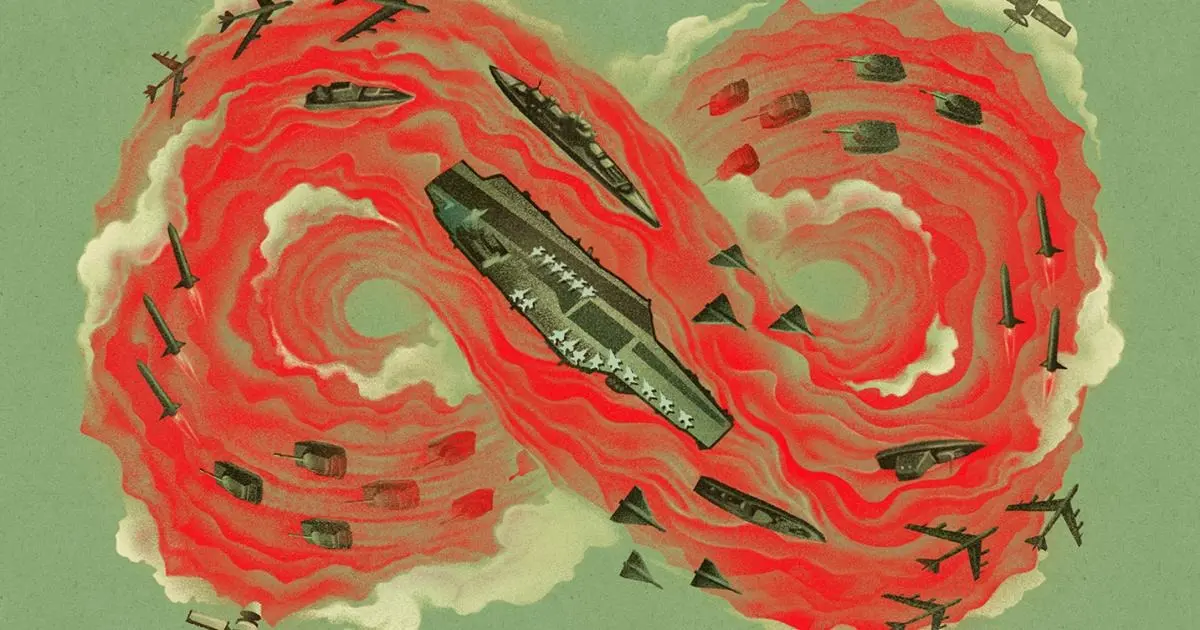
Military victory remains one of the most alluring concepts in statecraft. The promise of a short, violent campaign that cleanly defeats an adversary offers the intoxicating prospect of immense political payoffs achieved at a tolerable price. Yet, history and contemporary conflicts consistently demonstrate that this promise is a dangerous illusion. From the Middle East to Eastern Europe, modern leaders continually pin their hopes on the prospect of total battlefield triumph, only to find themselves mired in protracted stalemates.
The Trump administration anticipated a swift and decisive outcome in its campaign against Iran. Prime Minister Benjamin Netanyahu’s government sought a similar resolution in Gaza, subsequently expanding its military operations into Lebanon and Iran. Russian President Vladimir Putin operated under the firm assumption that his 2022 invasion of Ukraine would deliver a rapid military collapse of the Ukrainian state. Meanwhile, critics of U.S. interventions in Afghanistan and Iraq frequently decry a supposed failure to achieve military victory, often drawing a stark contrast with what they perceive as decisive battlefield outcomes in the 1990–91 Gulf War and World War II. Until recently, debates over Western military aid to Ukraine were heavily dominated by calls to help the nation secure a pure military victory, while dismissing diplomatic negotiations as a form of dangerous appeasement.
Yet, despite how frequently the term is invoked by policymakers, pundits, and military analysts alike, few ever define it. In political science and strategic theory, "victory" fundamentally means achieving the political aims for which a nation went to war. However, the modifier "military victory" implies something far more absolute. The adjective signals that those political aims are secured purely through combat rather than at the bargaining table. Negotiation inherently requires compromise, involves frustrating stalls, and risks exhausting the political will of a domestic population. Battlefield victory, by contrast, dangles the promise of a prostrate enemy left with no meaningful choice but to accept the victor’s terms strictly on the victor’s own timetable. That potent promise is precisely what makes the idea of military victory so attractive and ubiquitous across global capitals.
Despite its enduring appeal, the notion of military victory is a myth with catastrophic consequences. The reality of modern warfare is that all wars ultimately end in negotiated settlements; diplomatic talks and political bargaining are never a second-best fallback option. To bring any war to a close, both opposing sides must actively choose to stop fighting, and those choices invariably require nontrivial bargaining. Physical destruction matters immensely, of course, as it is precisely what distinguishes war from peacetime politics. However, the true role of military force and destruction is to shape the terms of the bargain, not to completely annihilate the enemy—an outcome that almost never happens in modern interstate conflict.
This persistent myth has repeatedly lured governments into initiating or prolonging wars on false premises regarding how those conflicts will eventually conclude. The Trump administration believed that overwhelming force could compel Iran’s unconditional surrender; instead, the United States has found itself trapped in a costly strategic stalemate. The Netanyahu government’s conviction that it can utterly defeat Hamas militarily has only served to lengthen the war in Gaza in pursuit of an unattainable objective. Similarly, Putin’s persistent expectation of a decisive battlefield victory in Ukraine has mired both nations in a grinding war of attrition with no apparent endgame in sight.
Should Chinese leader Xi Jinping fall into the same strategic trap, a military assault on Taiwan could easily ensnare Beijing in a conflict that is far easier to start than to stop, carrying geopolitical stakes that extend far beyond the Taiwan Strait. Conversely, if Washington assumes it could secure a clean military victory in a direct conflict with China, it too could find itself economically and politically exhausted in a fight it cannot easily conclude. Muddled strategic thinking regarding how wars conclude also breeds prewar errors in intelligence gathering, defense modernization, and force design. Furthermore, a fundamental misunderstanding of the relationship between bargaining and fighting produces a systematic failure to integrate negotiating strategy with overarching military campaign planning. As long as policymakers fail to grasp that wars end exclusively when both sides are ready to lay down their arms, they will continue to be frustrated by the inherent inability of military force alone to achieve their political goals.
Carthage Was the Exception
No modern war has ever completely destroyed an enemy’s ability to resist. Belligerents can almost always choose to keep fighting, even after their enemies sweep their conventional military forces from the field or capture their capital city. Such persistent irregular resistance can dramatically reverse fortunes and ultimately decide the outcome of wars. Winning a war requires offering surviving and potential fighters a political deal that they actively prefer to the hardships of continued resistance. These arrangements can certainly be highly one-sided, but terms and bargaining always matter: no war ends unless both sides choose to accept a settlement and stop fighting.
The sole historical alternative is the physical annihilation of one’s enemies. The Roman Republic famously succeeded in doing so when it ended the Third Punic War by enslaving Carthage’s surviving citizens and, according to legend, salting the earth of the city’s ruins so that nothing would grow there again. Yet no war in the modern era has ever met this absolute criterion, and vanishingly few have even come close. Since the conclusion of the Napoleonic Wars in 1815, defeated parties in interstate wars have lost a median of just eight percent of their total military forces. In two-thirds of those historical cases, that casualty figure remained under ten percent. The only nation to lose more than 90 percent of its armed forces was Paraguay during the catastrophic Triple Alliance War from 1864 to 1870. The vast majority of belligerents willingly accept defeat—settling on highly unfavorable terms—long before their physical capacity to resist has actually run out.
War-ending settlements can manifest explicitly or tacitly. Explicit negotiations involve direct diplomatic communication, formal offers, and structured counteroffers, such as the Korean War armistice and the 1995 Dayton Accords that successfully concluded the Bosnian war. Tacit bargaining, on the other hand, utilizes military actions, strategic threats, or public declarations to signal acceptance or rejection of terms without requiring formal diplomatic talks.
The 1990–91 Gulf War serves as a classic example of tacit bargaining. The conflict ended when the U.S.-led coalition announced a unilateral cease-fire, and Iraqi forces simultaneously stopped fighting, all without direct diplomatic exchanges. Combat operations had clearly demonstrated to Iraqi President Saddam Hussein that continued military resistance would bring further coalition advances, potentially all the way to Baghdad. The announced cease-fire signaled that U.S. and allied forces would hold their positions provided the Iraqis did the same. Saddam understood the implicit message and reciprocated. General Norman Schwarzkopf, the coalition commander, subsequently instructed Baghdad to send a military delegation to Safwan airfield to negotiate the practical terms of disengagement. The resulting arrangement heavily favored the United States and its allies. They successfully liberated Kuwait, which was their central war aim, while Saddam preserved his regime but lost his territorial conquests and faced crippling postwar restrictions, leaving him significantly worse off than before his initial invasion.
This was an unambiguous strategic victory, but it was not achieved by entirely destroying Iraq’s military capacity to resist. At the moment of the cease-fire, the Iraqi army retained the vast majority of its prewar strength. Up to 50,000 Iraqi soldiers had been killed and 75,000 wounded out of a total force exceeding one million personnel—representing under 15 percent of their total strength. More than 800,000 troops survived and theoretically could have continued fighting. Indeed, just days later, Iraqi military forces ruthlessly crushed major Shiite uprisings in the south.
Saddam’s decision to halt operations in 1991 was not a mere passive acceptance of unalterable reality, as demonstrated by Iraq’s subsequent experience in its next war with the United States. In 2003, the Iraqi military disintegrated after a mere seven weeks of conventional combat, with soldiers abandoning their posts, shedding their uniforms, and leaving behind their weapons and commanders. By mid-May, Saddam was utterly incapable of bringing conventional military power to bear in the way he had at Safwan in 1991. If a country could ever truly end a war by completely disarming its enemy, the United States should have definitively accomplished this in Iraq by May 2003. Yet, it did not.
Although the formal Iraqi military could no longer hold territory or resist coalition advances, many of its former soldiers carried on the fight, seamlessly transitioning to irregular insurgent tactics even after Baghdad fell. Sunni Baathists understood the implicit terms on offer: a future living under a U.S.-installed Shiite government. They overwhelmingly preferred to fight on. The U.S. military suffered fewer than 3,000 casualties during the conventional invasion in 2003, but endured more than 33,000 casualties over the subsequent eight years of insurgency. While the insurgents ultimately failed to restore Saddam’s regime, the war did not end in 2003 when Baghdad fell and its uniformed military evaporated.
Afghanistan offers a remarkably similar historical parallel. By mid-2002, the U.S. invasion had effectively disarmed the Taliban’s conventional military, occupied Kabul, and driven the group’s leadership out of the country. Just like the Iraqi Baathists a year later, the Taliban faced a dominant enemy controlling their homeland, with no immediate, realistic prospect of retaking the capital. If "military victory" could genuinely terminate a war, then Afghanistan should have stood as a decisive, textbook U.S. success. It was not. Surviving Taliban fighters flatly rejected the terms on offer—specifically, an Afghan political order that entirely excluded them—even though their strategic situation was far bleaker than Saddam’s had been in 1991. They continued fighting as an irregular insurgency, and by 2021 they successfully recaptured Kabul, drove out remaining U.S. forces, and fully restored their rule.
The elusiveness of total military victory does not render battlefield effectiveness irrelevant. However, the fundamental purpose of combat is to shape the bargaining leverage of both sides by shifting their realistic expectations of future costs, not to physically annihilate the enemy. Success in combat enables productive political talks, but it can never serve as a substitute for them.
Terms of Surrender
Perhaps the most frequently cited historical example of military victory—the imposition of a brute-force triumph over a utterly prostrate enemy—is the Allied conquest of Nazi Germany and imperial Japan during World War II. In modern conflicts ranging from Afghanistan to Ukraine and Gaza, policymakers and commentators frequently invoke the ostensible military destruction of Germany and Japan as a direct contrast to wars that ended with messy negotiated outcomes. Yet, World War II did not end simply because the vanquished had no alternative choice other than unconditional surrender. The fighting did not completely disarm either Germany or Japan. Both nations retained the capacity to inflict enormous casualties on the Allies right up until the end, and neither actually surrendered unconditionally. Instead, the victors offered explicit terms and conditions to both adversaries. While these concessions were relatively minor and the Allies achieved an unambiguous victory, even World War II ultimately concluded through a series of bargains struck between actors who still possessed strategic options.
Imperial Japan fielded nearly eight million troops during the global conflict, of whom fewer than two million died in combat. When Japan formally surrendered in August 1945, more than six million armed, equipped, uniformed, and commanded soldiers remained active in the field. While these forces could no longer reclaim Japan’s overseas conquests—which the Allies had steadily rolled back since mid-1942—they still posed a formidable threat. By the summer of 1945, the U.S. military had driven the Japanese navy back into port and severed Tokyo’s control over vital airspace and sea-lanes, leaving the Allies poised to launch a mainland invasion and depose Emperor Hirohito.
Yet, Japan continued its fierce resistance not because it realistically expected to destroy the Allied militaries, reconquer lost territories, or throw an invasion force back into the sea, but because it sought to secure more tolerable settlement terms by threatening to inflict casualty figures far higher than the American public was willing to bear. Japan retained significant bargaining leverage. At the Battle of Okinawa, which concluded in June 1945, Japanese forces inflicted roughly 50,000 casualties on U.S. troops. By August, the U.S. War Department estimated that invading the Japanese mainland would cost hundreds of thousands more American lives. Japanese leaders understood this grim math and hoped the prospect of bloodletting would persuade Washington to soften its terms. Ultimately, it did.
The Allies had famously demanded "unconditional surrender" at the Casablanca conference in January 1943, but they never formally defined what that phrase actually entailed. Officials in Tokyo naturally assumed it included dismantling the entire imperial system and imprisoning or executing the emperor. For more than two years, Japan fought on rather than accept such a devastating political outcome.
On July 26, 1945, just ahead of the planned November invasion of the Japanese mainland, the Allies issued the Potsdam Declaration. Although the document once again called for "unconditional" surrender, it simultaneously offered multiple explicit conditions. Japan would retain sovereignty over its four main home islands, its military personnel would be permitted to return home without facing internment, the country would keep its industrial base intact, and its civilian population would not be subjected to forced labor. Furthermore, Japan would regain access to essential raw materials and international trade. In practice, the declaration did not actually demand unconditional surrender; rather, it articulated specific conditions for surrender.
Most importantly, the declaration remained conspicuously silent regarding the legal status of the emperor, reflecting deep and extensive debates among U.S. government officials. Some figures, such as Secretary of State James Byrnes, strongly advocated an explicit demand that Hirohito be prosecuted as a war criminal. Others, including Secretary of War Henry Stimson, argued that such a demand would needlessly prolong the war and favored allowing Hirohito to remain on the throne. The final document compromised by simply omitting the subject entirely. Stimson hoped that Tokyo would understand this notable omission as an implicit offer to preserve the Japanese monarchy, and his calculation proved correct. Japanese leadership interpreted the silence as a signal that the emperor could remain in place. Hirohito subsequently served as emperor until his death in 1989.
This concession was modest, but it was certainly not trivial. While regime change remained a central goal of the Allies, it was never their only objective. The entire U.S. war cabinet placed high value on prosecuting the emperor, yet some members were willing to sacrifice that specific aim in order to end the bloodshed, while others were not. Sparing Hirohito meant relinquishing an objective that mattered less than total regime change, but one that still mattered significantly.
Holding out for this vital concession cost Japan dearly; accepting the pre-Potsdam terms just a few months earlier would have saved hundreds of thousands of lives and averted the atomic bombings of Hiroshima and Nagasaki. Nevertheless, Tokyo successfully coerced a vital modification in the Allies’ formal offer, and as a result, its surrender was not genuinely unconditional. The defeat of Japan constituted a deeply one-sided bargain, not a pure military victory imposed upon an opponent devoid of agency.
Germany presents an almost identical historical case. When the German military surrendered in May 1945, the Wehrmacht still fielded more than three million armed and actively resisting soldiers. German forces had been steadily losing ground since the catastrophic defeat at the Battle of Stalingrad in 1943, and by early 1945 Allied armies were advancing deep into the heart of the Reich. Yet the German army fought on tenaciously, inflicting severe casualties until the very end. During the Battle of Berlin, waged in April and May, more than 360,000 Soviet troops were killed, wounded, or reported missing.
The millions of surviving Wehrmacht troops could easily have melted into the countryside, transitioned to a widespread guerrilla insurgency, and fought on long after Berlin fell—precisely the path the Afghan Taliban and Iraqi Baathists would choose decades later. Hitler’s inner circle had seriously considered pursuing this exact strategy and had even developed written plans for prolonged partisan resistance. Yet, his successors ultimately chose to end the war and signed the formal instrument of surrender on May 7. As with Japan, this was a conscious choice; the Germans could easily have chosen a different path. Instead, their leadership decided that the terms on offer were vastly preferable to the catastrophic cost of a protracted struggle that Germany was still fully capable of waging.
Although the terms accepted by Germany were heavily one-sided, they did not amount to unconditional surrender. The Allies offered explicit conditions, which they actively softened in early 1945 to persuade the remaining German forces to lay down their arms. Earlier that autumn, U.S. policymakers had proposed the Morgenthau Plan for postwar Germany. Originally outlined by Treasury Secretary Henry Morgenthau, the proposal sought to render the nation permanently incapable of future aggression by completely deindustrializing it, disarming its population, and dividing it into impoverished rump states. The plan called for stripping the country of its factories, internationalizing the industrial Ruhr Valley, resettling the region’s workforce elsewhere, destroying its mines, forcing German civilians into labor abroad, and expropriating all German economic assets.
When the details of the plan leaked in September 1944, Nazi Propaganda Minister Joseph Goebbels immediately seized upon it to rally the German public. If this was what the Allies intended to do, he argued, then every German had a duty to resist to the last cartridge. He instructed German forces in the city of Aachen, then under direct American attack, to turn "every house into a fortress." Alarmed by the fanatical resistance fueled by the Morgenthau Plan, Allied officials publicly repudiated the proposal and softened their diplomatic position. At the Yalta Conference in February 1945, U.S. President Franklin Roosevelt explicitly declared, "It is not our purpose to destroy the people of Germany." The eventual surrender terms completely omitted deindustrialization, forced labor, and permanent economic destruction. In the final weeks of the war, the Allies added explicit conditions ensuring that Germany would avoid formal annexation, remain independent—though not sovereign or unitary—and rely on armed German citizens for domestic policing duties.
These conditions were admittedly modest, and the Allies undeniably won the war, stripping Germany of all its wartime conquests, subjecting it to foreign occupation, and keeping the nation partitioned for 45 years. Yet the terms on which the conflict ended were far from trivial. The Allies wanted the Nazi regime eradicated, but that was not their sole consideration; the precise political and economic status of post-Nazi Germany mattered immensely to Germans and Americans alike.
While Roosevelt initially favored a punitive peace that would permanently humble and weaken Germany, he ultimately settled for a more generous outcome because his first-choice model proved entirely unacceptable to the German leadership. Intense diplomatic and strategic deliberations produced this compromise decision, reflecting a conscious effort to ease conditions that Allied leaders ultimately judged to be too harsh. Germany accepted terms that offered at least some postwar guarantees once its signatories understood that the Allies no longer intended to cripple the nation forever. The resulting conclusion was a one-sided, tacit coercive bargain—but a bargain nonetheless.
No Deal, No Peace
No modern war can ever truly end without an offer that the enemy is ultimately willing to accept, regardless of how overwhelmingly powerful one’s armed forces may be or how heavily one-sided the combat operations have been. Belligerents can almost always choose to fight on, much like the Taliban did in 2002 and Iraqi Baathists did in 2003 even after losing their capitals and conventional militaries, or as the Germans and Japanese could have done in 1945. This continued resistance can occasionally reverse fortunes in dramatic fashion, as demonstrated by the Taliban’s return to power by 2021. The choice to continue fighting may carry immense costs, but it is rarely entirely futile.
This distinction is far more than mere semantics; widespread misconceptions about military victory carry profound real-world consequences. Policymakers who view negotiation as a second-best alternative to total military victory routinely reject early diplomatic feelers that could otherwise shorten wars or even reverse their ultimate outcomes. For instance, immediately after the fall of Kabul, representatives of the former Afghan regime approached the United States seeking a political deal that would grant them legal status and a meaningful role in a new Afghanistan. The George W. Bush administration, operating under the firm belief that it had achieved a complete military victory and therefore had no need to bargain with a defeated enemy, summarily rejected these diplomatic overtures and established a transitional government that deliberately excluded the Taliban and their supporters. The resulting consequence was two decades of grinding insurgency, tens of thousands of deaths, trillions of dollars in expenditures, and an eventual Taliban restoration that proved far less compatible with U.S. strategic interests than a compromise settlement in 2002 would have been.
This strategic blindness is by no means limited to Afghanistan. During World War II, a clandestine anti-Hitler resistance movement within Germany actively sought to overthrow the Nazi government and negotiate an early end to the war, coming tantalizingly close when they attempted to assassinate Hitler in 1944. However, the rigid Allied insistence on unconditional surrender severely hamstrung this domestic opposition. Plotters found it nearly impossible to persuade other high-ranking German elites to risk their lives in a coup conspiracy when success would yield nothing short of the complete destruction of Germany by merciless adversaries. Even if alternative terms had been offered sooner, the plotters might still have failed, or a coup might have succeeded without producing an immediate settlement; nevertheless, the unrelenting Allied pursuit of total military victory did nothing to improve those odds.
The Trump administration’s military campaign against Iran offers yet another stark illustration of this dynamic. While the White House outlined various strategic aims, it designed its military campaign from the outset to compel what President Donald Trump described as Iran’s unconditional surrender, rather than using force to build leverage at the bargaining table. Tearing up existing diplomatic agreements, launching surprise military strikes amid ongoing talks, and assassinating foreign officials whom Washington had previously identified as being more willing to negotiate—all of which occurred during the opening weeks of the conflict—are hardly tactics designed to foster political agreement. This rigid expectation of military victory ultimately left the administration without a coherent theory of how to end the fighting, even as the strategic costs mounted rapidly through billions of dollars in expenditures, strained munitions stockpiles, and wider economic disruption.
The war in Ukraine presents a mirror-image of the exact same strategic error. Putin launched a war that he had no feasible way to conclude quickly or cheaply. When Russia’s initial gambit failed by April 2022, Moscow failed to return to the brief diplomatic track that had opened in March, choosing instead to escalate the conflict. That September, Russia formally annexed four Ukrainian regions that it did not even fully control, a drastic step that severely narrowed Moscow’s own room to maneuver and compromise ever since.
Rather than pursuing serious diplomatic negotiations, the Kremlin has systematically widened the war through relentless bombing campaigns targeting Ukraine’s civilian infrastructure, the mobilization of additional military reserves, and covert sabotage operations directed against European industrial targets. While all wars eventually terminate at the bargaining table, no belligerent can summon a viable peace deal entirely on demand; both sides must be genuinely ready to settle, and Russia has consistently shown it is not.
Nor could any feasible strategy pursued collectively by the United States and Europe have ended Russia’s war without Putin’s ultimate acquiescence. Even with significant Western military assistance, Ukraine was no more capable of achieving a unilateral military victory than Russia was, and Moscow’s maximalist terms amounted to the complete eradication of Ukrainian sovereignty. From the very beginning, U.S. and European policymakers should have recognized that they were facing a protracted war with no easy exit—one that urgently called for sustained industrial mobilization rather than a disjointed series of short-term aid packages. Those fragmented packages signaled little credibility regarding long-term allied commitment, either to defense contractors or to the Kremlin. The fundamental purpose of combat operations is to open a workable bargaining space; Putin’s aggressive choices have opened none, and only substantial, hard fighting will eventually produce one.
An Expensive Habit
Misunderstanding the fundamental nature of how wars conclude inevitably yields ill-designed military operations. Because every war ultimately terminates with a political bargain, the only rational purpose of engaging in combat is to shift the terms of that bargain in one’s own favor. Yet, U.S. policymakers rarely manage to successfully integrate negotiating strategy with overarching campaign planning. American military war plans for Afghanistan between 2009 and 2013—including those pursued after official talks with the Taliban began in 2011—consistently excluded State Department officials responsible for political settlements and failed to articulate how ongoing military operations would create meaningful leverage. Instead, U.S. troops remained largely tethered to fixed geographic locations simply to provide local population security. This strategic posture severely weakened Washington’s hand by limiting its ability to dynamically redeploy forces and credibly threaten or reward different Taliban factions based on their willingness to negotiate.
A persistent fixation on total military victory can similarly distort peacetime defense planning. Modern U.S. military force structures are predominantly built around the core assumption of short, decisive wars. Consequently, munitions stockpiles remain strictly limited, preparation for rapidly reconstituting a highly skilled professional force is minimal, and the maintenance of reserve weapons and equipment is frequently neglected. These policies essentially trade long-term strategic staying power for short-term battlefield lethality, presupposing that the United States can abruptly conclude any conflict by swiftly destroying the opposing military. However, if ending a war is fundamentally a matter of coercive bargaining in which adversaries can almost always choose to keep fighting, Washington cannot create short wars simply by fiat. Prudence dictates thoroughly reconsidering strategic choices that assume the exact opposite.
American military planners are hardly alone in facing this persistent hazard. Short-war assumptions premised on the myth of military victory are inherently dangerous for all major powers. The Chinese Communist Party, for instance, should never assume that a swift military campaign can successfully end a conflict over Taiwan. The actual duration of such a war would depend heavily on political and military choices made in Taipei and Washington—variables that Beijing can certainly influence, but never entirely control. Initiating a war that only pays off if the enemy surrenders rapidly is a reckless gamble, one that can easily entrap a nation in a long, grinding conflict whose ultimate costs far outweigh the value of the geopolitical stakes involved.
Nor can the United States simply assume that maintaining a small stockpile of highly sophisticated advanced weapons will swiftly defeat the Chinese military. If China resolves to fight on, the war will not be short, regardless of the sheer volume of firepower Washington brings to bear. Conversely, if Taiwan were to accept highly unfavorable terms rather than continuing to fight, the resulting settlement would prove deeply detrimental to democratic security, no matter how much military assistance Washington provided beforehand. American military power possesses the capability to shape the bargaining space, but it can never win a war without a political agreement in which all key parties accept terms that safeguard vital national interests.
Effective strategic planning for such a conflict therefore demands considerably more than merely tallying up ships, missiles, and aircraft. The ultimate outcome of a war over Taiwan would depend crucially on Taiwan’s collective willingness to endure heavy bombardment and naval blockades, on Xi Jinping’s internal political calculus regarding the costs of a protracted conflict versus the severe risks of backing down, and on the baseline motivation of Chinese military forces facing large-scale combat for the first time in half a century. These human and political variables are undeniably harder to assess than straightforward comparisons of military hardware, yet they are precisely what will determine how such a war ultimately ends.
Military force can never completely eliminate an adversary’s agency. Policymakers who persistently ignore this fundamental truth will continue launching wars that they cannot successfully conclude, leaving their military plans and forces poorly adapted to the actual conflicts they are forced to fight. Clinging to the myth of military victory remains an extraordinarily expensive habit.