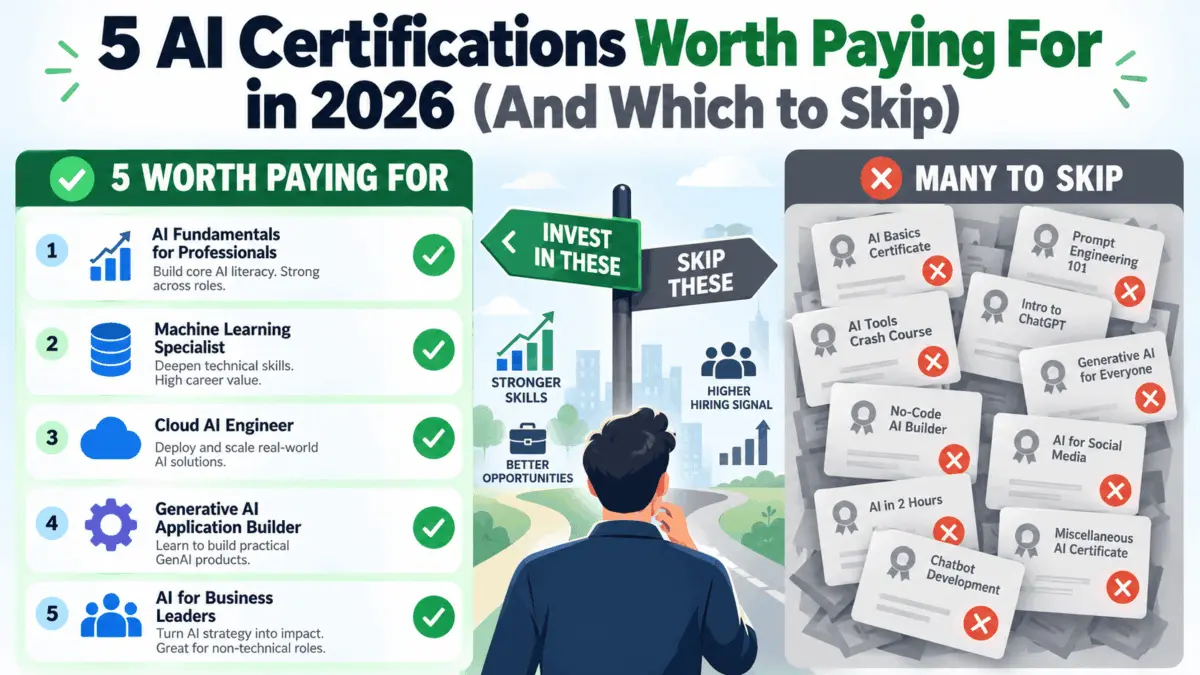
The market for artificial intelligence credentials has expanded dramatically, transforming how professionals signal their expertise and how employers vet talent. According to recent labor market research from Revelio Labs, AI credentials account for nearly 30 percent of all professional certifications being pursued by workers, marking a striking twentyfold increase compared to pre-ChatGPT levels. This massive surge in demand has sharply divided the credentialing landscape into two distinct categories: a select few programs that actively attract employer attention and correlate with measurable salary premiums, and a sprawling ecosystem of commercial offerings that generate revenue for their creators while offering virtually no hiring signal to the job seekers who purchase them.
Industry data reveals an uncomfortable reality for many aspiring practitioners: the vast majority of available AI certifications fail to provide a meaningful return on investment. Hiring managers report that candidates who successfully secure technical roles frequently possess fewer formal certificates combined with substantial, demonstrable production experience. For senior engineering leaders, a resume listing five distinct AI certifications completely devoid of a supporting project portfolio serves as a warning sign. Conversely, a single robust cloud certification paired with a public repository of deployed applications carries significantly more weight during the hiring process.
Nevertheless, specific credentials continue to hold genuine value for concrete reasons. The issuing organizations command established employer trust, the examinations rigorously test production-relevant competencies rather than mere rote memorization, and the certifications regularly appear in active job descriptions. Five prominent credentials meet these strict criteria, standing apart from a crowded market filled with low-signal alternatives.
The Evolution of Cloud Machine Learning Credentials
The foundational infrastructure supporting enterprise artificial intelligence has shifted rapidly, rendering several long-standing credentials obsolete while introducing updated pathways aligned with modern workloads. For instance, the AWS Certified Machine Learning Specialty exam, historically a staple for cloud practitioners, was permanently retired on March 31, 2026. While legacy web pages continue to recommend the discontinued test, candidates must look toward newer, broader assessments that reflect current industry demands. Similarly, Microsoft has scheduled updates for its Azure AI Engineer Associate certification to match shifting platform capabilities.
Among current offerings, the Google Cloud Professional Machine Learning Engineer certification stands out as a high-impact credential for experienced professionals. Priced at two hundred dollars, the professional-level exam requires approximately two hours and focuses heavily on the full machine learning engineering lifecycle within Google Cloud environments. Multiple labor market analyses indicate that holders of this certification command roughly a twenty-5 percent salary premium compared to their uncertified peers, representing the largest differential among current machine learning credentials. A comprehensive update introduced mid-year integrated extensive generative AI content, including solutions built using Vertex AI Agent Builder and Model Garden, aligning the examination directly with modern production demands.
Similarly, Amazon Web Services restructured its machine learning credentialing by launching the AWS Certified Machine Learning Engineer Associate examination to replace its retired specialty test. Priced affordably at one hundred and fifty dollars, the associate-level credential emphasizes practical workloads involving Amazon Bedrock, MLOps patterns, and retrieval-augmented generation pipelines. Because enterprise machine learning heavily features AWS infrastructure, this certification provides practitioners with a recognizable baseline that aligns with contemporary hiring requirements across multiple sectors.
Specialized Platforms and Applied Foundations
Beyond major cloud providers, platform-specific and foundational credentials occupy a vital space in the professional development market. Microsoft’s Azure Data Scientist Associate certification addresses a critical segment of the enterprise landscape, where Azure maintains a prominent presence in data science job postings, particularly within highly regulated industries such as financial services and healthcare. Unlike infrastructure-heavy cloud exams, the Azure credential centers closely on applied data science tasks, evaluating a candidate’s ability to implement and run machine learning workloads using managed platform tools.
For data scientists and machine learning engineers operating within Apache Spark and MLflow ecosystems, the Databricks Certified Machine Learning Professional credential offers targeted validation. As Databricks cements its role as a standard component of modern enterprise data architectures, this platform-specific examination tests advanced capabilities in scaling data pipelines and managing model lifecycles. Because the assessment requires genuine hands-on familiarity with the environment, it functions as a reliable indicator of platform proficiency for mid-to-large enterprise teams.
For practitioners seeking to strengthen their conceptual understanding before tackling rigorous proctored cloud exams, non-vendor programs like the DeepLearning.AI Deep Learning Specialization provide a respected academic baseline. While course completion certificates do not carry the identical proctored hiring signal of a major cloud provider credential, the extensive curriculum covering neural network fundamentals and sequence models signals substantive conceptual study. Industry educators and hiring managers generally view such specializations as effective preparatory steps rather than standalone destinations for experienced engineers.
Navigating Low-Signal Offerings and Strategic Choices
The proliferation of commercial training programs has flooded the market with options that offer little to no professional utility. Generic artificial intelligence certificates from obscure providers, expensive university professional certificates carrying multi-thousand-dollar price tags, and brief prompt engineering credentials frequently fail to appear as requirements in technical job descriptions. Hiring managers consistently emphasize that practical skills must be demonstrated through deployed projects and functional code repositories rather than short-term completion badges.
Ultimately, selecting the right credential requires aligning personal career tracks with target employer infrastructure and existing technical experience. Professionals focusing on machine learning engineering find the greatest utility in infrastructure-aligned cloud certifications, while applied data scientists often benefit more from platform-specific managed service credentials. By treating certifications as structured learning instruments that complement a robust project portfolio, technical professionals can successfully navigate the crowded credentialing market and validate their production capabilities to prospective employers.