As organizations worldwide continue to grapple with shifting technology landscapes, enterprise automation has transitioned from an aspirational goal into a fundamental pillar of daily operations. According to the latest research released by Precisely and the Americas SAP Users Group (ASUG), the market for SAP automation is evolving rapidly, moving away from experimental adoption and squarely into rigorous execution.
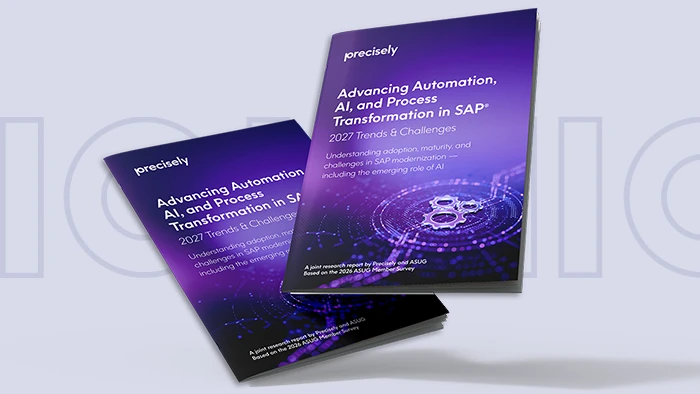
The comprehensive fourth annual report, titled *Adv
ancing Automation, AI, and Process Transformation in SAP: 2027 Trends and Challenges*, captures this pivotal shift. Based on survey responses from 169 enterprise SAP stakeholders spanning diverse industries—including consumer products, manufacturing, healthcare, and utilities—the data paints a clear picture of an ecosystem maturing under pressure. Where 13% of surveyed stakeholders reported an absolute lack of automation maturity back in 2023, that figure has plummeted to a mere 3% for 2027.
However, reaching this baseline level of operational maturity is not a finish line. Instead, it serves as the starting block for a new wave of complex hurdles. As artificial intelligence embeds itself into core SAP workflows and migrations to SAP S/4HANA uncover deeper technical roadblocks, IT leaders and business process owners are finding themselves forced to confront mounting questions around operational scale, specialized internal skills, and, above all, absolute trust in their enterprise data.
What the SAP Automation Trends for 2027 Say About Maturity and Strategy
The overarching trajectory of enterprise technology points toward broader adoption coupled with smarter architectural planning. The new research indicates that automation usage specifically dedicated to SAP migrations and digital transformation initiatives has climbed to 61%, up noticeably from 57% in the previous year’s survey. Concurrently, the cohort of organizations still searching for a definitive automation approach has shrunk to just 5%, signaling a growing consensus around standard methodologies.
Perhaps the most telling evolution lies in broader enterprise strategy. The deployment of best-of-breed toolsets nearly doubled in a single year, leaping from 19% to 33%. This substantial jump suggests that business teams overseeing mature automation programs are moving away from piecemeal, case-by-case tooling. Instead, they are standardizing on a cohesive core set of specialized solutions that can be deployed smoothly across a multitude of SAP use cases and distinct business functions.
This evolution in tool strategy is running parallel to a rise in business-user enablement, empowering non-technical teams to take a more active role in workflow management. Even so, internal realities often lag behind organizational aspirations. The data reveals that the largest share of enterprises still relies heavily on specialized SAP IT developers to build and maintain automation scripts and workflows. Consequently, while the appetite for citizen development and broader business-user empowerment is real, the heavy lifting remains concentrated within traditional IT departments.

How SAP Teams Are Adopting AI and Autonomous Agents
For the first time in its four-year history, the Precisely and ASUG research partnership has closely examined the integration of artificial intelligence and AI agents within SAP automation frameworks. The overriding takeaway from this inaugural data set is that AI is no longer a futuristic concept for enterprise roadmaps; it is already actively deployed in the field.
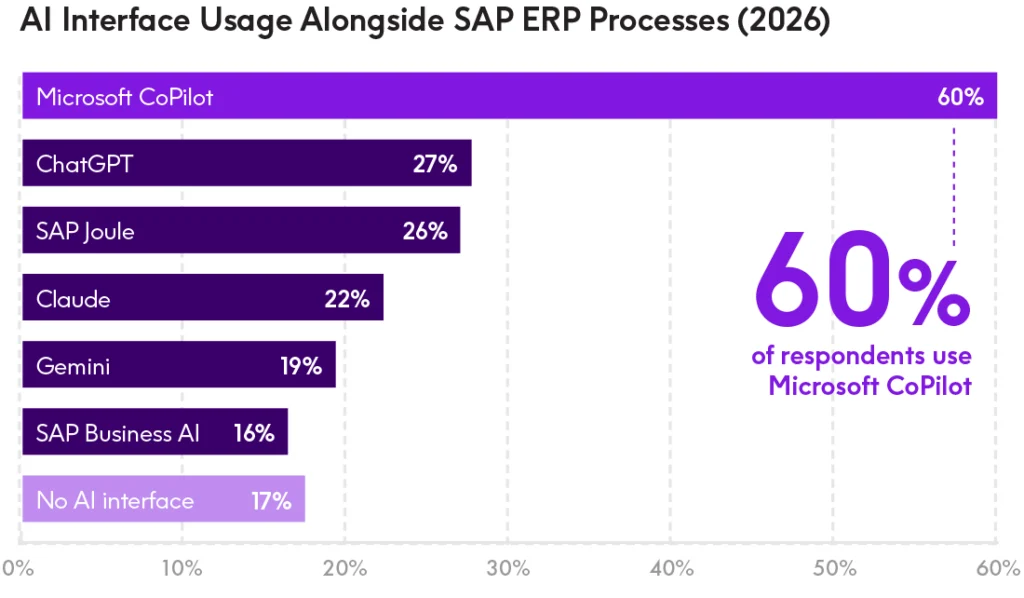
Despite this widespread presence, the nature of its deployment varies significantly. According to the findings, only 17% of respondents report using no AI interface whatsoever with their core SAP ERP processes. Among the various tools gaining traction, Microsoft Copilot leads the field, utilized by 60% of surveyed organizations. Yet, despite the proliferation of generative and conversational AI tools, true end-to-end automation remains rare. Only 3% of organizations report operating fully automated, AI-driven processes, demonstrating that the vast majority of businesses are currently utilizing AI to assist and augment human judgment rather than replace it entirely.
Unsurprisingly, organizational maturity plays a decisive role in how effectively these technologies are leveraged. Enterprise automation programs that rank highest in overall maturity are also significantly further along in their successful integration of AI capabilities.
Industry experts note that artificial intelligence functions most reliably when it is built on top of robust automation foundations and thoroughly validated, trusted data. Because AI models do not inherently pause to question the veracity of the inputs they receive, they will execute tasks rapidly even when fed erroneous information. This inherent characteristic underscores why AI-ready data—data that is visible, reliable, accountable, and complete—remains so critical, particularly within complex SAP environments where master data integrity and strict process governance carry high operational stakes.
Why SAP S/4HANA Migrations Grow Harder as More Teams Go Live
Enterprise momentum toward modern enterprise resource planning architectures remains robust. The 2027 data shows that 67% of organizations are now either fully or partially live on SAP S/4HANA, representing a steady climb from 59% in 2025. Furthermore, the percentage of companies reporting absolutely no plans to migrate has dwindled to a negligible 1%.
Yet, as more organizations clear the initial hurdles of going live, the remaining migration projects are encountering steeper technical barriers. Managing and refactoring legacy customizations built up over years in SAP ECC has emerged as the single greatest migration challenge, cited by 53% of survey respondents. Furthermore, the transfer of intricate process complexities and the execution of complex data transformations are registering as some of the fastest-rising barriers to successful deployment.
Data cleansing practices reflect a similar paradox. While 83% of participants continue to view the cleansing of SAP master data as an important prerequisite for a successful migration, fewer organizations are actually completing this rigorous work prior to making the physical move. Instead, an increasing number of enterprises are opting to push data cleansing tasks into the active migration phase or postpone them until after the go-live date.
Industry observations indicate that many companies find themselves dangerously close to their scheduled go-live milestones, only to encounter unexpected data and process surprises that were never factored into the original project timeline. Organizations that successfully leverage comprehensive automation platforms to manage the transfer of complex data and intricate business processes consistently report encountering fewer of these disruptive setbacks.
The Evolution of SAP Fiori and SAP BTP
The technological shift within user interfaces and cloud platforms tells a parallel story of transition and coexistence. SAP Fiori has officially reached a definitive tipping point across the enterprise landscape. Approximately 81% of organizations now utilize Fiori in some capacity, while holdouts relying exclusively on the traditional SAP GUI have shrunk to just 2%. For the vast majority, a hybrid reality exists: 67% of respondents operate Fiori side-by-side with the legacy SAP GUI. This dual-interface environment places a heavy technical demand on automation systems, which must be capable of working consistently and reliably across both modern and legacy screens.
Concurrently, adoption rates for the SAP Business Technology Platform (BTP) continue to climb steadily, with more than half of all surveyed organizations now actively utilizing BTP services. The more compelling narrative, however, centers on how these services are being deployed and what obstacles continue to impede broader utilization.
Among organizations with established BTP environments, process automation and artificial intelligence applications are generating the most significant performance gains. At the same time, the primary hurdle has shifted; rather than struggling to understand what capabilities BTP offers, IT leaders now point to internal shortages in specialized skills and available resources as the main barrier to execution.
Who Stands to Gain from the 2027 Research Insights
The comprehensive findings offer distinct benchmarks tailored to various leadership roles within the modern enterprise. For executives directing SAP IT infrastructure, enterprise architecture, or major migration programs, the data provides essential reference points for projecting realistic timelines, resource allocation, and cloud platform strategies. For business process owners overseeing critical domains such as finance, master data management, and supply chain logistics, the research illustrates how industry peers are successfully deploying automation and AI agents to streamline parallel operations. For teams spearheading internal automation initiatives or citizen development programs, the report serves as a diagnostic tool to evaluate their internal maturity and tool strategies against broader industry standards.
Reflecting a cross-section of modern commerce, the survey participants represent a diverse array of sectors, ensuring that the documented trends mirror the practical realities of a wide range of SAP-run enterprises.
The persistent thread binding four consecutive years of this ongoing research is the undeniable weight of enterprise complexity—manifested through legacy processes, fragmented data silos, and constrained internal human capacity. Organizations that actively address these foundational challenges by investing in robust automation platforms, stringent data quality management frameworks, empowered citizen developers, and unified data management strategies are fundamentally better positioned to extract maximum value from their extensive SAP investments as they modernize their operations for the years ahead.