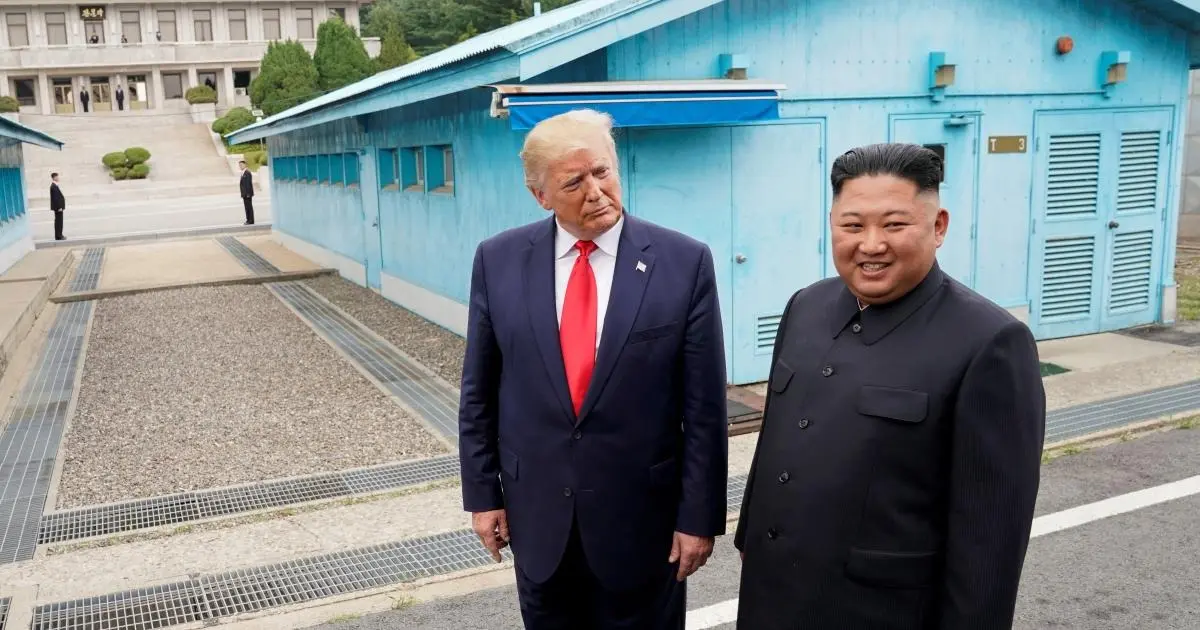
Donald Trump has Pyongyang firmly on his mind once again. In recent months, the U.S. president has made a series of public comments to the media suggesting that he is already in backchannel communication with North Korean leader Kim Jong Un. In a Truth Social post on August 17, for instance, Trump announced that the United States would scale back joint military exercises with South Korea. He wrote that the decision was "based on my very good relationship with Kim Jong Un," describing the authoritarian leader as "unthreatening and respectful."
The president has made little secret of his desire to restart high-level diplomacy with Pyongyang. With an eye fixed firmly on his historical legacy and a stalemated war with Iran drawing heavily on U.S. resources, Trump is eager to secure a major foreign policy win. During
his first term in office, Trump held two historic summits with the North Korean leader aimed at achieving the complete denuclearization of the Korean Peninsula. Both meetings ultimately foundered due to deeply disparate expectations and terms for a final deal. Since his reelection, however, Trump has been actively looking to reopen the diplomatic channel.
The ball now rests firmly in Pyongyang’s court. While Kim Jong Un has not explicitly signaled an eager rush for immediate engagement, he has shown an unmistakable unwillingness to slam the door shut. In August, following Trump’s repeated assertions that he was in direct touch with North Korean leadership, Kim Yo Jong—the influential sister of the North Korean leader—released a carefully worded statement. She noted that while she was personally unaware of recent direct communications between the top leaders, her head of state continued to hold fond personal memories and positive feelings toward Trump, adding that the relationship between the two leaders remained excellent. Although this response falls far short of an official agreement to meet, it signals that Pyongyang is keeping its options open.
If leader-to-leader talks eventually materialize, Trump likely believes his personal rapport with Kim will yield a breakthrough. Yet, he will be facing a vastly different North Korea than the one that sat across the table from him at their last meeting in Hanoi in 2019. The cumulative fallout from unfinished diplomacy during Trump’s first term, the disruptions of the global COVID-19 pandemic, and sweeping international developments—such as the sharp escalation of the U.S.-Chinese strategic rivalry and Russia’s full-scale invasion of Ukraine—have drastically destabilized the regional security landscape. Furthermore, North Korea’s continued expansion of its nuclear and conventional military capabilities, coupled with robust and growing support from Moscow, has significantly strengthened Kim’s hand. Confronted with an emboldened Pyongyang, Trump can no longer rely on the same concessions and negotiation tactics he deployed during past talks.
For any future U.S.-North Korean summit to succeed, Washington must approach the negotiating table with well-defined strategic goals and a realistic understanding of what concessions it is willing to make. Analysts suggest that Washington should temporarily shift its focus away from the elusive goal of immediate denuclearization, concentrating instead on more achievable nuclear arms control and safety measures. At the same time, the United States must maintain a capable troop presence on the Korean Peninsula and explicitly reiterate its security assurances—particularly its nuclear-deterrence guarantees—to vital regional allies like South Korea and Japan.
Although diplomacy with North Korea has historically proven exceptionally difficult, Trump remains eager to meet with Kim, and both sides share an underlying interest in avoiding a slide toward nuclear proliferation or all-out war in the Indo-Pacific. Careful, calibrated engagement with Pyongyang could defuse festering tensions on the peninsula and lay the groundwork for a more stable security architecture.
Tables Turned
Since the high-profile U.S.-North Korean summit in 2019, intersecting conflicts in Ukraine and the Middle East have dramatically reshaped the Indo-Pacific, shifting the balance of leverage in Kim’s favor. The ongoing U.S.-Israeli conflict with Iran has successfully drawn Washington’s focus away from Asia. For the third time in the past quarter-century, U.S. strategic attention and vital military assets have surged toward the Middle East. The final American aircraft carrier previously stationed in the Indo-Pacific departed for the Persian Gulf in August, and sustained U.S. strikes against Iran have rapidly depleted American munitions stockpiles.
Washington’s Indo-Pacific allies, already strained by earlier abrupt shifts in U.S. policy and punishing tariffs, are now increasingly anxious about deteriorating regional deterrence. Asian economies, many of which remain deeply dependent on energy supplies from the Middle East, have contracted as the security of the Strait of Hormuz has been compromised. Amid visible signs of American retrenchment, regional partners are growing increasingly skeptical of Washington’s long-term commitment to Asia.
Even more consequential has been Russia’s invasion of Ukraine, which has directly benefited North Korea on multiple fronts. The once-dormant relationship between Moscow and Pyongyang has flourished as Kim has supplied thousands of artillery shells and munitions to replenish Russia’s depleted stockpiles, alongside thousands of soldiers sent to fight and die on European battlefields. Public imagery of new memorials dedicated to fallen Korean People’s Army soldiers indicates that North Korea has already suffered significant casualties.
In return, Pyongyang has received generous assistance from Moscow in clear violation of international sanctions. This includes substantial financial support to stabilize Kim’s regime and critical technology transfers that have enhanced North Korean military capabilities. Most concerningly, this assistance may help Pyongyang improve the accuracy of its intercontinental ballistic missiles aimed at the United States. This Russian patronage has allowed Kim to generously reward his domestic elites, cementing their political loyalty.
Yet, the long-term durability of this partnership remains an open question. Following years of grinding warfare with no clear end in sight, Moscow faces deep international isolation and may eventually find itself ill-equipped to sustain its support for Pyongyang. Russia’s overwhelming preoccupation with Ukraine has already allowed China to quietly expand its economic presence in Central Asia and Turkey to deepen its influence in Azerbaijan. Russian aggression has also spurred nations like Armenia and Moldova to look westward, while hundreds of thousands of young Russians have fled the country to evade conscription and over a thousand Western companies have departed. Severe international sanctions are starving Moscow of vital capital and technology, creating long-term structural imbalances and inflation within the Russian economy. Should North Korea continue to tie its fortunes to Moscow while Russia falters, the international environment could become significantly more hostile for Pyongyang.
The deepening axis between Russia and North Korea has likewise altered Beijing’s strategic calculus in the region. China remains Pyongyang’s most important economic and political partner, but the fundamental dynamics of the relationship have evolved. Historically, Beijing viewed the denuclearization of the Korean Peninsula as a paramount national priority and a rare area of alignment and cooperation with the United States. China openly disliked the destabilizing regional impact of North Korea’s nuclear ambitions and repeatedly expended significant political capital to manage international condemnation of Pyongyang. Between 2006 and 2017, Beijing voted in favor of a series of UN Security Council resolutions imposing strict sanctions and economic restrictions in response to six North Korean nuclear tests.
Today, however, pressed to maintain its own influence in Pyongyang amid the burgeoning Russia-North Korea security partnership—and with the broader international community distracted by multiple global crises—China has grown largely silent on the issue of denuclearization. When Chinese leader Xi Jinping visited North Korea to reassert Beijing’s influence, denuclearization was conspicuously absent from public remarks. This shift in China’s posture will complicate future U.S. diplomatic efforts and risks driving regional powers like South Korea and Japan to seriously reconsider their own positions on the potential deployment or domestic development of nuclear weapons.
Whether Pyongyang ultimately reengages with Washington may also depend on the extent of its continued economic reliance on China. The vast majority of North Korean commerce flows across the Chinese border. Although the Beijing-Pyongyang relationship appears stable on the surface, it remains transactional and inherently wary, with each side deeply suspicious of the other’s long-term motives. North Korea may seek to reengage with the United States precisely to counterbalance its overdependence on China, or as a strategic hedge against a potential Russian failure in Ukraine. Conversely, as Trump and Xi work to stabilize and upgrade broader U.S.-Chinese relations, Beijing could theoretically step in to help broker the next high-level meeting between Trump and Kim.
Kim Possible
The Kim dynasty has long vexed generations of U.S. policymakers. Successive administrations in Washington have pursued various diplomatic openings with North Korea, including Trump’s first-term summits, but mutual missteps and deep-seated mistrust ultimately derailed them. Pyongyang has proven remarkably resilient in the face of both unilateral U.S. and sweeping international sanctions. During the COVID-19 pandemic, North Korea went so far as to completely seal its borders, imposing economic self-deprivation far more severe than any international sanctions regime, yet the state survived. Congressional interventions focused on human rights and humanitarian aid have similarly failed to alter Pyongyang’s behavior. To cushion the economic blow of sanctions, North Korea has increasingly turned to state-sponsored cybertheft, exemplified by a massive $6.3 billion cryptocurrency heist targeting the Binance exchange. All the while, Pyongyang has steadily advanced its military capabilities and expanded its nuclear arsenal.
While Washington’s past attempts to rein in North Korea have largely fallen short, Trump’s renewed eagerness to meet with Kim and his unorthodox approach to foreign policy could create a fresh opening for diplomacy. Trump has consistently favored cultivating a direct, personal relationship with Kim, deliberately bypassing the slow bureaucratic negotiations that typically precede major agreements. While a purely performative summit would offer little genuine benefit to U.S. security interests, Washington could utilize renewed reengagement to thaw inter-Korean relations and stabilize the peninsula by slowing or formally freezing North Korea’s ongoing nuclear buildup. While these goals may appear conventional, they are essential to averting a potentially catastrophic conflict as regional tensions worsen and North Korea’s nuclear capabilities grow.
Three central questions continue to cast a shadow over the possibility of renewed U.S.-North Korean engagement. First is the specific purpose of restarting talks: What is the ultimate strategic goal? Second is the logistical challenge of reopening communication channels. Despite Trump’s public assertions, there is no verified proof of recent interactions between Trump and Kim; all available evidence indicates that the last direct contact between American and North Korean officials occurred in 2019, leaving a seven-year diplomatic drought to bridge. Third is the question of what incentives and tradeoffs the United States would be willing to place on the table during negotiations—the exact stumbling block that ultimately paralyzed officials in Hanoi.
One potential formula for progress is focusing, at least temporarily, on steady arms control and international safety measures rather than the elusive, long-term goal of total denuclearization. While denuclearization should remain Washington’s ultimate strategic aspiration, a North Korea possessing an ever-growing stockpile of nuclear weapons makes the global security environment increasingly dangerous in the interim. This pragmatic approach requires serious diplomacy to minimize second-order consequences, particularly avoiding any weakening of U.S. alliances in the Indo-Pacific or triggering the collapse of the global nuclear nonproliferation regime out of fear among regional states. China, and potentially even Russia, may share Washington’s interest in preventing the emergence of additional nuclear-armed states in East Asia, providing a narrow baseline for renewed engagement.
Art of the Deal
Kim Jong Un commands substantially more geopolitical leverage today than he did during his earlier encounters with Trump. Reopening communication lines will require a careful mix of positive and negative assurances to convince the North Korean leader that he is unlikely to secure a better deal elsewhere. Kim is likely to press the United States to scale back aspects of its security cooperation with South Korea—such as joint military exercises and U.S. support for Seoul’s pursuit of nuclear-powered submarines—as strict preconditions for sitting down with Trump. Kim may even offer his own symbolic assurances of peace on the peninsula in exchange for a reduction of U.S. military forces stationed in South Korea, though it remains unclear whether Trump would entertain such conditions.
In a worst-case scenario, Kim could exploit Trump’s eagerness for a deal to extract major concessions from the United States. The North Korean leader has little incentive to meet unless he calculates he can secure core demands, such as de facto international recognition as a nuclear weapons state, the lifting of punishing sanctions, or the complete withdrawal of American troops from the peninsula. Furthermore, Kim would likely insist that any discussions completely exclude North Korea’s support for the Russian invasion in Ukraine, its documented human rights abuses, or a final accounting for Japanese citizens abducted by North Korean agents under the rule of Kim Il Sung. Granting such sweeping concessions would effectively dismantle the U.S.-South Korean alliance.
To ensure that North Korea cannot exploit the administration, Washington must carefully weigh the tradeoffs it is willing to make. Lifting international sanctions, abandoning or delaying denuclearization, temporarily accepting North Korea’s nuclear status, and reducing the U.S. military footprint in South Korea are all long-standing demands of Pyongyang that will likely surface during talks. While lifting international sanctions would require a formal consensus within the UN Security Council, Trump might be willing to unilaterally scale back U.S. sanctions, which he views as an impediment to bilateral relations and which have proven ineffective at halting North Korea’s nuclear advances.
Although denuclearization has been a central talking point for U.S. administrations since the early 1990s, the administration may need to set it aside as an immediate precondition, at least in the short term. Pyongyang’s nuclear capabilities have demonstrably expanded since the 2018 and 2019 summits, suggesting that the diplomatic stalemate caused by rigid U.S. demands for the full-scale dismantlement of the program inadvertently gave Kim the time and space to grow his arsenal. Even if denuclearization remains a long-term priority, pragmatism is essential to reducing the immediate threat posed by Pyongyang. In exchange for temporarily stepping away from total denuclearization, Trump should demand that Kim freeze any further expansion of his nuclear arsenal and explore steps toward strategic stability. These could include renewed inter-Korean dialogue, transparency and confidence-building measures, safety protocols for nuclear facilities to guard against accidents, and strict adherence to nonproliferation norms. Trump must make it clear to Kim that an unconstrained nuclear expansion will inevitably pressure South Korea and Japan to consider hosting nuclear weapons or developing their own independent arsenals.
Regardless of Kim’s opening demands, the United States must preserve its troop presence on the Korean Peninsula and continue joint military exercises with South Korea as long as the threat of northern aggression persists. The foundational mantra for U.S. forces in South Korea is to remain "ready to fight tonight." Joint exercises keep American and South Korean forces prepared for combat, which is vital to deterring attacks. It would be dangerously irresponsible to station American personnel on the peninsula without ensuring peak operational readiness. Instead of withdrawing troops, the United States should offer targeted confidence-building measures, such as military-to-military engagement, reciprocal security reassurances, or greater transparency around military drills through reciprocal observation. Maintaining the alliance with South Korea and preventing cascading nuclear proliferation remain critical U.S. interests. American negotiators must remind Kim that the U.S. military presence and extended deterrence guarantees actually hold back even larger conventional and nuclear buildups in the region.
Finally, the United States and North Korea—and eventually South Korea and Japan—should sustain diplomatic engagement by agreeing to establish reciprocal liaison offices in each other’s capitals. This would maintain formal communication channels without immediately granting full diplomatic recognition. During 2018 and 2019, both sides previously discussed housing such diplomats within the German Embassy in Pyongyang and the Swedish Embassy in Washington. Liaison offices would help stabilize and prolong the communication necessary to quietly navigate complex negotiations.
If North Korea ultimately rejects Trump’s diplomatic overtures, the United States is far from devoid of options. Washington could ramp up pressure on the Kim regime by intensifying the scale and tempo of joint military exercises with South Korea, deploying additional advanced U.S. armaments—including short-range ballistic missiles, cruise missiles, and potentially tactical nuclear assets—to South Korea and Japan, and launching a renewed campaign to choke off North Korea’s illicit economic resources through aggressive sanctions enforcement and maritime interdiction. The United States could also deploy advanced air defense assets, such as THAAD radar systems and interceptors, to Japan and South Korea. Furthermore, Washington and its allies could dramatically expand efforts to delegitimize Kim’s rule by highlighting the dangers of his nuclear arsenal and North Korea’s reliance on international criminal enterprises and cybertheft to defraud other nations, potentially pressuring third-party countries to curtail their material or diplomatic support for Pyongyang.
Third Wheels
Beyond immediate negotiations, a fourth strategic question is less complicated but equally vital: What role should Japan and South Korea play in U.S. engagements with North Korea? Previous Republican and Democratic administrations alike have considered close coordination with regional allies essential to forging a durable solution on the peninsula. However, Trump’s traditional skepticism toward formal alliances suggests that close consultation with Seoul and Tokyo is far from guaranteed. Their absence from the negotiating table might paradoxically accelerate U.S.-North Korean engagement, as multi-lateral allied coordination can often be unwieldy and slow, and Pyongyang has historically rejected outreach from Seoul and Tokyo. Although South Korean President Lee Jae-myung and Japanese Prime Minister Sanae Takaichi both express rhetorical support for engagement with North Korea, Pyongyang has repeatedly rebuffed their direct overtures.
Even if Seoul and Tokyo are not seated directly at the negotiating table, they would likely welcome a U.S.-brokered deal with Kim if it successfully safeguards their core security interests. Conversely, any deal with Kim that ignores the anxieties of American allies would be profoundly dangerous. South Korea harbors a latent appetite to develop its own independent nuclear arsenal, particularly if it perceives that U.S. security guarantees are receding. Should Seoul move in that direction, Tokyo would almost certainly reconsider its own non-nuclear status, potentially igniting a destabilizing nuclear arms race across Asia. Given North Korea’s long-standing hostility toward both neighbors, regional proliferation would shatter the global nonproliferation regime and plunge the Indo-Pacific into deep instability.
Any eventual agreement, even one addressing the core concerns of Seoul and Tokyo, must be paired with firm American security reassurances to allied governments and publics. Japan and South Korea must continue building their own conventional defense capabilities while the United States sustains its ironclad commitment to regional defense through extended nuclear deterrence. Washington must navigate this delicate diplomacy carefully to avoid inadvertently creating a stronger, legitimized North Korea, straining its alliances, and debilitating global nonproliferation standards.
Window of Opportunity
Despite the inherent risks of U.S.-North Korean engagement, the current moment may offer a unique window to break the diplomatic paralysis that has allowed Pyongyang to relentlessly advance its military capabilities. The latter half of Trump’s presidency—particularly a scheduled trip to Asia—will bring him physically closer to the region, potentially facilitating a face-to-face meeting with Kim. Such a visit would present the prime opportunity for the high-profile, performative summitry that both leaders historically favor.
Trump remains an iconoclast in traditional great-power politics, as demonstrated by his shifting relationships with leaders like Xi Jinping and Russian President Vladimir Putin, an approach that could heavily shape Washington’s outreach to Pyongyang. Still, there may be a viable path to leverage Trump’s personal affinity for Kim, alongside Kim’s recent restraint in criticizing the United States, to outline an agreement that curbs the growing threat of North Korea’s nuclear weapons.
At the same time, shifting domestic political realities, including bruising midterm election losses for the Republican Party, could alter North Korea’s diplomatic calculus. Such political setbacks suggest that Trump’s domestic standing has faced hurdles and that he may struggle to unilaterally deliver the sweeping results Kim desires. Nevertheless, Trump may force the issue, proposing a meeting with Kim following regional summits in Asia, potentially even suggesting that the meeting take place in Pyongyang to put Kim directly on the spot. If leader-to-leader talks ultimately occur, both sides would do well to remember the central lesson of Trump’s first-term summits: high-level engagement without meticulous preparation and clearly defined strategic goals is insufficient to secure lasting peace and stability on the Korean Peninsula.
Growing tensions across the Indo-Pacific raise the specter of a much darker future, where conditions on the Korean Peninsula remain deadlocked and Asia’s regional flashpoints metastasize into broader conflict, whether ignited around Taiwan, the South China Sea, or the Korean Peninsula. Even if all-out war is avoided, the United States could soon find itself inhabiting a world where Asia’s current five nuclear-armed states are joined by two, three, or more new players.
Yet, this bleak future is not inevitable. All the key leaders engaged in North Korean security debates—from Lee and Takaichi to Xi and Putin—have a shared interest in avoiding catastrophic escalation. Even Pyongyang surely recognizes that unchecked confrontation remains its most dangerous path. This shared objective ensures that diplomacy remains possible, despite formidable obstacles. For all of Trump’s political idiosyncrasies, his desire to peacefully resolve tensions on the Korean Peninsula can be taken at face value; he has made his intentions clear. What happens next remains entirely up to Chairman Kim.