In the world of software development and data science, JavaScript Object Notation, or JSON, remains one of the most ubiquitous formats for storing and exchanging structured data. Its lightweight syntax, human-readable structure, and native compatibility with modern web applications have made it a staple across countless technology stacks. For everyday applications dealing with small or moderately sized datasets, Python’s built-in json module handles data extraction effortlessly, loading files directly into memory with a few simple lines of code. However, as modern applications ingest increasingly massive volumes of data, developers frequently encounter a severe performance bottleneck: memory exhaustion caused by large JSON files.
The root of the issue lies in how traditional parsing mechanisms operate. When a developer invokes standard loading functions on a sizable document, the parser reads the entire file into memory at once, constructing a sprawling network of corresponding Python objects before any actual data analysis can even begin. Consequently, a file that occupies a few hundred megabytes on a hard drive can demand multiples of that storage space once converted into active Python dictionaries, lists, strings, and numerical values. This discrepancy between disk size and memory footprint has prompted many engineers to reevaluate conventional parsing strategies in favor of streaming architectures.
To understand the scale of the challenge, data engineers frequently look to expansive public repositories, such as the San Francisco City Lots dataset. Hosted widely for civic tech and spatial analysis, this prominent GeoJSON file catalogs comprehensive land-parcel information across the California municipality. When downloaded for experimental performance profiling, the dataset spans roughly 181 megabytes. While manageable for modern desktop hardware, its structural layout illustrates the hidden memory costs of standard parsing methods. The dataset follows a standard FeatureCollection format, meaning the primary payload resides within an expansive array of spatial features.
Each feature in the collection represents a distinct land parcel, housing nested hierarchies of property attributes alongside intricate geometric coordinates. For many common data processing tasks, an analyst might only require a few specific values nestled deep within the property metadata, such as block numbers or street names. Yet, when using standard parsing techniques, Python is forced to ingest the entire document, loading thousands of complex polygon coordinates and spatial arrays that a given analytical workflow may completely ignore.
When developers implement traditional loading approaches on files of this magnitude, the immediate consequence is a dramatic spike in resource consumption. Benchmarking experiments demonstrate that parsing a dataset of this scale via standard methods can cause memory utilization to surge significantly, pushing RAM usage past the three-quarter gigabyte mark depending on the execution environment. This behavior highlights a critical lesson for software architects: the physical size of a file on disk bears little resemblance to its active memory footprint once translated into high-level programming language objects. Every key, string, integer, and floating-point coordinate compounds the memory burden, creating a heavy operational overhead.
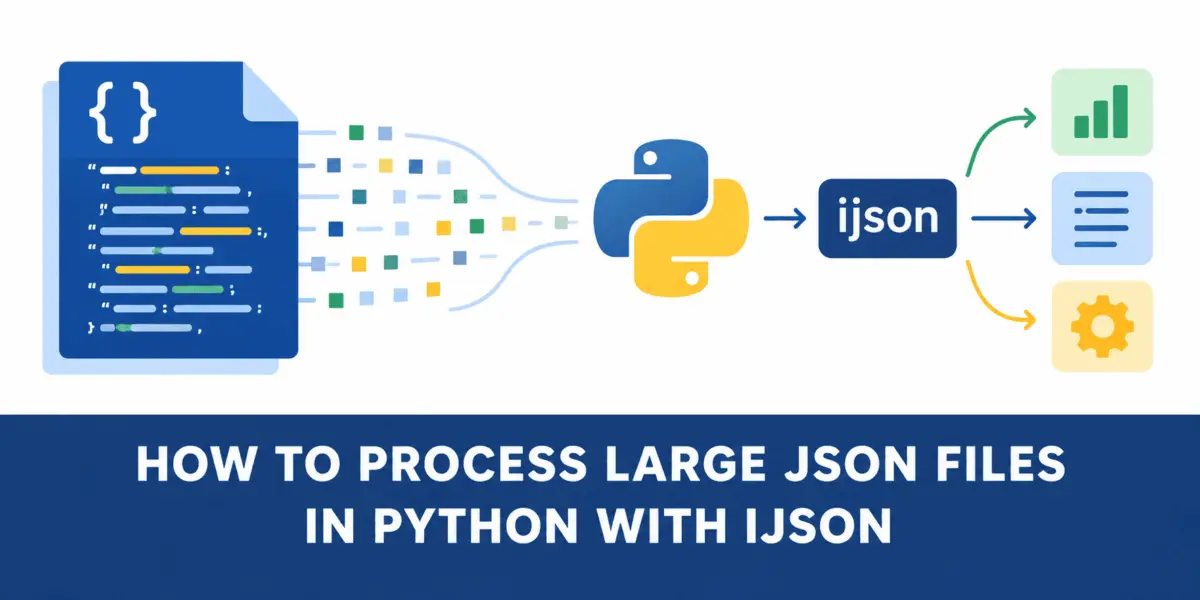
Recognizing these limitations, the developer community has increasingly turned toward iterative parsing solutions designed to process data incrementally. Among the most prominent tools for this approach is ijson, an iterative JSON parser that allows applications to read and analyze data streams piece by piece. Rather than forcing a complete document into active memory, iterative parsers scan the file sequentially, allowing developers to target specific structural paths and evaluate individual records on the fly.
By applying an iterative approach to the San Francisco land-parcel dataset, engineers can target specific data arrays directly without materializing the surrounding structure in RAM. The parser navigates the hierarchical layout, isolating individual records and passing them to the execution loop one at a time. This paradigm shift fundamentally alters the runtime dynamics of the application. Instead of loading every record into memory simultaneously, the program reads a single entry, evaluates its attributes against the analytical criteria, and immediately discards it before moving on to the next item in the stream.
Comparative benchmarking between traditional loading methods and iterative streaming reveals stark differences in resource allocation. While both approaches achieve identical analytical outcomes—such as counting specific street parcels or filtering identifier codes—their memory profiles diverge sharply. Traditional loading methods maintain a massive, continuous memory allocation for the duration of the execution. In contrast, iterative streaming maintains a remarkably stable and minimal memory footprint, largely constrained only by the size of the active record and the parser’s internal buffer.
Crucially, experts emphasize that adopting an iterative parser is not a guaranteed mechanism for achieving faster execution speeds. In scenarios where a computing environment possesses abundant random-access memory, traditional full-document parsers can sometimes complete execution very rapidly due to optimized C-level implementations. The true value of streaming JSON data lies in stability and scalability. By decoupling memory consumption from the total size of the input document, iterative parsers ensure that applications can process multi-gigabyte or even terabyte-scale JSON files without triggering out-of-memory exceptions or crashing production servers.
The broader implications for data engineering workflows are clear. As organizations continue to collect and analyze ever-larger repositories of semi-structured data, the traditional assumption that files can simply be loaded entirely into memory is becoming increasingly unsustainable. The challenge is rarely the JSON format itself, but rather the architectural decisions developers make when ingesting the data. By shifting away from all-or-nothing loading strategies and embracing incremental processing models, developers can build more resilient, resource-efficient applications capable of handling the data demands of modern software engineering.