More than two years after the initial deadline passed with widespread delays, new analysis reveals that 58% of countries worldwide have now fulfilled a United Nations call to submit updated national strategies for halting and reversing the alarming decline of the natural world.
According to data compiled by Carbon Brief, 113 countries have formally come forward with new National Biodiversity Strategies and Action Plans (NBSAPs). This marks a significant improvement from just a year ago, when only 55 nations—representing roughly 28% of the global community—had released their updated pledges.
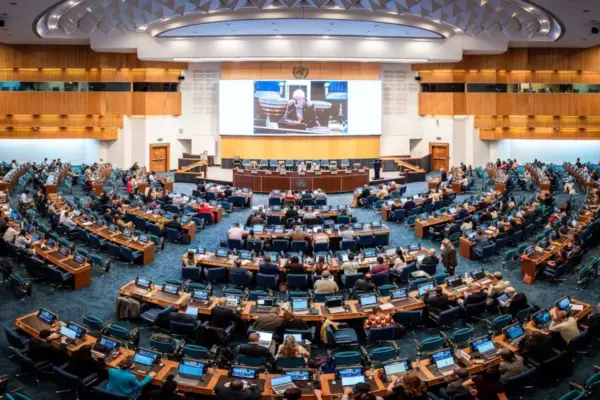
The renewed momentum comes ahead of the upcoming COP17 biodiversity summit, scheduled to begin next week in Yerevan, Armenia. The conference represents a critical milestone for international environmental policy, serving as the halfway point of the Kunming-Montreal Global Biodiversity Framework (GBF). Adopted during the landmark COP15 summit in Montreal, Canada, in 2022, the framework established an ambitious global mission to halt and reverse biodiversity loss by the year 2030.
As delegates gather in Armenia, the summit will provide the stage for the first comprehensive global review of how effectively countries are progressing toward the fulfillment of the framework’s core targets.

Global Review and the Road to 2030
The Kunming-Montreal Global Biodiversity Framework is anchored by a comprehensive list of 23 distinct targets designed to guide global conservation efforts up to 2030. These targets span an expansive range of critical environmental and socio-economic topics, including the active restoration of degraded ecosystems, addressing the compounding pressures of climate change, and mobilizing substantial financial resources to help developing nations shoulder the costs of protecting domestic and regional biodiversity.
As part of the monitoring mechanisms embedded within the GBF and its foundational documents, participating governments agreed to a structured schedule for tracking and evaluating national progress. This process involves the preparation of a coordinated global report compiled by the United Nations, which relies heavily on individual countries’ NBSAPs and national targets. Furthermore, the evaluation incorporates the seventh national reports, which governments were mandated to submit to the UN earlier this year.
The latest Carbon Brief analysis highlights that out of 196 total parties to the UN Convention on Biological Diversity, 113 have successfully produced a new NBSAP. This brings the current compliance rate to 58%, a substantial leap from the paltry 15% of nations that managed to meet the original deadline set for the start of the COP16 summit in Cali, Colombia, in October 2024.
When the initial deadline was overwhelmingly missed, negotiators at COP16 adopted a revised text that explicitly "urged" member states to release their long-overdue NBSAPs "as soon as possible."
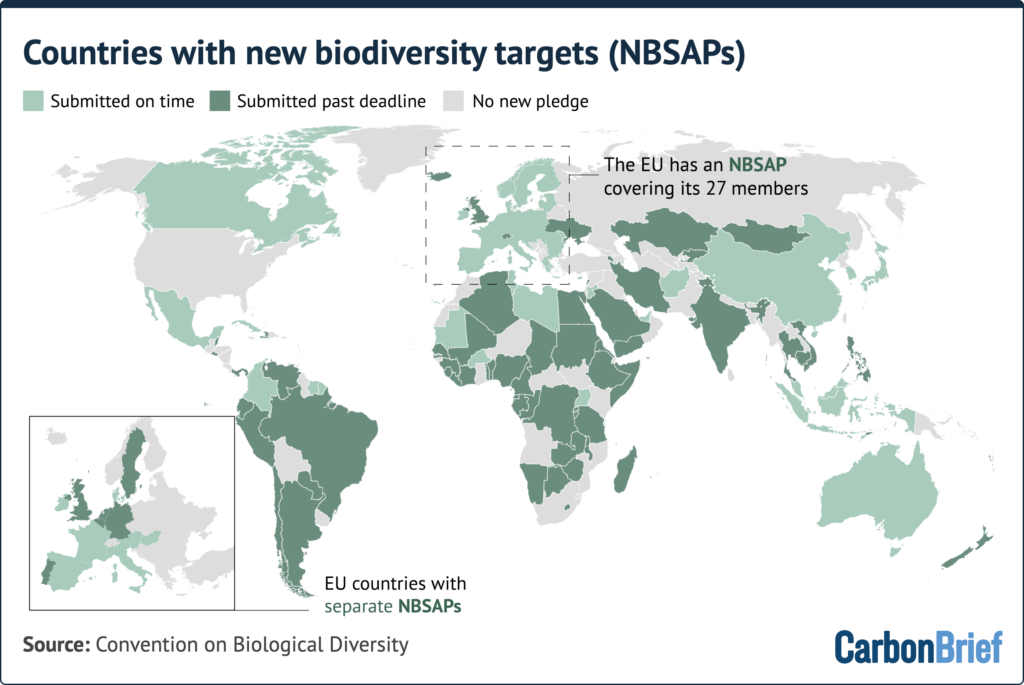
Geographically, the acceleration of submitted plans has been propelled by robust engagement across multiple regions. Over the past year, a wave of African nations has published updated NBSAPs. This growing roster includes Algeria, Benin, Botswana, Cameroon, Comoros, Congo, Côte d’Ivoire, the Democratic Republic of Congo, Egypt, Equatorial Guinea, Eritrea, Ethiopia, Gabon, Gambia, Guinea, Lesotho, Liberia, Madagascar, Malawi, Mali, Namibia, Rwanda, Senegal, Sierra Leone, Somalia, Sudan, Zambia, and Zimbabwe.
Similarly, key South American nations have stepped up their commitments. Brazil—widely recognized as the most biodiverse nation on Earth—has released its updated strategy, alongside Belize and Chile. Meanwhile, the host nation for COP17, Armenia, finalized and published its own NBSAP in April.
Targets Versus Full Action Plans
Under the established protocols of the GBF, countries that found themselves unable to meet the strict deadline for producing comprehensive NBSAPs ahead of COP16 were permitted an alternative route. These governments were requested to submit standalone national targets instead.
Unlike fully articulated NBSAPs, which are supposed to detail practical implementation frameworks, financing mechanisms, and policy instruments, national targets function essentially as a list of targeted environmental goals without necessarily containing an accompanying blueprint for how those objectives will be achieved.

Despite the broad global uptake in overall planning, notable gaps remain among some of the world’s most ecologically vital regions. Four of the globe’s designated "megadiverse" nations—countries that harbor the vast majority of Earth’s endemic species—have yet to publish new NBSAPs. These holdouts include Papua New Guinea, Peru, South Africa, and the United States.
The absence of the United States remains a unique geopolitical factor in global environmental diplomacy, as it is famously the only UN member country that is not a signatory to the underlying UN Convention on Biological Diversity. Additionally, Russia, which encompasses the largest land area of any country on Earth, has also failed to produce a new NBSAP.
Nevertheless, progress is evident when looking at broader reporting metrics. By the conclusion of COP16, approximately 119 parties had produced at least one national target. Two years later, that figure has climbed to 175, representing roughly 89% of the international community.
In parallel, reporting on national indicators has also improved. While roughly half of all countries met the initial deadline to produce their seventh national reports by February of this year, compliance has since risen to 73% of nations.

Financing and Implementation Challenges
Throughout the two-year period following the COP16 summit, numerous developing countries have consistently voiced concerns that severe shortages of available funding have served as a major barrier preventing them from finalizing and publishing their NBSAPs. Developing economies often require targeted international support to build institutional capacity, conduct scientific assessments, and implement large-scale conservation policies.
To address these financial hurdles, multilateral mechanisms have been deployed to assist governments in need. According to representatives from the Global Environment Facility (GEF)—the primary multilateral fund tasked with supporting the preparation of NBSAPs—financial assistance has been widely distributed. In previous statements to researchers, a GEF spokesperson indicated that out of 139 countries that requested financial support following COP16, 120 had successfully accessed the necessary funds.
The UN Environment Programme has similarly worked to clear administrative and technical hurdles to ensure that the remaining developing nations can secure the financial assistance required to finalize their national strategies. As delegations prepare to travel to Yerevan for COP17, the availability of long-term funding and the rigorous evaluation of existing commitments will undoubtedly sit at the forefront of international negotiations as the world attempts to measure its collective distance from the 2030 targets.