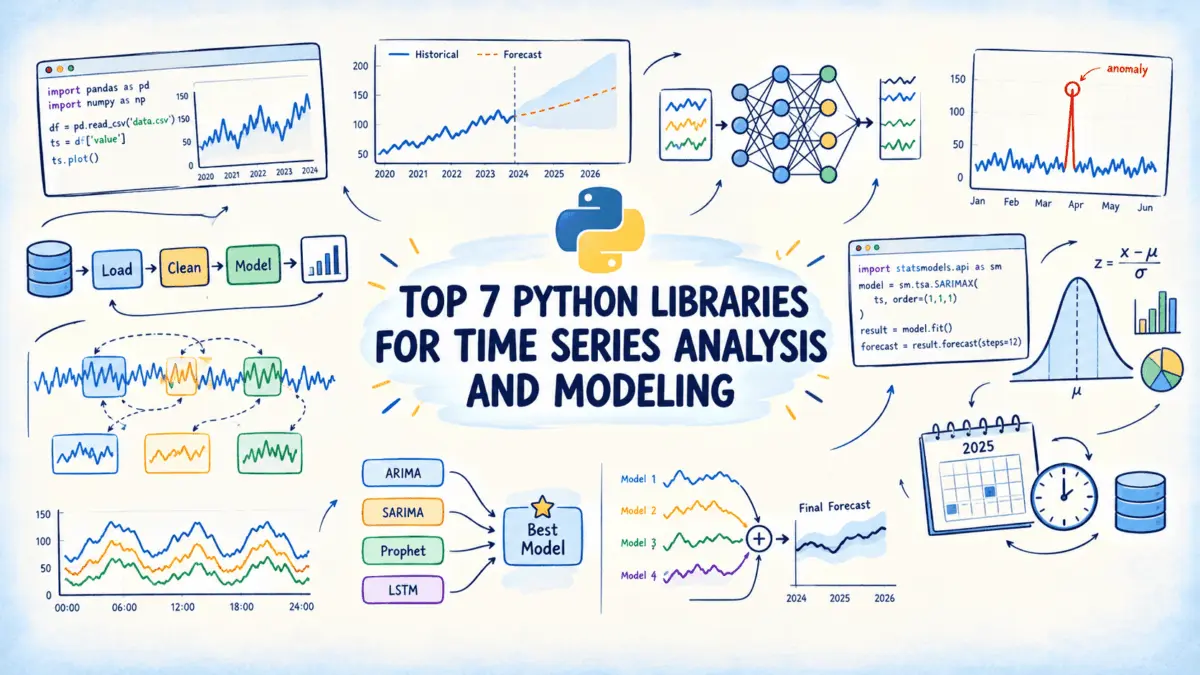
Time series analysis occupies a uniquely fragmented space within the Python ecosystem. Depending on whether data scientists and engineers need statistical forecasting, machine learning pipelines, deep learning models, or anomaly detection, they must reach for entirely different tools. Each of these solutions typically arrives with its own distinct application programming interface, data format expectations, and underlying assumptions about the problem at hand.
To bridge this gap, a comprehensive examination of seven prominent Python libraries highlights how they collectively span the full spectrum of time series work. From traditional economics models to modern deep learning architectures and unsupervised anomaly detection, understanding these tools helps developers select the right instrument for their specific analytical challenges.
Building Statistical Forecasting Models with Statsmodels
When interpretability holds just as much weight as raw predictive power, statsmodels remains a primary foundational choice for practitioners. As the bedrock of classical time series analysis in Python, the library implements the statistical models that have served as workhorses across economics, finance, and operations research for decades.
Statsmodels provides robust capabilities for traditional forecasting frameworks, offering rigorous diagnostic tools alongside the full ARIMA and SARIMAX model families. Because these models are deeply rooted in statistical theory, they offer clear insights into coefficients, confidence intervals, and residual analyses. This makes statsmodels especially valuable when forecasts must be presented to stakeholders who demand transparency and understandable causal logic behind the numbers.
Automating Model Selection with Pmdarima
Finding the correct parameters for classical forecasting models—specifically the p, d, and q orders required for ARIMA—frequently ranks as one of the most tedious steps in the workflow. The pmdarima library addresses this operational bottleneck by bringing R’s popular auto.arima functionality directly into the Python ecosystem. By wrapping statsmodels under the hood, pmdarima automates the often exhaustive model selection process.
Pmdarima serves as an efficient tool for generating rapid statistical baselines or for managing automated forecasting operations across large collections of series simultaneously. However, developers should note that maintenance and development cycles for the library have slowed in recent releases, making it wise to review the latest changelogs before pinning it directly into newly constructed production pipelines.
Building Unified Machine Learning Pipelines with Sktime
To combat the inherent fragmentation of Python’s time series landscape, sktime provides a unified interface that accommodates a vast array of learning tasks. The library spans classical statistics, machine learning, and deep learning, bringing forecasting, classification, regression, clustering, and annotation under a single structural roof.
Sktime shines when workflows demand systematic execution, reproducibility, and seamless comparison across multiple model families. By standardizing how time series data is handled and processed, the library enables developers to experiment with diverse algorithmic approaches without needing to completely rewrite data ingestion and preprocessing pipelines for every distinct tool they test.
Forecasting at Scale with Darts
While sktime focuses heavily on unifying external libraries and algorithms under a common interface, Darts takes a broader, self-contained toolkit approach. Instead of merely orchestrating other packages, Darts implements classical, machine learning, and deep learning models directly within its own architecture, placing a strong emphasis on probabilistic forecasting and multi-series scale.
Darts allows practitioners to tackle complex forecasting challenges that require uncertainty quantification across numerous related series. Its comprehensive model catalog spans traditional exponential smoothing and ARIMA alongside modern gradient-boosted regression and several deep learning network designs, all housed within a cohesive package that simplifies scaling operations.
Detecting Temporal Patterns with Stumpy
While the vast majority of time series libraries concentrate primarily on forecasting future values, stumpy approaches temporal data through a fundamentally different lens. Stumpy computes the matrix profile, a specialized data structure that records the distance between every subsequence in a series and its nearest neighbor.
This underlying structure empowers practitioners to perform motif discovery, discord detection, and pattern extraction without requiring pre-labeled training data. Consequently, stumpy proves exceptionally useful when the central research question focuses on identifying recurring behaviors, structural changes, or anomalous shapes hidden deep within historical records, making it a natural complement to traditional forecasting systems in production monitoring environments.
Scaling Anomaly Detection with PyOD
For outlier detection across tabular and multivariate feature matrices, PyOD stands out as a comprehensive resource within the machine learning community. Its major iterations implement more than sixty distinct detection algorithms accessible through a single, consistent interface. While initially focused on tabular information, PyOD has progressively expanded its scope to handle time series, graph, text, and multimodal data structures.
In practice, PyOD is most frequently deployed on engineered feature matrices—such as rolling statistics, lag variables, and frequency components—rather than raw sequence data directly. This enables organizations to leverage a wide array of unsupervised anomaly detection techniques at scale, identifying unusual behaviors across complex operational metrics.
Forecasting with Deep Learning Using NeuralForecast
When traditional statistical techniques and standard machine learning models reach their performance limits, deep learning approaches can often close the accuracy gap. Developed by Nixtla, NeuralForecast brings a wide collection of advanced neural forecasting architectures to Python in a manner optimized for production environments.
NeuralForecast introduces capabilities centered around global model training, allowing deep learning architectures to learn patterns simultaneously across thousands of individual time series. The library operates as part of the broader Nixtla ecosystem, which also encompasses StatsForecast for high-speed classical modeling and MLForecast for gradient boosting workflows.
Evaluating the Landscape
These seven libraries collectively map out the entire time series stack, ranging from transparent statistical formulations and automated model selectors to unified machine learning pipelines, pattern discovery frameworks, large-scale anomaly detectors, and deep learning architectures.
For developers and data scientists seeking mastery over these tools, the most effective approach involves applying multiple libraries to the same dataset and critically comparing the resulting outputs. Gaining a deep understanding of why specific models succeed or fail on a given problem yields practical insights into underlying data structures that static benchmark comparisons alone cannot provide.