Nearly two years after missing an initial international deadline, approximately 58% of the world’s countries have now officially submitted new pledges to address the accelerating crisis of nature loss, according to a comprehensive new analysis by Carbon Brief.
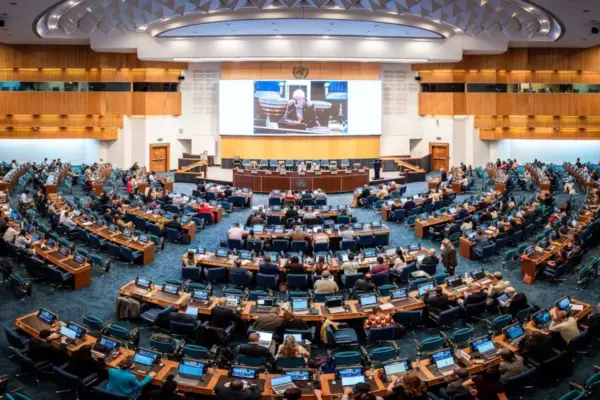
The developments come as government delegates prepare to travel to Yerevan, Armenia, next week for the upcoming COP17 biodiversity summit. The upcoming conference marks a crucial crossroads for global environmental policy, serving as the official halfway point of the Kunming-Montreal Global Biodiversity Framework (GBF)—a landmark international agreement struck in December 2022 aimed at halting and reversing the decline of the natural world by the end of the decade.
Under the rules and schedules established by the United Nations, nations were originally asked to submit updated national biodiversity strategies and action plans, known as NBSAPs, by the start of the COP16 biodiversity summit held in Cali, Colombia, in October 2024. However, that initial deadline saw a sluggish response, with only 15% of nations managing to release their plans on time. Confronted with widespread delays, negotiators at COP16 agreed to soften the immediate punitive measures while introducing a new text that explicitly "urges" countries to release their comprehensive roadmaps "as soon as possible."
Fresh data compiled by Carbon Brief indicates that this diplomatic pressure has yielded substantial progress. A total of 113 countries have now come forward with new NBSAPs. This represents a significant upward trend from the 55 nations that had completed their documents just a year ago, reflecting a broader global mobilization as governments realize the 2030 deadline is rapidly approaching.

Global Review and the Kunming-Montreal Framework
The upcoming summit in Yerevan will provide the global stage for the first official review of countries’ collective progress toward meeting the ambitious targets of the GBF. When nearly every government in the world gathered in Montreal, Canada, in 2022 to approve the framework, they committed to an overarching mission: to bend the curve of biodiversity loss upward by 2030, restoring natural habitats and safeguarding the ecological systems that sustain human life and economic stability.
The GBF is underpinned by a granular list of 23 distinct targets for 2030. These targets cover an expansive and interconnected range of environmental challenges, including large-scale ecosystem restoration, mitigating the impacts of climate change, and securing adequate financial flows to help developing nations shoulder the economic burden of conservation.
To ensure accountability, the framework established a rigorous schedule for monitoring progress. This process has culminated in the preparation of a comprehensive global report coordinated by the United Nations, which synthesizes data to inform the global review taking place at COP17. The UN’s global report draws heavily upon the newly submitted NBSAPs, individual national targets, and seventh national reports that countries were required to submit earlier this year.
Carbon Brief’s tracking confirms that 113 out of 196 parties—or roughly 58%—have fulfilled the core requirement to produce a modern NBSAP. Geographically, the wave of recent submissions has been bolstered significantly by nations across the Global South.
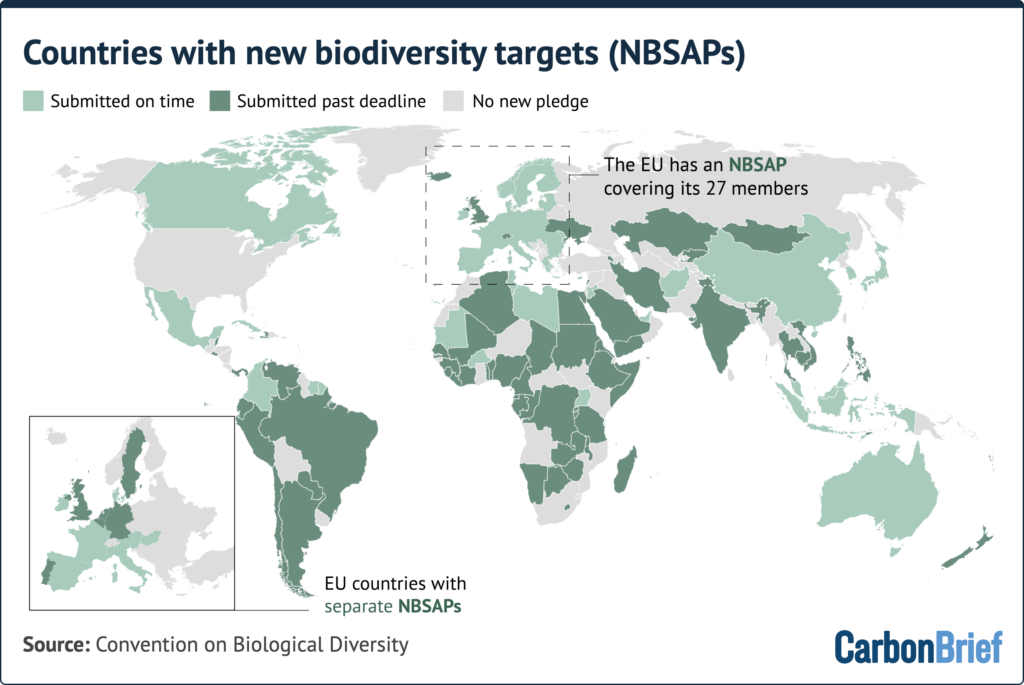
In Africa, a substantial block of countries has published new strategies over the past year. The expanding roster now includes Algeria, Benin, Botswana, Cameroon, Comoros, Congo, Côte d’Ivoire, the Democratic Republic of Congo, Egypt, Equatorial Guinea, Eritrea, Ethiopia, Gabon, Gambia, Guinea, Lesotho, Liberia, Madagascar, Malawi, Mali, Namibia, Rwanda, Senegal, Sierra Leone, Somalia, Sudan, Zambia, and Zimbabwe.
Similar momentum has been observed in South America. Brazil, recognized globally as the most biodiverse nation on Earth, has formally published its updated NBSAP, alongside neighbors Belize and Chile. Meanwhile, COP17 host nation Armenia delivered its national strategy in April, setting the stage for next week’s diplomatic engagements.
Targets Versus Action Plans and Missing Key Players
While the primary vehicle for implementing the GBF is the detailed NBSAP, the UN framework anticipated that some governments would face insurmountable administrative or capacity hurdles. Consequently, countries that found themselves "not in a position" to finalize complete action plans ahead of COP16 were permitted to submit standalone national targets instead.
Unlike fully realized NBSAPs, which include implementation timelines, budgets, and operational frameworks, national targets simply outline the specific biodiversity goals a government aims to achieve, without necessarily detailing the step-by-step mechanisms for execution.
Despite the flexibility, several critical nations have yet to finalize their comprehensive strategies. Four of the world’s designated "megadiverse" nations—countries that harbor the vast majority of Earth’s total plant and animal species—have not yet published new NBSAPs. This group includes Papua New Guinea, Peru, South Africa, and the United States. The omission of the United States remains a unique diplomatic hurdle, as it is the only UN member country that is not a formal signatory to the underlying UN Convention on Biological Diversity. Furthermore, Russia, which encompasses the largest land area on Earth, has also failed to produce a new NBSAP.
Nevertheless, intermediate indicators show widespread engagement. By the conclusion of COP16, roughly 119 parties had produced at least one national target. Over the subsequent two years, that figure has climbed to 175, representing nearly 89% of all countries.
In parallel, reporting requirements have also seen steady improvement. While only about half of all nations managed to meet the initial February deadline to produce their seventh national reports, compliance rates have since climbed to approximately 73% across the international community.
Financial Hurdles and Institutional Support
A persistent friction point throughout the implementation phase has been the availability of financial resources. Over the past two years, numerous developing countries have voiced deep concerns that chronic funding shortages have severely hampered their ability to conduct environmental assessments, draft complex policy documents, and launch actionable NBSAPs.

To alleviate these pressures, multilateral institutions have stepped up technical and financial assistance. According to a spokesperson for the Global Environment Facility (GEF)—the primary multilateral fund tasked with supporting nations in the preparation of their biodiversity strategies—significant headway has been made in disbursing aid.
The GEF reported that out of 139 developing countries that requested financial support in the wake of COP16, 120 have successfully accessed the necessary funds. Meanwhile, the UN Environment Programme has been actively working to resolve outstanding administrative and technical bottlenecks to ensure the remaining 19 countries can secure their financial assistance packages.
As delegates converge on Yerevan for COP17, the spotlight will inevitably turn to whether these newly minted strategies, bolstered by growing financial backing, are robust enough to alter the trajectory of global biodiversity before the 2030 deadline arrives.