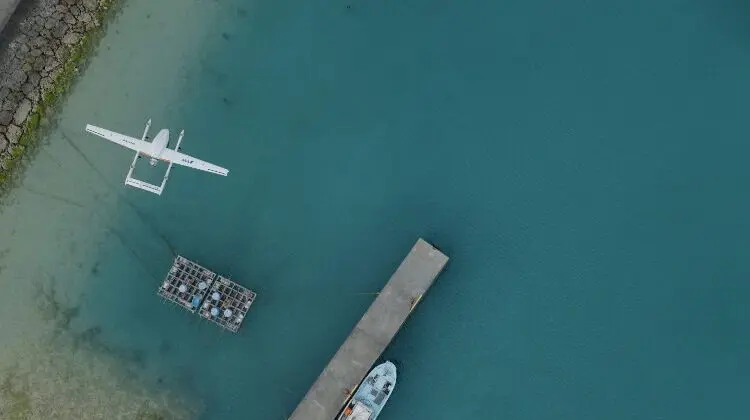
In a landmark regulatory milestone for the commercial aviation and energy sectors, the Federal Aviation Administration (FAA) has issued its first-ever authorization for a drone to fly beyond the operator’s visual line of sight (BVLOS) from the United States mainland out over the high seas of the Gulf of Mexico.
The historic decision, announced on November 9, 2026, opens the door to a new era of advanced long-range commercial drone operations. The authorization was awarded to Skyways, an autonomous aircraft development company headquartered in Austin, Texas. Under the terms of the groundbreaking approval, Skyways will deploy its autonomous V2 vertical takeoff and landing (VTOL) aircraft to execute complex operational missions connecting a mainland industrial energy asset directly to an offshore facility.
The flights will originate from a Shell facility located in Gibson, Louisiana, and travel across open water to reach a designated Shell offshore platform in the Gulf. According to federal regulators and company project outlines, the initial operations are designed to serve a dual purpose: combining vital infrastructure surveillance with simulated logistical support.
Offshore BVLOS Drone Mission Profile
The scope of the authorized mission highlights the evolving operational capabilities of modern commercial uncrewed aircraft systems (UAS). As outlined by the FAA, Skyways’ V2 aircraft will not merely make a transit flight over the water; it will actively perform critical industrial tasks along its route.
On the outbound leg from the Gibson facility toward the offshore platform, the autonomous V2 aircraft will conduct a comprehensive pipeline right-of-way inspection. Pipeline monitoring is traditionally a resource-intensive and costly undertaking, requiring either manned helicopter patrols or ground-based crews traversing difficult terrain. Utilizing an autonomous long-range VTOL aircraft for this task allows energy companies to monitor structural integrity and environmental safety along critical pipeline corridors with unprecedented frequency and minimal human exposure to risk.
Upon arriving at the offshore platform, the aircraft will transition into its secondary mission profile: a simulated equipment delivery. Offshore platforms require a constant stream of replacement parts, tools, and critical supplies. While heavy cargo is traditionally moved by supply vessels or manned helicopters—both of which entail significant logistical expenses, fuel consumption, and weather-related limitations—long-range cargo drones offer a rapid, flexible, and lower-emission alternative for light-to-medium payload deliveries.
Federal regulators noted that the mission is specifically structured to demonstrate how advanced autonomous drones can reliably support critical infrastructure and complex offshore operations in demanding maritime environments. By proving the safety and viability of these routes, the project serves as a proving ground for future commercial drone applications across the globe.
The approval follows months of steady industry anticipation. Back in June, Bill Wimberley, chief commercial officer of Skyways, spoke at an industry conference where he hinted at upcoming operational developments in the region. Wimberley told attendees that the company was actively cultivating a significant commercial agreement to provide advanced cargo delivery and inspection services to enterprise customers with substantial energy assets stationed in the Gulf of Mexico. Although he refrained from publicly naming the corporate partners at that time, the regulatory green light confirms the deep collaboration between Skyways and energy giant Shell to bring long-range autonomous logistics to life.

Section 927 Waiver Pathway
The path to securing this regulatory breakthrough was made possible through a specific legislative mechanism established under federal law. The FAA approved the operation utilizing Section 927 of the FAA Reauthorization Act of 2024.
This particular statutory provision grants the agency the authority to evaluate and approve certain advanced drone operations through a targeted waiver pathway, rather than requiring a lengthy, traditional rulemaking process or individual exemptions. By leveraging Section 927, the FAA can systematically advance innovative commercial operations and gather real-world flight data while the broader, comprehensive regulatory framework for routine BVLOS operations continues to wind its way through development.
The administration’s leadership emphasized that the authorization aligns closely with national goals to foster technological dominance and modernize the domestic airspace.
"The Trump Administration envisions a future where advanced drone operations are routine," said Michael Kratsios, assistant to the president for science and technology and director of the Office of Science and Technology Policy. "This authorization marks an important step toward that vision, demonstrating the potential of American innovation and ingenuity to transform offshore operations as we work to establish a regulatory framework that enables these capabilities safely and at scale."
For the aviation authority, the decision represents a proactive step in adapting traditional airspace management to the rapid pace of technological change. Regulators stress that safety remains the paramount priority while simultaneously seeking ways to prevent bureaucratic bottlenecks from stifling commercial growth.
"The FAA is focused on safely unlocking the full potential of American drone technology and ensuring our regulatory framework keeps pace with innovation," said Liam McKenna, acting deputy administrator of the FAA. "This first-of-its-kind authorization demonstrates how we are working with industry to move beyond traditional operating limitations and enable the next generation of commercial drone operations."
As Skyways prepares to launch its V2 aircraft from the Gibson facility toward Shell’s offshore assets, aviation and energy analysts alike will be closely monitoring the operational data generated by the flights. The success of these missions could heavily influence how federal regulators draft permanent rules for long-range maritime drone transit, potentially transforming logistics and infrastructure management for energy operations worldwide.