All of the NHS ambulance services across England experienced some of their busiest days in history during a record-breaking heatwave in June, according to new data obtained through freedom-of-information requests.
During the intense late-June weather event, temperatures climbed past 37 degrees Celsius in parts of the country, prompting authorities to issue only the second-ever "red" extreme heat warning. The data, compiled and analyzed by Carbon Brief, reveals how the staggering surge in demand during the five-day heatwave outpaced levels typically seen during the traditionally pressured winter months, and in many cases, even surpassed the peak operational strains of the Covid-19 pandemic.
The findings underscore a shifting paradigm in public health emergencies, as severe summer heat increasingly rivals traditional winter pressures on the National Health Service. Four out of every ten NHS ambulance services in England—including the London Ambulance Service—responded to unprecedented numbers of life-threatening emergencies on at least one day between June 23 and June 27. Additionally, services in the south-west and east of England recorded their highest volumes of 999 calls in their history.
Heat Demand and Rising Risks
Extreme heat significantly amplifies the physiological risk of numerous life-threatening conditions, most notably cardiovascular diseases and acute respiratory problems. The end of June brought historic temperatures to England, with the entire country blanketed under amber or red heat-health alerts issued by the government.
A red alert, deployed across the Midlands and the south of England, signifies a significant risk to life even for healthy populations. Researchers have since calculated that the summer heatwaves resulted in nearly 3,000 heat-related deaths across the United Kingdom. This mortality toll has been accompanied by unprecedented strain on hospital emergency departments and regional ambulance trusts.
To evaluate the true extent of the crisis, Carbon Brief filed freedom-of-information requests with all 10 NHS ambulance trusts in England, asking for comprehensive logs of their busiest operating days. The inquiries captured both total volumes of 999 emergency calls and "category 1" responses, which designate immediate, life-threatening incidents such as cardiac arrests.
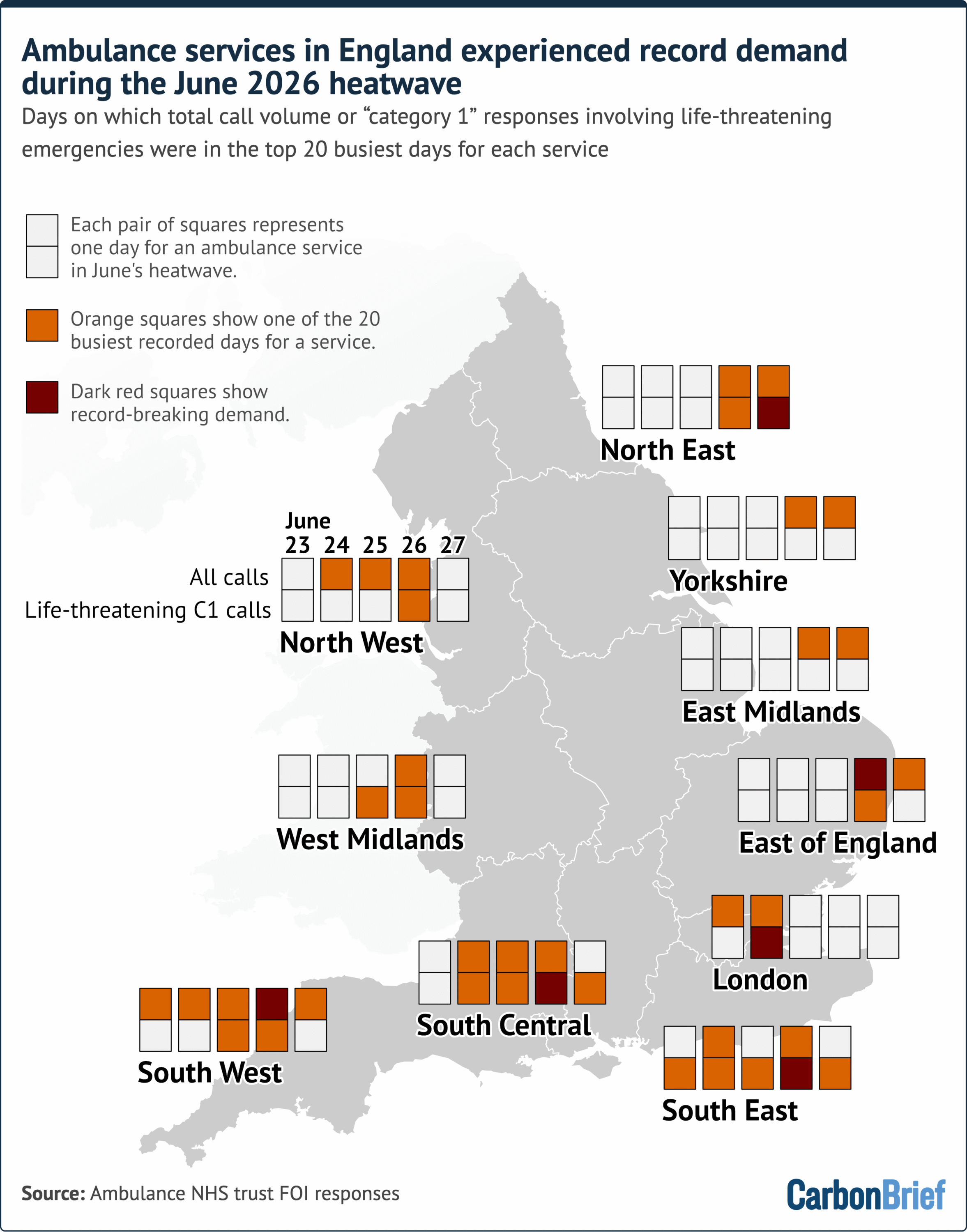
The resulting records show that the five-day window from June 23 to June 27 is heavily overrepresented across national metrics. At least two distinct heatwave days rank within the top 20 busiest days on record for every single ambulance service in the country. This trend is particularly pronounced across the south and east of England, where June temperatures regularly exceeded 36 degrees Celsius and pushed toward 38 degrees Celsius in localized areas.
Regional Services Stretched to the Limit
The operational burden was visibly concentrated in regions experiencing the most severe thermal conditions. London, the South East Coast, the South Central, and the North East ambulance services all reported breaking daily records for responding to life-threatening emergencies during the height of the heatwave.
For the South East Coast and South Central services, which cover an expansive territory stretching from Oxfordshire to Kent, June 25, 26, and 27 all witnessed unprecedented volumes of category 1 callouts consecutively. Meanwhile, the South Western and East of England ambulance services both logged their highest-ever totals of general 999 calls on June 26, matching the day the highest June temperature ever recorded in the UK was measured in Norfolk.

Public health analysts note that demand for ambulance services, including category 1 emergencies, has been on an upward trajectory for many years. This structural growth is driven by a combination of an aging national demographic, an increase in patients living with complex chronic health conditions, and rising pressures on mental health services. These underlying factors help explain why historical dates from prior to the 2020s are virtually absent from the top operational rankings provided by the trusts. Looking more broadly at healthcare trends, the year as a whole remains on track to set new records for annual ambulance demand.
Stifling Heat and Frontline Pressures
On June 26, the single busiest day of the heatwave, ambulance crews across England responded to 4,084 life-threatening emergencies. By comparison, the average daily volume for such critical incidents normally hovers around 2,500 during a typical summer month.
Stu Holliday, head of emergency preparedness, resilience, and response at the North East Ambulance Service, explained the direct physiological triggers behind the surge. During periods of sustained hot weather, services routinely encounter a sharp spike in calls from individuals suffering from acute dehydration, heat exhaustion, and heatstroke. Furthermore, prolonged high temperatures exacerbate pre-existing medical conditions, particularly among vulnerable populations such as older adults, young children, and pregnant individuals.

While winter has historically been the most demanding period for emergency medical services due to seasonal respiratory viruses and cold-related injuries, the June data demonstrates that extreme heat days are beginning to match or surpass winter peaks. This shift mirrors broader observations across the entire healthcare system, prompting warnings from public health officials that the NHS must structurally prepare for predictable annual summer heat pressures.
The unrelenting pace has taken a heavy toll on frontline personnel as well as patients. Labor representatives, including the UNISON trade union, issued warnings during the crisis regarding ambulance crews operating in stifling conditions, often with faulty or entirely absent air conditioning systems, while attempting to manage relentless back-to-back emergency callouts.
Methodological Context
The data compiled by Carbon Brief followed requests sent to the 10 primary NHS ambulance trusts operating in England: London, South East Coast, South Central, South Western, West Midlands, East Midlands, East of England, North East, Yorkshire, and North West. The trusts were asked to supply figures for their 50 busiest days on record, reaching as far back as their digital archives allowed.

While most services provided historical data originating in the 2010s, the North East and South Central trusts could only supply records dating back to 2021 and 2022 respectively. Because underlying demand has grown steadily over the decade, the vast majority of all-time busiest days across the national network naturally fall within the 2020s, with nearly all category 1 record days occurring within this decade.
Parallel requests submitted to health authorities in Scotland and Northern Ireland indicated that call volumes in those cooler regions did not reach top-50 historical rankings during the June heatwave, while the Welsh Ambulance Service did not respond to the information request.