OpenAI recently announced an extraordinary milestone: an internal artificial intelligence system has produced a proposed solution to the Navier-Stokes existence and smoothness problem, standing as one of mathematics’ legendary Millennium Prize Problems.
More precisely, the system constructed a finite-time singularity for the three-dimensional Navier-Stokes equations with a smooth external force, representing one of the routes permitted by the official Clay Mathematics Institute formulation of the problem. However, this achievement does not settle the better-known question of whether the unforced equations always remain smooth under all circumstances.
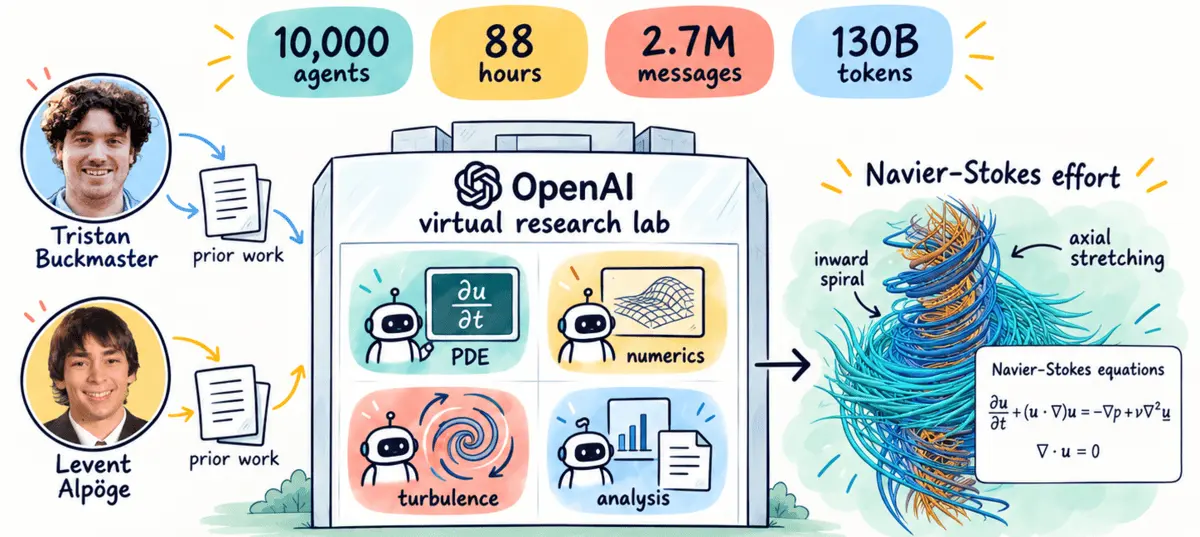
According to OpenAI’s official report, the monumental Navier-Stokes effort involved on the order of 10,000 concurrent AI agents, generating 2.7 million messages and roughly 130 billion output tokens. The distributed agents reached their proposed solution about 88 hours after the experiment officially began, followed by another 17 hours of rigorous Lean formalization and verification to ensure mathematical consistency.
At first glance, this outcome resembles the scenario people have long imagined from highly autonomous artificial intelligence: give a system a deeply complex problem that human mathematicians have struggled with for decades, allow it to compute and reason for a few days, and receive a complete, verified proof in return. Yet, a closer examination reveals that the actual story of how OpenAI reached this point is considerably more intricate and deeply intertwined with the ongoing efforts of human researchers.
The Story Started With Two Human Mathematicians
Before OpenAI deployed its massive army of 10,000 agents, mathematicians Tristan Buckmaster of New York University and Levent Alpöge, who works at Anthropic, had already been making major, groundbreaking progress on closely related fluid dynamics problems. Crucially, they were not working entirely without the assistance of advanced computational tools either.
Their rigorous research utilized sophisticated systems including Claude and OpenAI Codex, and their resulting mathematical proofs were formally verified using Lean. Their collective work notably included constructing finite-time blowup for the three-dimensional incompressible Euler equations under smooth forcing. While this specific result did not completely solve the Navier-Stokes problem itself, it pushed the boundaries much further into a closely related and highly challenging mathematical frontier.
Then a significant convergence of events occurred. According to OpenAI, on September 1, 2026, the company heard rumors that two separate Millennium Prize problems had been successfully solved. Those circulating rumors, combined with exceptionally strong preliminary results from its newly trained internal model, prompted the company to test the system across the remaining open Millennium Prize problems to gauge its capabilities.
OpenAI later realized that the rumors were directly connected to the independent breakthroughs achieved by Buckmaster and Alpöge. Consequently, the artificial intelligence system did not simply wake up one morning, independently select the Navier-Stokes equations from a blank slate, and solve them entirely from nowhere. Human researchers were already actively making significant, pioneering progress around the very same mathematical frontier. However, it was OpenAI’s own internal Euler result that subsequently convinced company leadership to concentrate its substantial computing resources specifically on the Navier-Stokes equations.
Then OpenAI Scaled It to 10,000 Agents
This juncture marked the point where OpenAI executed a strategy that was genuinely unusual in both scale and methodology. The company essentially engineered a gigantic virtual research laboratory, orchestrating a vast network of cooperating digital entities.
The agents were organized into distinct groups capable of communicating internally, running complex code, and accessing a cached version of the internet to gather background information. Different groups were assigned to explore varied mathematical approaches and hypotheses simultaneously. Nearly 100 agents initially worked for roughly 50 hours on an Euler-related problem and successfully produced a result that OpenAI considered highly promising.
At that critical juncture, OpenAI redirected its agents away from other Millennium Prize problems and focused them entirely on Navier-Stokes. The system also began sharing useful findings between the various working groups. OpenAI described this collaborative mechanism as cross-pollination, where Codex consolidated promising intermediate results from different agent groups, and those findings were systematically fed back into later prompts to guide subsequent exploration.
Eventually, the successful effort involved approximately 10,000 concurrent agents working in tandem. This massive parallelization may actually represent the most significant narrative of the entire experiment. A single human mathematician can explore a limited handful of complex ideas at any given time, and even a dedicated university research group can only investigate a few more. In contrast, ten thousand agents can investigate vast numbers of possible mathematical paths simultaneously, rapidly discard dead ends, and continuously build upon promising incremental results without fatigue.
Perhaps the true breakthrough is not that artificial intelligence suddenly transformed into an isolated mathematical genius, but rather that it has evolved into an incredibly scalable research workforce.
Then the Controversy Started
Following the public emergence of OpenAI’s result, Tristan Buckmaster raised an uncomfortable and serious question regarding data usage and intellectual property. He and Levent Alpöge had been utilizing Codex while developing their own private research and, according to Buckmaster, had fed drafts and working sessions from the project into the tool. Consequently, he asked OpenAI whether its newly trained model had been trained on, or had direct access to, those specific session histories.
As detailed in journalistic accounts of the emerging dispute, Buckmaster stated he was initially told that the model did not look up user data. When he inquired specifically about model training data, he reported that he did not immediately receive a definitive answer. Buckmaster remained cautious in his public statements, explicitly noting that he did not know what their model actually did or how it functioned, and that he could not confirm whether their private data had been utilized.
OpenAI subsequently launched an internal investigation into the matter. In an updated report, the company stated that Buckmaster’s Codex prompts from the preceding two months could not have influenced the system in any conceivable way, including through model training. Furthermore, OpenAI maintained that its human researchers and automated agents had not seen Buckmaster and Alpöge’s unpublished work before it became publicly known. Based on the verifiable evidence currently available, there is no technical basis to claim that OpenAI trained its systems on their unpublished proof or improperly copied their private research.
However, a secondary and distinct disagreement quickly emerged regarding the attribution of academic and professional credit. There were now two separate, high-level results on the table: the Euler work completed by Buckmaster and Alpöge, and the Navier-Stokes proof generated by OpenAI.
According to Buckmaster, OpenAI researcher Sébastien Bubeck presented two potential ways forward. One option was for Buckmaster and Alpöge to publish their Euler result before OpenAI officially released its Navier-Stokes findings. The second option proved significantly more controversial. Buckmaster stated he was offered the opportunity to author a paper presenting OpenAI’s Navier-Stokes proof, with explicit acknowledgment that an OpenAI model had generated it, but under the condition that Alpöge would be excluded from the authorship because of his employment at Anthropic. Buckmaster ultimately refused this arrangement.
Bubeck later clarified his position, stating that he had proposed Buckmaster as the lead author of a rewritten presentation of OpenAI’s proprietary proof, and that he considered it inappropriate for an active Anthropic employee to co-author work belonging directly to OpenAI. He also clarified that he had never proposed removing Alpöge from Buckmaster and Alpöge’s own independent Euler paper.
This sharp disagreement highlights a profound systemic problem that academic publishing and institutional ethics were never originally designed to handle. When human researchers develop the surrounding conceptual framework, AI tools actively participate in the exploratory research, another automated system generates the final complex proof, and humans are still required to interpret and publish the findings, determining who actually deserves the credit becomes an unprecedented challenge.
So What Did AI Actually Discover?
OpenAI’s high-profile experiment was clearly not a scenario where 10,000 agents started from a completely blank page and invented advanced fluid dynamics entirely from scratch. Instead, the system built directly upon decades of accumulated human mathematics, recent human progress accomplished in the exact same subject area, and specific research directions that were already showing immense promise at the frontier. Human researchers also maintained control over where to allocate computational resources, while OpenAI deliberately engineered the system to pass useful intermediate findings between separate agent groups.
Yet, those contextual realities do not make the final achievement any less significant. What OpenAI successfully demonstrated is an entirely new paradigm: thousands of artificial intelligence agents can explore complex research pathways in parallel, efficiently discard unproductive dead ends, combine promising conceptual ideas, and compress what would normally be an enormous amount of exhaustive work into just a few days.
The Clay Mathematics Institute subsequently acknowledged that the Navier-Stokes problem has apparently been settled, while simultaneously emphasizing that thoroughly evaluating the mathematical result and accurately determining appropriate credit will inevitably take considerable time. Therefore, the most vital question is perhaps not whether artificial intelligence has suddenly achieved broad artificial general intelligence.
What this unique experiment truly reveals is that humanity can now entrust a profoundly difficult research problem to thousands of artificial intelligence agents, allow them to explore countless theoretical possibilities simultaneously, and potentially finish in a matter of days what might otherwise take human researchers many years or decades to accomplish. That represents a fundamental shift in how scientific inquiry can be conducted.
At the same time, this milestone introduces complex new philosophical and ethical dilemmas. If artificial intelligence is building directly upon decades of prior human research and then exploring those established concepts at a massive computational scale, which portion of the final intellectual output should genuinely be classified as an authentic AI discovery?
Final Thoughts
The most compelling aspect of this scientific experiment is not merely the speed with which a famous mathematics problem was addressed, but rather the operational methodology behind it. OpenAI did not simply ask a single sophisticated language model to sit and think harder about fluid dynamics. Instead, it deployed thousands of distinct agents, directed them down diverging research paths, funneled increased compute toward the most promising avenues, shared valuable discoveries across different units, and maintained the process continuously until a working solution materialized.
This approach begins to resemble less of a traditional chatbot interface and more of an industrial-scale research organization operating at machine speed. In fact, OpenAI has consistently described its broader corporate objective as the development of an automated AI researcher.
Nevertheless, the Navier-Stokes breakthrough also illustrates precisely why observers must exercise caution when casually using terms like discovery. The agents were operating entirely on top of decades of prior mathematics, established literature, strategic human decisions, and theoretical ideas that were already evolving rapidly at the bleeding edge of the field.
Consequently, the true historical milestone here may not be that artificial intelligence suddenly learned how to generate independent discoveries out of thin air. Rather, it is that the fundamental process of scientific research itself has potentially become scalable. And if ten thousand AI agents can achieve this level of output today, the much larger and more consequential question is what will happen when this exact methodological framework is inevitably applied to thousands of other unsolved problems across mathematics, theoretical physics, biological science, and advanced engineering.