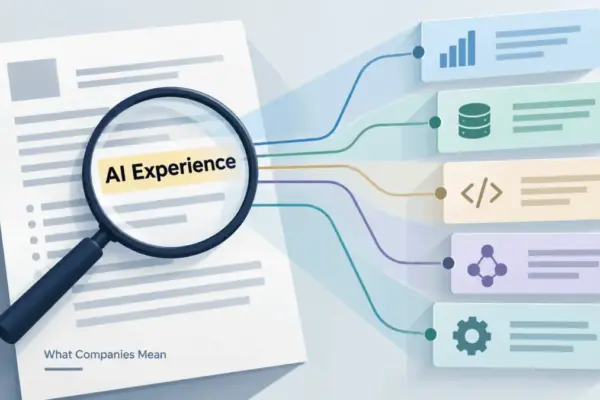
Job listings targeting data analysts, statisticians, and researchers increasingly feature a prominent and uniform requirement: "AI experience." Yet, beneath this ubiquitous phrase lies a surprising lack of standardization. Depending on the company, the industry, and the specific challenges a team faces, those two words can signify wildly disparate expectations. A hiring manager at a traditional retail giant, a cutting-edge biotech startup, and a multinational financial services firm might all use identical phrasing to describe entirely different technical competencies and daily responsibilities.
This pervasive ambiguity stems from the fact that "AI experience" functions primarily as a modern market signal rather than a precise technical specification. Unlike traditional credentials such as five years of regression analysis or demonstrated proficiency in statistical programming languages like R, the term carries no universally accepted definition across organizations. This linguistic vagueness is rarely accidental. Hiring teams often struggle to reach an internal consensus on their exact technological needs before drafting a requisition. Consequently, they resort to broad buzzwords that signal forward-thinking operations and effectively filter for candidates who have closely monitored recent technological developments, even when a precise competency profile remains undefined.
For job seekers navigating this landscape, the initial challenge involves deciphering the intent behind the listing. The surrounding job description, the broader industry context, and the designated seniority level collectively provide vital clues regarding what an employer actually requires. Industry sectors characterized by heavy regulatory compliance approach artificial intelligence differently than agile consumer technology companies, and understanding these nuances allows professionals to interpret the underlying operational reality of the role.
Most corporate uses of the phrase generally cluster around a few distinct paradigms. Some organizations are simply looking for baseline familiarity with enterprise software tools that incorporate artificial intelligence, expecting employees to navigate emerging productivity applications without fear. Other environments demand a solid theoretical awareness of machine learning concepts, requiring professionals to understand how algorithms evaluate data even if they do not build those models from scratch. More technical positions involve hands-on modeling work, while specialized roles call for domain-specific applications where industry expertise intersects with advanced computational methods. Recognizing which category applies to a specific opening fundamentally alters how candidates should approach the interview process and frame their professional histories.
For traditional statisticians and quantitative researchers, this landscape offers considerable reassurance. Statistical training forms the bedrock of nearly every business application currently labeled as artificial intelligence. The perceived gap between a traditional statistician and an active practitioner in the field is largely a matter of vocabulary and tooling rather than underlying analytical reasoning. Professionals do not need to discard their established credentials or overhaul their resumes; instead, they must learn to translate their core competencies into the contemporary lexicon of the corporate world.
When a resume states that a candidate built predictive regression models to forecast quarterly demand, a hiring manager searching for artificial intelligence capabilities is essentially reading about supervised learning and model evaluation. By framing past achievements around tangible business outcomes and analytical reasoning processes rather than rigid software platforms, the direct connection between traditional statistics and modern technical roles becomes immediately visible.
Navigating these postings effectively requires treating the job advertisement much like a complex dataset, approaching it with healthy skepticism while focusing on what the available evidence actually supports. Headline requirements listed at the very top of a posting are frequently aspirational. Companies routinely assemble a wish list of every ideal skill they hope to find, fully aware that no single applicant will check every box. A brief mention of artificial intelligence buried near the bottom of a lengthy qualifications list typically carries far less weight than the core operational duties outlined in the main body of the text. The day-to-day responsibilities and the specific organizational problems the position aims to solve provide the most reliable indicators of what the team truly values.
A useful shortcut for applicants is examining whether a role focuses on utilizing tools to accelerate analysis or centers on building and validating new computational models. While the headline requirements often obscure this distinction, the descriptive paragraphs detailing daily tasks usually clarify the exact nature of the work. Additionally, the specific modifiers attached to the requirement offer important context. When a listing notes that such experience is merely preferred, it typically indicates a secondary asset rather than a dealbreaker. Conversely, absolute demands for hands-on machine learning proficiency accompanied by specific software listings point toward much heavier technical expectations.
The seniority level associated with an opening also reshapes how organizational expectations must be interpreted. For junior positions, companies generally value adaptability and a willingness to learn internal systems over deep technical specialization. At the mid-level, employers look for informed collaboration, expecting professionals to work alongside engineering teams, contribute to model evaluation discussions, and effectively bridge the gap between data science specialists and business stakeholders. Senior roles demand strategic judgment, requiring experienced leaders who understand precisely when computational solutions are appropriate, who can clearly communicate technical limitations to executive leadership, and who can help the broader organization avoid the substantial operational costs associated with careless deployments.
Several common misconceptions continue to complicate the job search for qualified professionals. Many applicants assume they should list every single software tool or application they have ever touched, a strategy that frequently backfires during technical screenings. Hiring managers consistently remember candidates who demonstrate sound analytical judgment and critical thinking rather than those who simply list software access. Describing the specific problems resolved and the underlying reasoning process provides far more value, with tools mentioned merely as supporting context.
Another widespread fear is that candidates are automatically disqualified if they have never built a complex machine learning model entirely from scratch. For the vast majority of positions utilizing this terminology, this is simply not true. What frequently disqualifies applicants is an inability to think critically about data quality, underlying model assumptions, and the accurate interpretation of results. Because these represent core statistical competencies, they precisely match what companies desperately need, even if human resources departments occasionally struggle to name them correctly in their initial postings. Similarly, the belief that an expensive professional certification is mandatory before submitting an application often deters qualified individuals. While credentials offer utility in certain specialized contexts, hiring managers evaluating analyst-level talent focus heavily on reasoning capabilities during direct interviews. The ability to articulate precisely when an automated system might fail, and the underlying reasons for those potential discrepancies, carries far more weight than any completed online training course.
Ultimately, encountering references to artificial intelligence within modern job advertisements should be viewed as an invitation to begin a professional dialogue rather than a rigid, insurmountable technical barrier. Because foundational quantitative training already covers substantial ground across various corporate applications, the primary task for job seekers involves reading postings with analytical precision, identifying the specific category of need, and framing existing professional backgrounds so that the connection to business goals remains unmistakably clear.