A policy document recently published by the UK’s opposition Conservative Party has sparked scrutiny after it was discovered that a headline figure regarding the cost of achieving net-zero carbon emissions appears to have been doubled due to a foundational spreadsheet error.
The policy booklet, titled "Right Way" and framed as a "common sense" guide to governance, argues that voters ultimately want administrations capable of solving the practical problems for which they take responsibility. Within a dedicated section cautioning that sophisticated economic modeling should never serve as a substitute for grounded political judgment, the document takes aim at various official estimates concerning the financial burden of transitioning the United Kingdom to a net-zero economy.
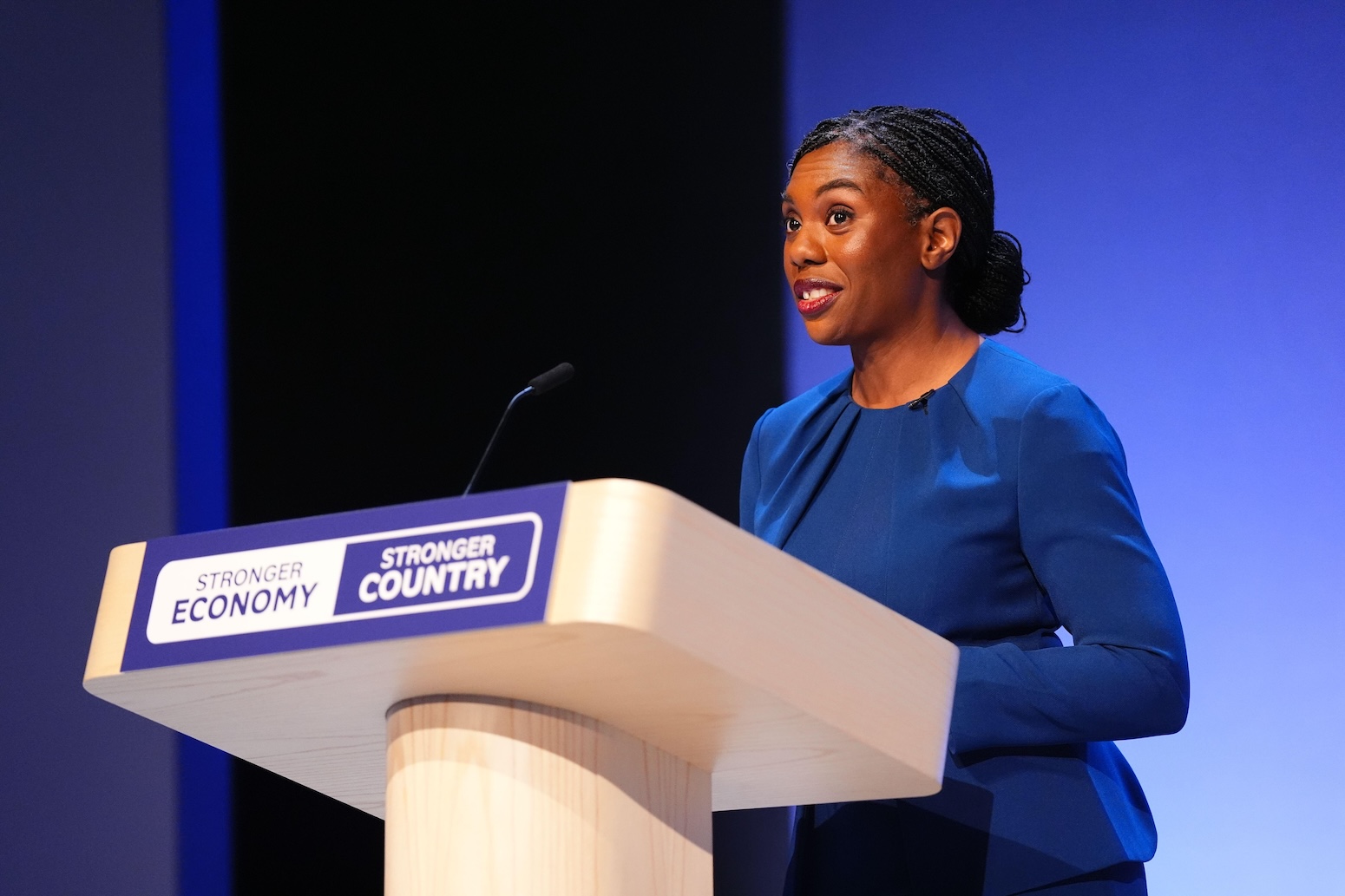
However, in making its case, the Conservative publication asserts—incorrectly—that the Climate Change Committee (CCC), the government’s official independent adviser on climate policy, pegged the cost of the net-zero transition at close to £1 trillion. Specifically, the booklet claims that back in 2020, the CCC estimated its designated route to net-zero would cost a staggering £957bn.
In reality, the CCC’s 2020 calculation was exactly half that amount, standing at £478bn. Furthermore, the committee adjusted its outlook significantly last year, publishing a revised net figure of £108bn largely driven by the rapidly falling costs associated with electric vehicles and advancing clean technologies.
The origin of the Conservative Party’s inflated figure appears to trace back to an accidental double-counting mistake embedded within a large economic dataset published by the CCC in December 2020 alongside its landmark Sixth Carbon Budget.
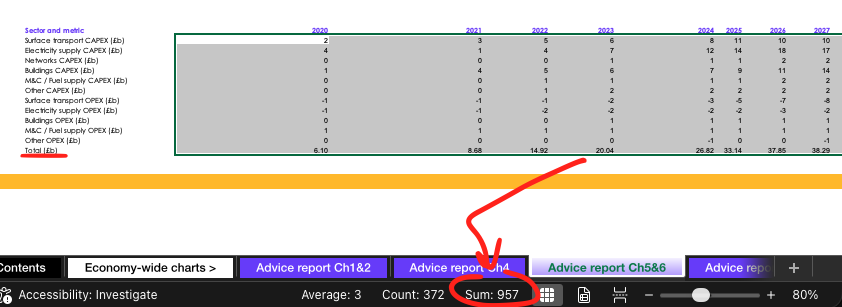
Spreadsheet Error
The spreadsheet in question was designed to outline the additional capital investments required to construct a net-zero economy over a 30-year timeframe spanning from 2020 to 2050. These projected expenses ranged widely, covering everything from low-carbon electricity generation infrastructure to domestic heat pumps and battery-electric vehicles.
In the document’s architectural layout, these extra capital expenditures—labeled as CAPEX—summed to a total of £1.38 trillion over the three decades. Against these expenditures, the model factored in expected operational savings, listed as OPEX, amounting to £0.90 trillion. When these two variables were synthesized across the 2020-2050 timeline, the combined net cost of CAPEX and OPEX yielded a true total of £478bn.
Alongside the individual sectoral breakdowns for annual CAPEX and OPEX, the CCC spreadsheet also featured a summary line providing combined annual totals for each individual year. An investigation into the origin of the higher figure indicates that an analyst inadvertently added all of these annual rows together alongside the grand totals, thereby accidentally counting the underlying savings and costs twice.
This double-counted accumulation resulted in a cumulative sum of £957bn. This exact figure has now found its way into official opposition literature, reproduced as an authoritative projection of government advisory bodies.
When the CCC originally published its Sixth Carbon Budget in 2020, it emphasized that the net cost of £478bn equated to less than 1% of the UK’s total Gross Domestic Product (GDP) over the course of 30 years. The committee stressed at the time that while the initial capital investment required was substantial, it would yield significant long-term savings through reduced dependency on volatile fossil fuel imports, ultimately providing a net boost to the wider economy of around 2% of GDP.
By 2025, the committee further updated its projections as market realities shifted. The CCC revised its estimated investment costs up to £670bn while raising operating savings to £562bn, yielding a revised net total of £108bn for the period between 2025 and 2050—representing less than 0.2% of GDP. Earlier this year, the advisory body underscored that achieving net-zero emissions would cost less than enduring a single major fossil fuel price shock, noting that the protective benefits of the transition would generate tangible savings worth £110bn annually.
Paper Trail and Dissemination
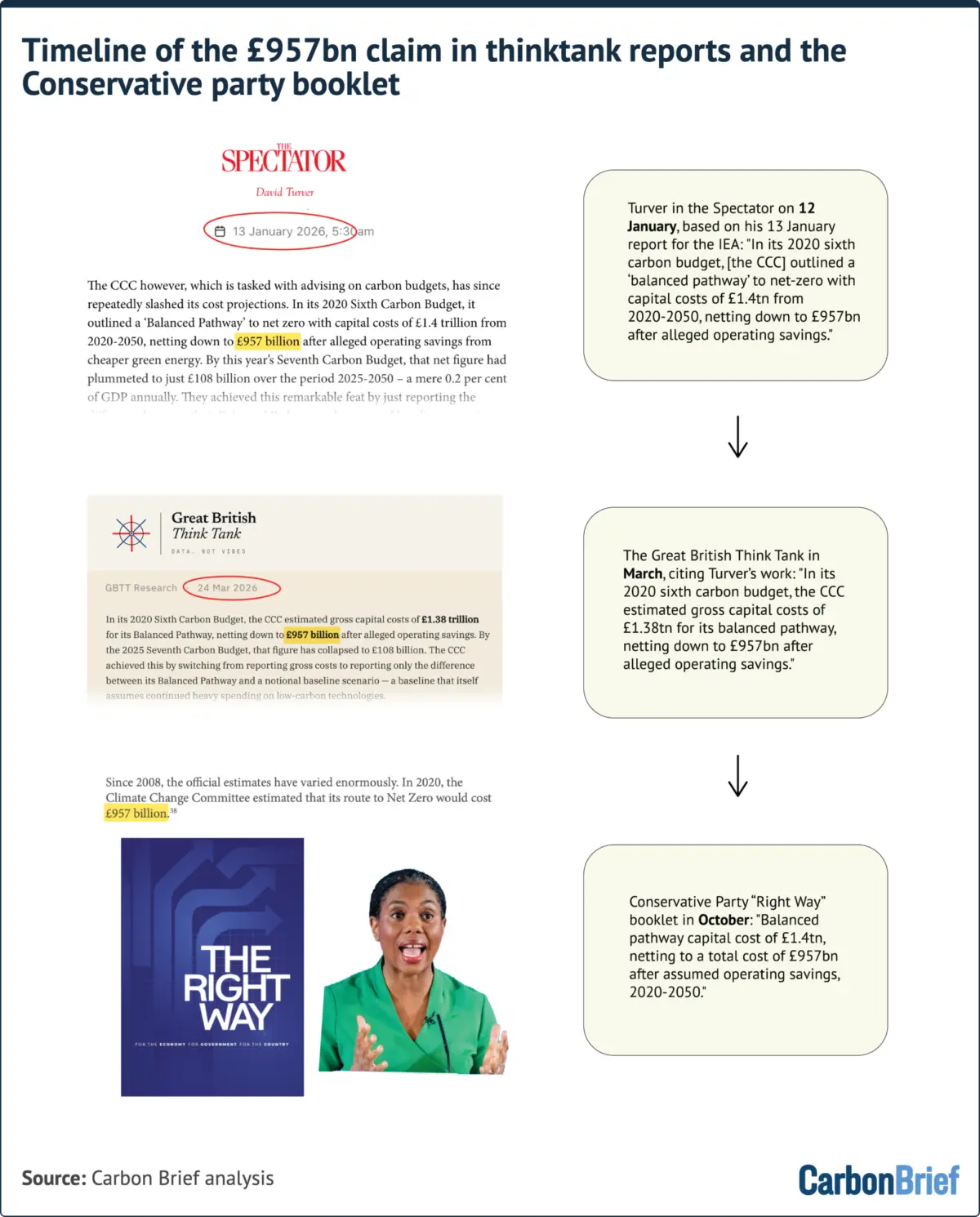
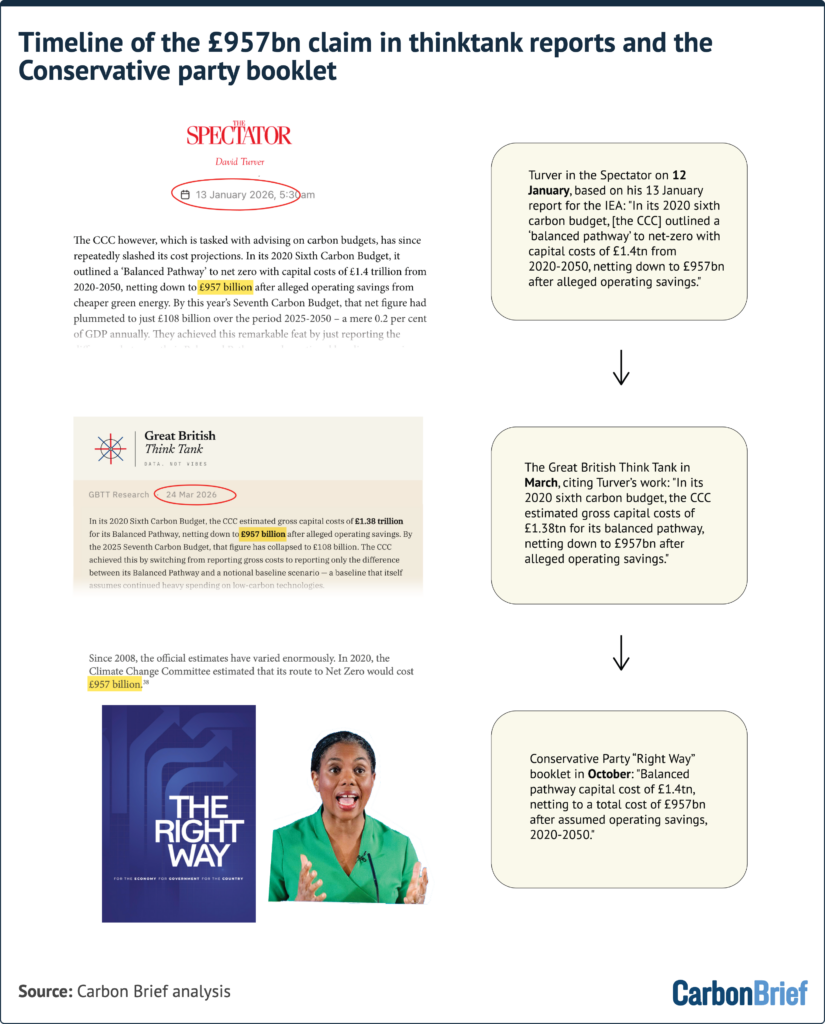
While the Conservative Party document formally cites the CCC’s 2020 advice on the sixth carbon budget as its source, the actual lineage of the £957bn figure reveals a distinct path through external think tanks and commentary spaces prior to its adoption by mainstream political figures.

The earliest known online reference to the £957bn figure appeared in January 2026 in an article published by The Spectator, authored by retired engineer and self-described "accidental energy analyst" David Turver. Just one day after that publication, Turver repeated the same figure within a formal report released by the free-market Institute of Economic Affairs (IEA), citing figure 5.3 of the CCC’s 2020 supporting data.
As detailed in the underlying data sheets, however, the table underpinning figure 5.3 totals £478bn. The duplication occurred because the analyst summed all individual rows without accounting for the pre-calculated annual summary lines already present within the digital workbook.
Turver’s initial calculations also spawned separate headlines elsewhere in public discourse, occasionally generating even larger claims—such as assertions that net-zero would cost between £7.6 trillion and £9 trillion. Those extended figures relied on theoretical assumptions treating fossil fuels and the millions of vehicles, boilers, and power plants dependent on them as having zero replacement or operational costs.

Following the circulation of the IEA report and related commentary in early 2026, the £957bn figure was referenced again in March by the Great British Think Tank, an organization whose public messaging heavily emphasizes data-driven research sourced exclusively from official public bodies. By October 2026, the figure had completed its journey into mainstream political discourse, securing a prominent place within the Conservative Party’s "Right Way" policy booklet.