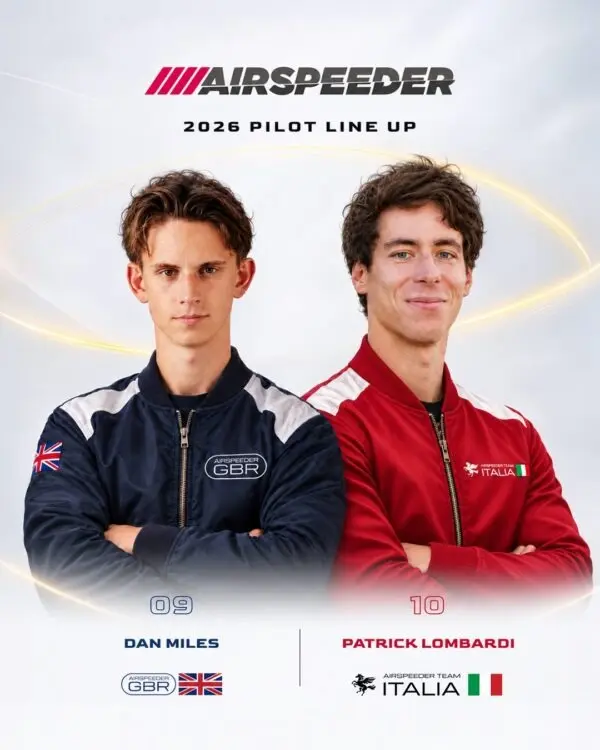
The dawn of a brand-new motorsport era has taken a major step forward as London-based electric flying car racing series Airspeeder officially announced the final two competitors for its inaugural international championship. FPV drone specialists Patrick Lombardi and Dan Miles have been locked in to round out the five-team roster, representing Airspeeder Team Italia and Airspeeder GBR, respectively.
The high-profile announcements, made on November 5, complete the initial pilot line-up for the five national squads preparing to compete in the world’s first-ever flying car racing series. The final pieces of the puzzle fall into place just ahead of the championship’s highly anticipated opening private race, slated to take place in Adelaide, Australia.
Lombardi and Miles join an already formidable group of elite aviators who have committed to the revolutionary motorsport category. The existing roster features Thomas Bitmatta representing Airspeeder Team Australia, Mason West flying for the DeLorean Airspeeder Team, and Seth Moore carrying the banner for Airspeeder New Zealand. Together, these five pioneering pilots will form the vanguard of a completely unprecedented era of competitive motorsport, taking crewed electric vertical takeoff and landing (eVTOL) aircraft to the absolute limits of performance and endurance.
Matt Pearson, chief executive and co-founder of Airspeeder, emphasized the significance of finalizing the pilot roster as the championship edges closer to its competitive debut. With all five primary teams now fully staffed with drivers, the competition has officially shifted into a higher gear, establishing clear narratives, national stakes, and personal rivalries for fans to follow.
"With Lombardi and Miles joining the line-up, the first five teams now have their pilots. That gives the competition a new edge," said Pearson. "Fans have teams to follow, pilots to back and rivalries to watch develop. Italy and Great Britain bring proud racing and engineering traditions, and we look forward to seeing these pilots write the next chapter for their teams."
The inclusion of powerhouse automotive and racing nations like Italy and Great Britain injects traditional motorsport prestige into a sport that relies entirely on cutting-edge aerospace technology. Both newly announced pilots bring deep, specialized backgrounds in high-speed, precision first-person view (FPV) drone piloting, making them uniquely qualified to handle the intense spatial awareness, reflexes, and split-second decision-making required to pilot full-scale electric flying race cars.
FPV Backgrounds for Airspeeder Pilots
The journey to the cockpit of an Airspeeder electric flying racing car is rarely conventional, and the backgrounds of both Lombardi and Miles highlight the unique cross-pollination between extreme sports, high-end commercial filming, and professional drone racing.
Patrick Lombardi, who will pilot the machine for Airspeeder Team Italia, was born and raised in Riva del Garda in scenic northern Italy. Long before he ever touched the controls of a racing drone or an eVTOL craft, Lombardi forged a fierce competitive spirit in international downhill skateboarding. Traveling around the globe to compete against the world’s best, he captured titles and mastered the art of maintaining absolute composure and split-second control while navigating high-speed descents.
However, a serious crash forced Lombardi to reevaluate his competitive trajectory, steering him away from physical board sports and directly into the rapidly expanding world of FPV drones. He quickly turned his passion into a professional career, earning industry recognition for filming high-performance supercars and extreme sports athletes with breathtaking precision and dynamic camera angles. For Lombardi, stepping out from behind the monitor and climbing into the pilot’s seat represents the ultimate evolution of his career.
"Taking on Airspeeder for Team Italy is the ultimate next level," Lombardi remarked following the announcement. "Transitioning from FPV to piloting a full-scale electric flying race car is a dream come true."

Across the English Channel, Dan Miles brings an equally impressive pedigree to Airspeeder GBR as a full-time racing and cinema pilot from Britain. Miles first purchased a drone in 2017 primarily for recreational and filming purposes, but his passion quickly evolved into competitive flying. He began flying FPV seriously in 2021, eventually entering professional competition through the rigorous ranks of the British Drone Racing Association. His natural talent and dedication paid off swiftly, earning him a coveted spot on Team GBR during his very first full season of competitive racing.
Miles’s competitive credentials reached a global scale in 2024, when he proudly represented Great Britain at the prestigious World Drone Racing Championships held in Hangzhou, China. Against the most elite drone pilots on the planet, Miles distinguished himself by finishing as his national team’s highest point-scoring pilot. Demonstrating his entrepreneurial and professional versatility in the industry, he also founded BusterVisuals in 2025, an FPV filming business specializing in high-octane motorsport coverage, live events, and commercial productions.
For Miles, joining Airspeeder feels like the culmination of every discipline he has mastered throughout his professional life. The blend of high-speed aerospace engineering, tactical racing lines, and the pioneering spirit of a brand-new sport offers a once-in-a-lifetime professional challenge.
"Airspeeder is where everything I’ve worked towards comes together: the precision of drone racing, the speed of motorsport, and a sport that’s still being written," said Miles. "I can’t wait to get out there, learn from the team and get racing."
Training for Full-Scale Flying Racecars
Transitioning from the relatively lightweight chassis of an FPV racing drone to the massive, complex scale of a crewed electric flying race car requires an intensive, highly specialized training regimen. According to Airspeeder leadership, the newly minted pilots must not only adapt rapidly to the physical scale, aerodynamic handling characteristics, and power delivery of the racing aircraft, but they must also build an intimate, highly functional working relationship with their respective engineering and flight crews.
To bridge the vast gap between simulator training and live aerial flight, Airspeeder relies heavily on its designated training provider partner, Global Drone Solutions. The comprehensive preparation program is overseen by Zeph Walsh, Airspeeder’s head of pilot training and a towering figure in the world of crewed eVTOL competition. Walsh etched his name into the history books in 2023 when he secured a historic victory in the world’s first-ever three-way crewed eVTOL aerial showdown hosted by Airspeeder, giving him unmatched insight into the pressures, strategies, and physical demands of piloting these revolutionary machines.
Walsh noted that the official naming of all five national pilots marks a crucial turning point, moving the organization from developmental phases into active, focused race preparations. The immediate priority is ensuring that every pilot thoroughly understands the mechanical and aerodynamic behavior of the aircraft while cultivating elite consistency at the controls under high-pressure conditions.
"Having all five pilots named brings the competition into focus," Walsh stated. "The next task is helping each of them understand the aircraft and build consistency at the controls. Simulator performance is part of that, but so is communication, judgement and working with the crew. Together with Global Drone Solutions, our Training Provider Partner, we’re preparing them to take on that next level."
As the clock ticks down toward the opening private race in Adelaide, anticipation continues to build across the global motorsport and aerospace communities. Airspeeder has announced that it will release further comprehensive details regarding team preparations, technical specifications, and the exact format of the inaugural event in the weeks leading up to the November race.
With five international teams now fully armed with world-class pilots drawn from the pinnacle of precision drone racing, the stage is set for a groundbreaking chapter in human-piloted electric aviation.