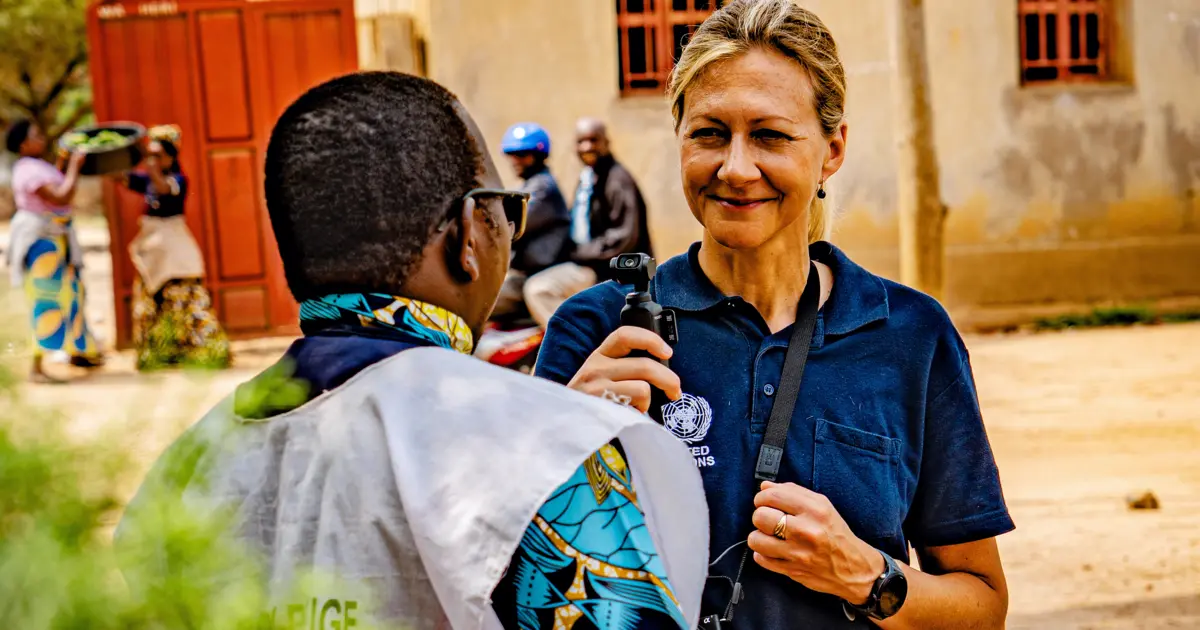
BUNIA, Democratic Republic of the Congo — For Priscilla Lecomte, a Public Information Officer with the United Nations Office for the Coordination of Humanitarian Affairs (OCHA), the assignment to eastern Democratic Republic of the Congo (DRC) was meant to be a professional mission. Deployed to support communications on the ground for the ongoing Ebola response, her goal was to document the reality of a health crisis that has increasingly slipped from the world’s focus.
However, statistics and strategic overviews quickly gave way to a deeply personal and harrowing encounter inside an Ebola treatment center in Rwampara, located half an hour outside Bunia, the capital of Ituri Province. It was there that Lecomte met Celestine.
Well, she did not truly meet her in the traditional sense. Standing outside a portable isolation chamber known as a "cube," Lecomte saw only her head and feet beneath a blanket, and, from behind, her frail shoulders. It was the sight of those shoulders that made the public information officer stop dead in her tracks.
Celestine was struggling to breathe. Placed inside the specialized containment unit at the heart of the Ebola treatment facility, she was suffering from acute respiratory distress. Oxygen was being actively pumped from a ventilator placed directly next to her enclosure. Through the transparent walls, Lecomte could observe the uneven, strained movement of the 60-year-old woman’s shoulders as she fought for every breath.
The visual brought an immediate, painful flash of memory. It reminded Lecomte of her own mother. During her mother’s final weeks, as she was losing her battle against cancer, she had begun to exhibit the exact same uneven chest movements when she could no longer breathe properly.
The recollection filled Lecomte with a profound sense of fear. She recalled thinking that her mother could stop breathing at any moment—an eventuality that ultimately came to pass when her mother died on June 16, 2017, with Lecomte right by her side.
Yet, the scene unfolding in the Rwampara treatment center possessed a chilling isolation entirely of its own. Nobody was standing next to Celestine inside the cube. No relative was there to hold her hand. No daughter was present to offer comfort. At one point, a doctor dressed completely in full protective equipment approached the chamber to administer palliative medication through an intravenous line, working with the clinical detachment required in the high-risk environment.
Dr. Etienne, a physician who had just finished his shift at the center, explained the grim details of the case. Celestine was in a coma and had been in that state for a week. She was 60 years old and had been confirmed to have contracted the deadly Ebola virus.
Lecomte had not initially set out to focus on individual patients. Her mandate was broader: to document the overarching Ebola response so that people abroad would pay attention to a regional health emergency that has struggled to maintain global visibility. But Celestine’s shoulders had stopped her in her tracks, forcing a haunting personal question: What if it were her own mother inside that cube, alone and terrified?
The Reality of Treatment and the Burden on Health Workers
Dr. Etienne later explained that patients in unstable conditions like Celestine’s often require specialized interventions, such as dialysis, to manage organ failure. However, severe resource constraints mean that such advanced care is frequently unavailable due to a lack of funding. With a gentle demeanor, the doctor communicated the severity of the situation, describing a complicated clinical outlook that another observer might have bluntly summarized as terminal.
The public health data surrounding the outbreak underscore the razor-thin margin between recovery and tragedy in eastern DRC. The overall fatality rate for the outbreak sits at 47 per cent, meaning nearly half of all people who have contracted the virus have succumbed to it since the beginning of the escalation in May.
Yet, public health officials emphasize that statistical averages fail to capture the stark binary of the disease’s progression. Patients who are fortunate enough to seek medical care early in the course of the infection enjoy an 80 per cent chance of survival. Conversely, those who arrive at a treatment center too late face an inverse statistic: an 80 per cent chance of dying.
The underlying question remains whether a different outcome might have been possible for Celestine. Had she accessed advanced medical care earlier, or recognized her symptoms sooner, would she have survived?
The non-governmental organization ALIMA, which operates the Rwampara treatment center near Bunia, has worked relentlessly to bridge the gap between patients and medical intervention through innovative design. ALIMA is credited with inventing the "cube," a portable treatment system that allows medical personnel to assist patients safely through transparent plastic walls fitted with integrated gloves and medical tools.
The innovation serves a dual purpose. It permits family members to see their loved ones up close without risking exposure, while enabling doctors to monitor patients easily. In Rwampara, the cube is deployed primarily for the most serious cases, as well as for pregnant women who may need to deliver their babies while battling the virus. In such high-stress scenarios, remaining inside full personal protective equipment throughout an entire delivery is exceedingly difficult for medical staff, making the cube an invaluable tool for clinical safety.
ALIMA is only one of the key organizational partners operating Ebola treatment centers across the eastern provinces of the DRC. The human toll on the medical workforce has been immense. Health professionals operate under intense pressure within a deeply stressful environment.
Lecomte met Danny, a nurse at the facility, who described the heavy emotional burden of watching so many members of his own community succumb to the disease. Despite the psychological strain, Danny and thousands of other local health workers continue to perform their duties to the best of their abilities.
The occupation is fraught with peril. More than 40 health workers have died since the beginning of the outbreak, contributing to a broader death toll that has surpassed 3,000 lives lost to the virus nationwide.
An Unforgiving Virus Outpacing the Response
The outbreak represents the largest the country has ever faced. Public health experts warn that it threatens to surpass the devastating 2014–2016 Ebola epidemic in West Africa, which claimed more than 10,000 lives.
Under different conditions—with a more robust national health system and the capacity for earlier disease identification—epidemiologists suggest the outbreak could have been contained. Instead, the virus has repeatedly outpaced the operational capacity of the response, leaving communities vulnerable and increasing the likelihood that more patients like Celestine will lose their lives.
Efforts to contain the virus involve a vast, coordinated network of actors. The Government of the DRC, spanning from the leadership of the Ministry of Health down to frontline community health workers, has mobilized every available resource. They are backed by the international community, with hundreds of aid workers and international health experts working around the clock to deploy the best possible response against the pathogen.
Despite these concerted efforts, the fundamental nature of the virus remains unchanged. It is silent, deadly, and unforgiving, stripping individuals of their lives with devastating speed. The heaviest burden falls on the most vulnerable segments of the population, disproportionately impacting older adults, children, and pregnant women.
Standing in front of Celestine’s isolation chamber, the OCHA public information officer was overwhelmed by emotion. Thinking of her mother, she wished she could have held Celestine’s hand to offer reassurance and tell her not to be scared, just as she had done years before during her mother’s final days. But the terror of the disease and the grim reality of the isolation ward made physical contact impossible.
Celestine passed away on August 25, 2026. While her journey has ended, hundreds of other patients continue to receive care inside Ebola treatment centers across eastern the Democratic Republic of the Congo, depending on the continued attention, funding, and support of the global community.