There has always been a persistent gap between what data scientists believe employers want and what hiring managers actually write into active job descriptions. Today, that gap is widest at the senior level, where professional requirements have shifted more dramatically over the past two years than they did in the preceding five combined.
An extensive new analysis of the employment market reveals that senior data science postings reflect a field that has moved decisively beyond the traditional era of simply building models in a Jupyter notebook. Instead, employers are aggressively screening for production-grade technical depth, fluency with modern artificial intelligence tooling that did not exist a few short years ago, and a robust combination of business and communication skills that many technically proficient candidates still severely underestimate.
This market overview draws on comprehensive analyses of thousands of active U.S. job postings. This includes a detailed review of 500 postings pulled directly from major employment platforms like LinkedIn, Indeed, and Glassdoor, an analysis of over 7,000 postings tracking artificial intelligence skill frequencies, and broader labor market data covering 12,148 positions tracked by Axial Search. The objective of synthesizing these datasets is to paint an accurate picture of precisely what senior data science roles demand, uncovering specific requirements that continue to catch many applicants by surprise.
The Baseline Has Risen: What Table Stakes Look Like Now
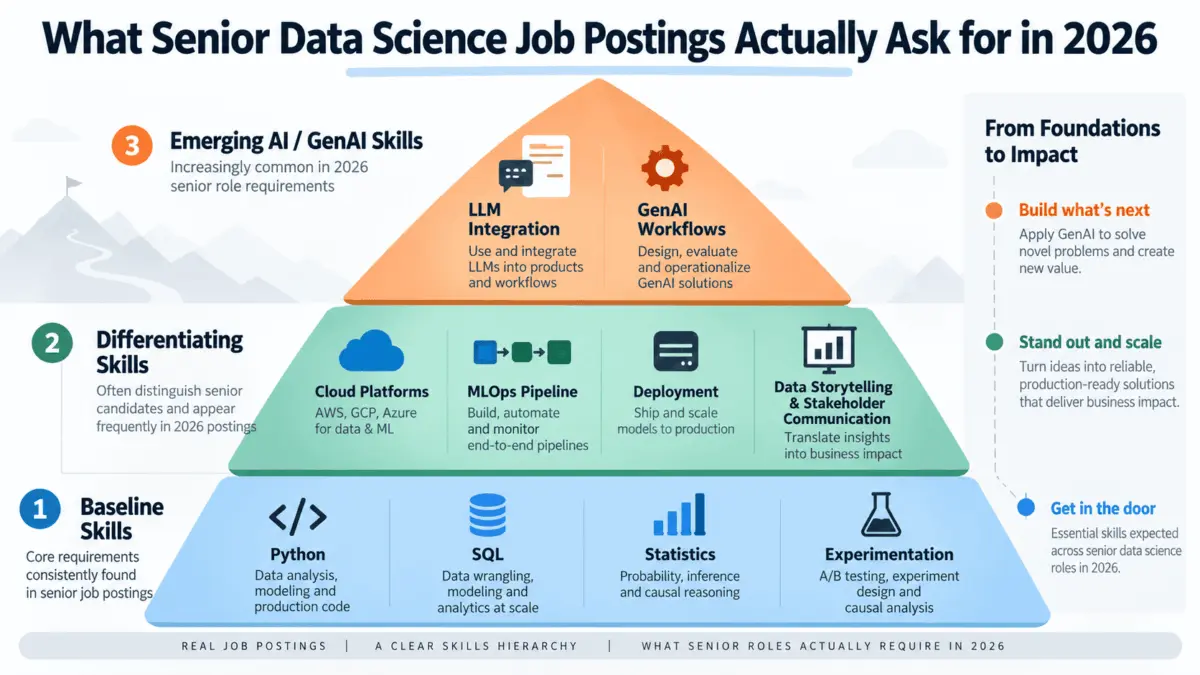
The employment data makes it abundantly clear that skills once considered advanced have now become baseline entry requirements at the senior level. Three core technical pillars appear in the vast majority of all data science postings, and none of them can be treated as optional.
Python continues to dominate as the most frequently required programming language across the board. However, job descriptions have become significantly more specific regarding the exact Python ecosystems they expect candidates to command. The modern market is no longer looking for basic pandas fluency alone. Senior role descriptions routinely call out scikit-learn for building machine learning pipelines, PyTorch or TensorFlow for deep learning applications, FastAPI or Flask for model deployment, and increasingly, specialized frameworks like LangChain or LlamaIndex for large language model integrations. Candidates whose Python capabilities stop at data manipulation and basic visualization now sit firmly in the bottom half of the talent pool for senior positions.
Structured Query Language, or SQL, continues to appear in nearly two-thirds of all data science postings, with that figure climbing even higher when examining senior roles exclusively. What has changed dramatically is the expected depth of knowledge. Senior postings increasingly specify advanced database capabilities, including window functions such as row numbering and ranking, complex common table expressions, nested subqueries, query optimization, execution plan analysis, and deep familiarity with cloud-native SQL variants found in data warehouses like Google BigQuery, Snowflake, and Amazon Redshift. For senior positions, vanilla SQL is simply no longer sufficient.
Machine learning similarly anchors a massive share of the market, appearing in nearly 70 percent of data scientist job postings. At the senior level, the core emphasis has shifted decisively from constructing models to owning them across their entire operational lifecycle. Postings now call out MLOps practices far more consistently than classical algorithm knowledge alone. Feature engineering and model interpretability frameworks, such as SHAP and LIME, appear regularly, particularly in highly regulated industries like financial services and healthcare. The clearest signal emerging from the data is that employers want engineering-minded professionals who can reliably deploy and maintain production models, rather than specialists who only know how to train them in isolation.
What Sets Senior Roles Apart: The Skills That Separate Levels
Beyond the baseline technical requirements, several distinct skill categories differentiate senior postings from mid-level ones. These are the advanced competencies that most frequently appear specifically at the senior and staff levels.
Cloud platform fluency has become structural rather than merely supplementary. In recent analyses of active listings, a clear majority mentioned at least one major cloud environment, led heavily by Microsoft Azure, Amazon Web Services, Google Cloud Platform, Snowflake, and Databricks. Senior postings go significantly further than mid-level equivalents in specifying exact operational services, such as AWS SageMaker for machine learning workflows, storage infrastructure like S3 and EC2, Google Vertex AI, Azure Machine Learning, and BigQuery. The underlying message from hiring managers is that a senior data scientist must be fully capable of deploying and scaling production systems on their preferred cloud provider, rather than merely running local scripts. Furthermore, roughly one in five data science postings explicitly requests a formal cloud certification, with credentials like the AWS Certified Machine Learning Specialty, Azure Data Scientist Associate, and Google Professional Data Engineer leading the market and consistently correlating with higher salary bands.
The broader shift toward MLOps and production-ready systems represents the defining technical evolution in senior hiring over the past two years. Senior listings routinely include tools such as MLflow for tracking and versioning, Apache Airflow for workflow orchestration, dbt for analytics engineering, Docker and Kubernetes for containerization, and continuous integration pipelines through GitHub Actions or Jenkins. Labor market insights indicate that hands-on technical execution currently ranks higher than boardroom influence as the defining leadership characteristic employers screen for. In practical terms, senior data scientists are expected to build and ship software systems, not merely direct others who do.
Generative artificial intelligence and large language model competencies represent the fastest-growing requirement category in the modern job market. Across hundreds of postings analyzed over recent months, a significant portion explicitly mentioned generative AI, large language models, or prompt engineering—a stark contrast to figures from just a few years prior. AI skills now appear in roughly two out of three postings overall, with about half expecting candidates to possess specific AI competencies or practical project experience. Among these, large language models lead the demand, followed closely by retrieval-augmented generation, autonomous AI agents, and advanced natural language processing.
These advanced AI requirements are heavily concentrated at the mid and senior levels. Research from the FutureProof Data Science newsletter indicates that the vast majority of postings mentioning AI skills target experienced practitioners rather than entry-level applicants, confirming that artificial intelligence fluency has become an expected core competency for senior professionals rather than a niche specialty. Real-world job postings from major institutions—spanning financial giants, chemical societies, and global consulting firms—illustrate this pattern by demanding full-stack agentic AI skills, hands-on production experience with LLM applications, multi-agent systems, and model fine-tuning architectures.
Statistical depth and mathematical rigor also remain vital requirements at the senior level. Job descriptions specifically call out probability theory, statistical inference, A/B testing and hypothesis testing design, Bayesian statistics, regression analysis, and time series forecasting. The correlation with graduate degrees remains strong in these areas. The reasoning behind this sustained emphasis is clear: as automated machine learning tools lower the initial barrier to building basic models, understanding why a model works, where its blind spots lie, and when it will ultimately fail becomes the primary differentiator for senior professionals. Employers want practitioners who can rigorously evaluate model choices rather than blindly implement them.
Data visualization and storytelling round out the technical requirements, appearing in over half of all postings. At the senior level, the expectation moves far beyond basic tool proficiency into the realm of executive-level data storytelling. This requires communicating complex model outputs and analytical findings to non-technical decision-makers in ways that directly drive business action. While standard tools like Tableau and Power BI continue to dominate alongside traditional programmatic libraries like Matplotlib and Seaborn, the ability to align visualization platforms with enterprise cloud ecosystems remains a key differentiator.
The Credentials Picture: Degrees, Experience, and What Actually Matters
When examining experience requirements, senior data science roles in the United States ask for a median of five years of industry experience. Career progression across seniority levels typically maps from two years for junior roles, four years for mid-level positions, five years for senior tracks, seven years for principal roles, and ten or more years for director-level oversight.
Market dynamics have shifted notably regarding entry-level hiring. While junior positions were once far more common, the market has evolved into a more selective, senior-weighted landscape where entry-level opportunities are scarcer, leaving mid-level and senior roles undersupplied.
Data science continues to be one of the most heavily credentialed functions in the technology sector. Comprehensive hiring data indicates that a vast majority of data science postings require a formal degree, outperforming most other artificial intelligence functions. Among postings specifying a degree level, a significant percentage require a master’s degree, while a substantial portion mention or actively prefer a PhD, with doctorate-level preferences increasing over recent hiring cycles.
At the same time, direct industry analyses show that a growing share of active listings do not specify a hard degree requirement at all, signaling that demonstrated practical work is gradually gaining ground relative to traditional academic credentials. For most standard industry roles, a master’s degree paired with a robust production portfolio remains the optimal profile. A PhD adds the highest value primarily in research-heavy environments or when targeting frontier AI laboratories. For practitioners without advanced graduate degrees, the hiring data consistently shows that a portfolio of shipped models, clean GitHub repositories, and proven production experience carries considerably more weight than an extensive list of non-cloud certifications.
In fact, formal certifications barely register as mandatory requirements in most job listings, accounting for a negligible fraction of overall postings. Cloud certifications serve as the primary exception, appearing in roughly one-fifth of descriptions and correlating strongly with elevated compensation packages. Hiring managers consistently report that they care far more about tangible portfolio projects than certificate badges, making a well-documented GitHub repository far more valuable during recruitment conversations.
The Skills That Do Not Show Up in Job Descriptions
Beyond technical qualifications, hiring managers frequently emphasize a category of skills that many candidates overlook: communication, business acumen, and cross-functional influence. Phrases such as "communicate insights to non-technical stakeholders" and "work cross-functionally" appear in nearly half of all data science postings, with those expectations scaling even higher for senior roles.
This trend reflects a structural shift in what employers value in an era of automated coding assistants. As generative AI tools render basic software development tasks more routine, modern employers place a premium on problem framing, business judgment, and the interpersonal ability to translate technical findings into actionable enterprise strategies. Senior postings consistently expect candidates to bridge the gap between abstract algorithmic logic and concrete business outcomes, confirming that the ideal senior professional is someone who can build systems, articulate their value, and connect their output directly to organizational goals.
Ultimately, the senior data science job market rewards a specific convergence of disciplines: deep statistical understanding, production-grade machine learning and MLOps capabilities, generative AI literacy, and the communication skills necessary to drive business value. Practitioners looking to position themselves effectively will find that regular benchmarking against active job listings remains the most reliable strategy for aligning their technical development with the evolving demands of the modern workforce.