For data scientists and machine learning engineers who have spent years building and refining text classification models, the standard workflow has long been a familiar, meticulous ritual. The process typically begins with the collection of hundreds or even thousands of meticulously labeled examples. Next comes the exhaustive task of cleaning raw textual data and converting it into suitable numerical representations that machine learning algorithms can actually process, such as dense vector embeddings or traditional statistical metrics like TF-IDF. Finally, engineers train robust classical models, ranging from standard logistic regression to sophisticated random forest classifiers.
However, the rapid rise and widespread adoption of large language models (LLMs) have fundamentally disrupted these traditional rules of engagement, permanently altering how data pipelines are conceptualized and executed. In the modern artificial intelligence landscape, it has become entirely possible to classify complex text simply by asking an advanced LLM to perform the task directly through natural language instructions. Yet, this paradigm shift introduces its own unique set of engineering hurdles. Shifting away from classical, deterministic machine learning workflows toward qualitative prompt engineering can be challenging, especially within production environments that demand consistency and integration with existing software stacks.
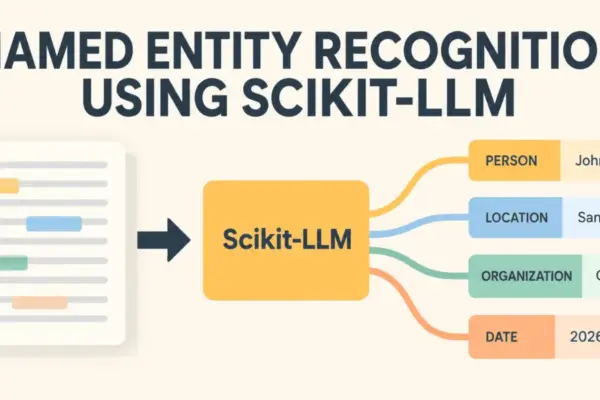
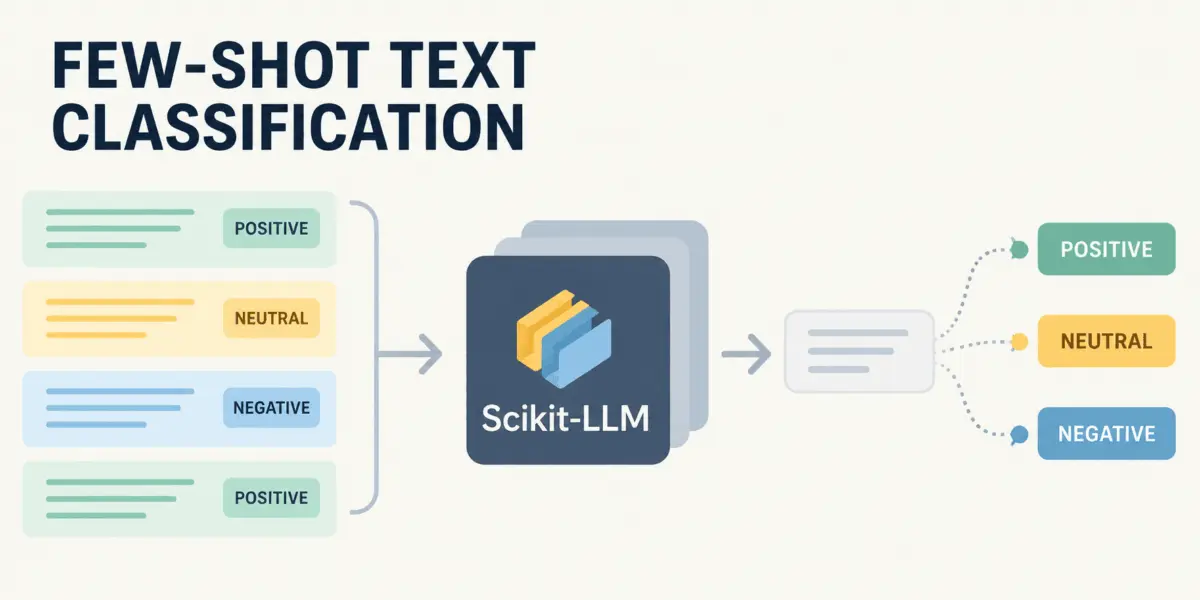
To bridge this widening chasm between classical machine learning and generative AI, the open-source community has introduced innovative integration layers. Among them is Scikit-LLM, a powerful Python library specifically designed to connect these two distinct technological worlds. By elegantly wrapping the formidable capabilities of pre-trained large language models behind the widely adopted and familiar scikit-learn interface—specifically utilizing standard methods like fit() and predict()—the library allows developers to leverage cutting-edge AI without abandoning their established programming habits.
This technological integration is especially valuable for addressing some of the most practical and persistent text classification tasks in contemporary enterprise applications, most notably few-shot classification. By leveraging a small, highly targeted number of labeled examples to guide an LLM on desired behaviors and classification boundaries, organizations can achieve high accuracy on specialized tasks without undergoing expensive model fine-tuning.
Before diving into practical implementations, industry experts often emphasize the critical distinction between few-shot classification and another prominent paradigm that has surged in popularity alongside generative AI: zero-shot classification. While zero-shot classification allows an artificial intelligence model to categorize text without seeing any prior examples by relying entirely on its broad pre-trained knowledge, it frequently stumbles when confronted with highly specialized or nuanced domains.
Few-shot classification consistently outperforms its zero-shot counterpart in highly domain-specific text classification environments. This superiority becomes especially apparent when processing texts laden with industry-specific jargon, complex edge cases, or nuanced, context-dependent sentiments. In the vast majority of real-world scenarios, providing a model with just three to five carefully curated, labeled examples is more than sufficient to teach a pre-trained large language model the supplementary rules and contextual boundaries required to execute accurate classifications. Crucially, this high level of domain adaptation is achieved entirely without the need to retrain or fine-tune the underlying base model, saving substantial computational time and financial resources.
The practical execution of this methodology has become remarkably straightforward thanks to modern open-source tooling. For instance, developers can implement few-shot classification workflows entirely within collaborative notebook environments like Google Colab by integrating specialized LLM hosting providers. Platforms such as Groq offer free-tier access to robust language model APIs, serving as efficient backends for libraries like Scikit-LLM. After acquiring and securely configuring an API key within a development environment’s secret management system, engineers can install the necessary packages with a single command and establish a direct connection to OpenAI-compatible endpoints using dedicated configuration classes.
Once the foundational environment and API connections are established, the next phase involves preparing the dataset. A major advantage of adopting a few-shot approach is that developers are no longer required to assemble massive, exhaustive labeled datasets, a constraint that traditionally hampered machine learning projects where data scarcity was an issue. Instead, practitioners only need to compile a remarkably small, highly representative set of labeled few-shot examples alongside their corresponding target categories.
To illustrate this practical utility, consider a common enterprise scenario: categorizing incoming IT support tickets into distinct operational departments such as hardware, software, or access management. Following classical machine learning conventions, these few-shot reference examples and their associated categorical targets are structured into training arrays, while a separate array contains unlabeled incoming texts destined for classification.
Integrating these components within the Scikit-LLM framework involves importing dedicated task-specific classes, such as the FewShotGPTClassifier. This specialized class wraps a chosen pre-trained language model inside a structured task layer, allowing the underlying generative system to be invoked using the exact same syntax familiar to practitioners of traditional scikit-learn workflows. During the initialization phase, developers simply point the classifier to their preferred model endpoint.
A crucial technical detail often highlighted by experienced machine learning practitioners is the behavior of the fit() method within this architecture. Unlike classical machine learning algorithms, where calling the fit function triggers intensive computational weight updates and gradient descents, executing the fit method on a Scikit-LLM classifier does not actively retrain the underlying large language model. Instead, this operation dynamically constructs a specialized few-shot prompt memory for the model. This memory securely houses the provided labeled examples, serving as an intelligent context window that the language model will reference for in-context reasoning and response generation when processing future inputs.
Once the contextual memory is established, executing predictions on entirely unseen text data requires nothing more than invoking the standard prediction method. When applied to incoming support tickets—such as hardware malfunctions involving peripheral devices, digital access lockouts, or software freezing during screen-sharing sessions—the model evaluates the contextual prompt memory against the new inputs. The resulting classifications accurately reflect the underlying intent and categorization rules established by the initial training examples, demonstrating the practical efficacy of combining classical machine learning interfaces with the reasoning power of modern generative language models.
The broader implications of these developments point toward a more streamlined, accessible future for enterprise artificial intelligence deployment. By utilizing elegant abstraction layers like Scikit-LLM, developers and data scientists can effectively harness the advanced reasoning capabilities of pre-trained, open-access language models to solve complex, domain-specific challenges without the heavy computational overhead of traditional model retraining or the financial burden of costly proprietary APIs. As artificial intelligence continues to mature in professional environments, the successful synthesis of traditional software paradigms with generative language capabilities will remain a cornerstone of efficient, scalable machine learning engineering.